
Review · BERLIN
Private Taxi Tour City East & West History and Architecture 3-4h
Berlin makes more sense from a moving taxi. In three to four hours, you can connect the polished boulevards of old West Berlin with the scarred, rebuilt center of the former East. Guide Gunter Bauer drives, explains, and adjusts the route to your interests, so you are not simply ticking off monuments.
I like the warm car on cold or rainy days, and I like the personal touches: Gunter has helped older visitors stay comfortable, taken photos at key stops, and even helped one couple with a train ticket after the tour. The drawback is simple: this is a fast overview, not a long visit inside museums or palaces. At $150.18 per person, value also depends on how many people share the private vehicle.
Key points to know before booking
- A private Berlin overview: Only your group takes part, with pickup from a hotel or apartment within the S-Bahn ring.
- East and West in one route: See Ku’damm, the Reichstag, Alexanderplatz, Checkpoint Charlie, the Brandenburg Gate, and former Wall areas in one outing.
- Gunter Bauer leads the tour: He offers fluent English, historical explanations, personal stories, and a route shaped around your interests.
- Strong bad-weather option: You spend much of the tour in a heated, air-conditioned taxi, with short stops to walk and take photos.
- Useful for families and older visitors: Child seats are available, and the private format allows a gentler pace than a large group tour.
- Expect an overview, not museum day: Several stops are photo visits or exterior explanations, with only limited time for interiors.
Why a private taxi works well in Berlin
Berlin is spread out. The Brandenburg Gate, Charlottenburg district, former Wall sites, government quarter, and Alexanderplatz are not all close together. Public transport is excellent, but changing trains and finding each site can consume much of a short visit.
This tour solves that problem with a private vehicle and a guide who explains what you are passing. You can look out at the city instead of studying a transit map. You also avoid the rigid pace of a large coach tour.
The route covers both sides of Berlin’s twentieth-century story. In the west, you see the Kaiser Wilhelm Memorial Church, Kurfürstendamm, KaDeWe, the Victory Column, and the former congress hall known as the Pregnant Oyster. In the east, you reach the Hackesche Höfe, the New Synagogue, Unter den Linden, Alexanderplatz, Nikolaiviertel, and the former border points near Friedrichstrasse.
That range is the main value. You are not only looking at famous buildings. You are seeing how Berlin’s political divisions shaped its streets, shopping areas, railway stations, government buildings, and empty spaces.
More Private History Tours in Berlin
- Berlin Private Complete History All Day Walking Tour
★ 5.0 · 474 reviews - Berlin Private Half-Day Walking Tour: Discover the German Capital’s History
★ 5.0 · 244 reviews - The History of Berlin: WWII PRIVATE Walking Tour With Locals
★ 5.0 · 209 reviews
Ku’damm, the Memorial Church, and West Berlin style
The western section begins around the Kaiser Wilhelm Memorial Church, one of Berlin’s clearest reminders that the city was damaged but not erased by war. The surviving tower and west portal belong to the original church, built in honor of Wilhelm I. The modern church hall and tower around it were designed by Egon Eiermann.
Berliners have long compared the blue glass buildings to lipstick and a powder compact. That local nickname gives the place a lighter touch, but the visit is still serious. Inside, thousands of specially made glass blocks create a deep blue light. The double-wall design also keeps much of the traffic noise outside.
You see the church from more than one side, which helps you understand its position in the busy center. The nearby European Center was once Berlin’s oldest shopping center and originally even had an ice rink. Today the area is a busy commercial crossroads.
From there, the taxi moves along Kurfürstendamm, usually shortened to Ku’damm. The boulevard stretches almost five kilometers toward Halensee and was modeled partly on the Champs-Élysées. Its older role as a grand avenue of cafés, cinemas, and entertainment has given way to shops and major international brands.
I find this part useful because it shows the changing character of West Berlin. During the Cold War, this was a major public face of the western half of the city. Today, the avenue is more commercial, with luxury stores farther west and large modern brands closer to the center.
At Tauentzienstrasse, you reach Kaufhaus des Westens, better known as KaDeWe. The department store covers about 60,000 square meters and is especially famous for its upper gourmet floor. You will not have time for a full shopping expedition during the tour, but Gunter can point it out and explain its role in Berlin life.
The Theater des Westens adds another layer. Its elaborate exterior reflects the period when wealthy Berliners moved west from the crowded center into larger villas and greener surroundings. Inside, it includes an imperial box and now functions mainly as a musical theater.
From the Zoo to the Victory Column
Berlin’s Zoological Garden is one of Germany’s oldest zoos and has a very large collection. You mainly see the site from outside, including the elephant gate and the lion gate near Bahnhof Zoo. The important point here is not an animal visit. It is the connection between the zoo, the former western center, and the city’s division.
The Bahnhof Zoo itself once served as the best-known railway station in West Berlin. After reunification, the new Berlin Hauptbahnhof took the main long-distance role, and Bahnhof Zoo became a regional station. That change still matters to people who remember how isolated West Berlin once felt.
The route then reaches the Tiergarten, the large park at the center of the city. It began as a royal hunting ground. Frederick the Great opened parts of it to Berlin residents, and later the planner Peter Lenné reshaped it with paths, water, lakes, and long views.
The park suffered badly in World War II. Trees disappeared, and even potatoes were planted near the Reichstag. Allied help later supported replanting. From the taxi, you get the broad idea of the park’s size and importance without spending an hour walking across it.
The Victory Column is another strong photo stop. It originally stood in front of the Reichstag and had three sections commemorating Prussian victories over Denmark, Austria, and France. Hitler later moved it to its present location and added another section.
Near the Spree, the former congress hall is easy to recognize. Its sweeping roof earned the nickname Pregnant Oyster. The roof collapsed in 1980, killing a journalist, but the building was reconstructed and now serves as the House of World Cultures. Its program focuses especially on non-European artists.
Government Berlin around the Reichstag
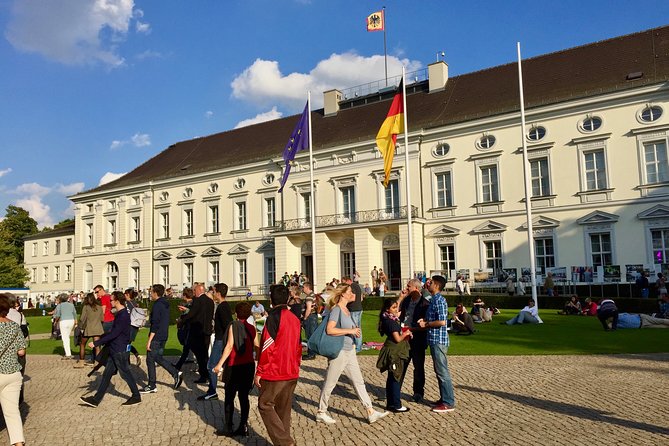
The government quarter gives the tour a useful modern contrast. Bellevue Palace, now the official residence of Germany’s Federal President, was built for August Ferdinand, the younger brother of Frederick the Great. Its former view toward Charlottenburg Palace has disappeared behind the modern city.
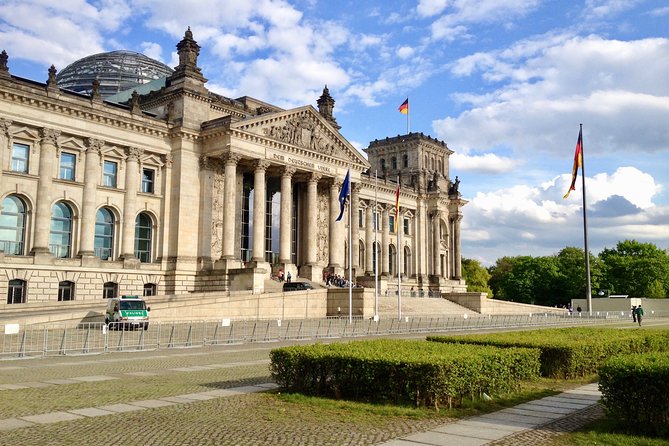
The Reichstag is the key stop. Its Wilhelminian exterior survived the war, although the building was badly damaged and then left close to the Wall in West Berlin. The famous photograph of Soviet soldiers raising their flag was recreated, but the building itself remains a powerful symbol of Germany’s political changes.
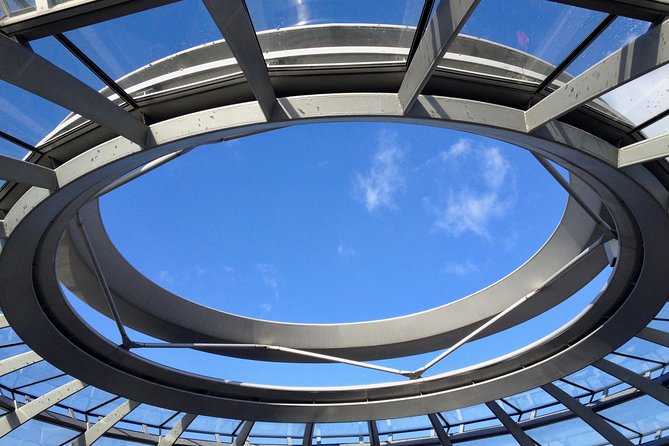
The glass dome is a later addition and was not part of the architect’s original plan. It now gives visitors a view into the parliamentary chamber below. The tour usually treats the Reichstag as an exterior and photo stop, so do not book this experience expecting a full visit inside the dome.
Across the river, the Paul-Löbe Building houses much of the working machinery of parliament. Committees meet there, and the building’s glass design lets you see some of the activity from outside. The large government buildings can seem severe, but Gunter’s explanations connect them to how German parliament actually functions.
The Federal Chancellery is hard to miss. It is a large building with ten floors, hundreds of offices, and a central rotunda. The press building nearby has a large window behind which accredited journalists hold government briefings. These details turn a drive past official buildings into a lesson in how the capital operates.
More Private History Tours in Germany
Hackesche Höfe and the old Jewish quarter
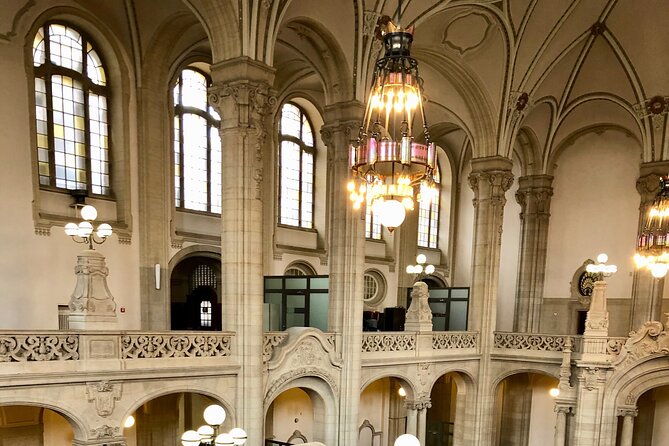
Hackesche Höfe offers one of the few chances to get out and walk through a compact historic complex. Built in 1908, the courtyards were designed to mix workshops, small factories, printing businesses, and homes. The restored Art Nouveau decoration makes the passageways attractive, but the practical idea behind them is just as interesting.
The courtyards were badly neglected during the East German period and were among the first major sites restored after the Wall fell. Today, small shops have replaced many workshops. You may also see Königliche Porzellan-Manufaktur products and Berlin’s familiar Ampelmännchen traffic-light figure.
Nearby, the New Synagogue is recognizable by its golden dome and Moorish-style details. The main synagogue was destroyed in the war, but the front section has been rebuilt and now includes an exhibition on Jewish life in Berlin.
Security is strict. You should expect airport-style checks if you enter. The tour normally gives you the outside view and the historical setting rather than a long interior visit.
This area also connects with the former Spandauer Vorstadt, where many Jewish residents settled. Torstrasse once marked part of the city’s outer limits, near the old gates. That is a useful reminder that Berlin grew outward in layers, rather than appearing all at once as a planned capital.
Unter den Linden, the Brandenburg Gate, and Gendarmenmarkt
The route through Unter den Linden gives you Berlin’s grandest ceremonial axis. It began as a bridle path from the royal palace toward the hunting grounds. Linden trees eventually won the planting debate, giving the boulevard its name.
The avenue links major buildings, including Humboldt University, the State Opera, the State Library, the former armory, and the Forum Fridericianum. At Bebelplatz, a glass panel in the pavement recalls the Nazi book burning of May 1933. The empty shelves below ground are easy to miss, but they make a sharp point about censorship and destruction.
The Neue Wache is another brief but meaningful stop. Once a guardhouse, it now honors victims of war and tyranny. Inside is Käthe Kollwitz’s enlarged Pietà, a mother mourning her dead son. Formal wreath ceremonies still take place here.
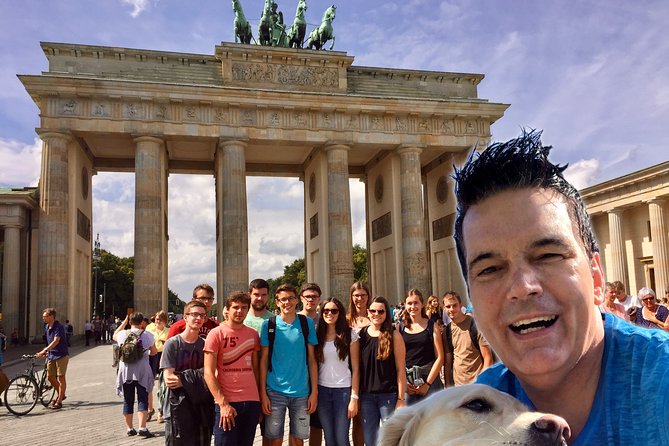
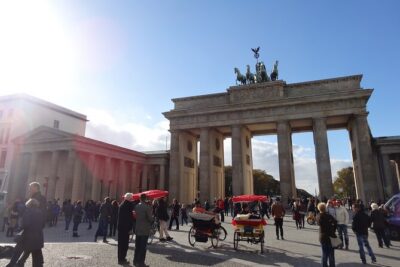
The Brandenburg Gate sits on Pariser Platz, Berlin’s polished front room. War and the Wall once left it isolated. After reunification, surrounding buildings were rebuilt in a modern style that follows the old street pattern. The gate is free to see and easy to photograph, but the story behind its isolation matters more than the columns themselves.
Gendarmenmarkt is often considered Berlin’s most beautiful square. The French and German cathedrals frame the concert hall in the middle. Despite their names, the two domes are not cathedrals in the usual sense. They are churches with decorative towers added under Frederick the Great.
The tour also passes the former Soviet embassy, a huge building intended to signal Soviet power in the heart of Berlin. Its scale makes more sense when you remember that the American, British, and French embassies around Pariser Platz had been destroyed.
Alexanderplatz, Nikolaiviertel, and the former border
Alexanderplatz shows a very different Berlin. In East German times, it was rebuilt as a broad socialist public space, designed for large gatherings and military displays. The television tower remains its most visible marker and was meant to show the technical confidence of the socialist state.
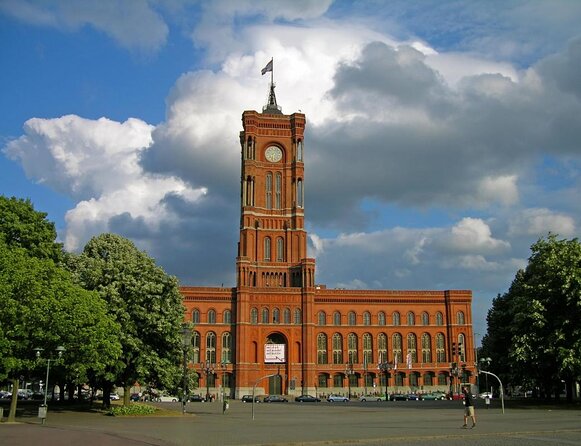
The Red City Hall gets its name from its red brick, not from the political party of the mayor. It served East Berlin’s government during the division and remains the city’s main municipal building.
Nikolaiviertel offers a smaller, older-feeling setting. The quarter was reconstructed in the 1980s, with the Nikolaikirche and Knoblauchhaus at its center. Much of what you see is a planned recreation rather than an untouched medieval district, but it provides a useful sense of old Berlin’s scale.
The nearby bridge and lock mark the early meeting point of Berlin and Cölln on opposite sides of the Spree. The area began around a ford, then developed through trade, mills, canals, and later locks. This is where the city’s earliest story becomes visible beneath the modern streets.
The taxi may also pass the former East-West boundary near the harbor. Günter Litfin was one of the first people killed while trying to escape after the Wall went up. That detail gives the border story a human scale, far beyond the usual photographs of concrete and barbed wire.
Checkpoint Charlie and the Topography of Terror
Checkpoint Charlie is one of Berlin’s most famous photo stops, but it is also one of the least original-looking sites. The guardhouse and sign visible today are replicas. The real significance lies in the 1961 tank confrontation, when American and Soviet forces faced each other at the height of the Cold War.
The tour treats the site honestly. You get the photograph, the explanation, and the chance to understand why this crossing became such a symbol. Do not expect a preserved checkpoint in the exact form used during the Wall years.
At the Topography of Terror, you can take a short walk and use the toilets. The documentation center occupies the former area of the Gestapo and SS headquarters. The site also brings together traces of Prussian government, Nazi administration, the Wall, and postwar remembrance.
This is one of the more serious stops. It works best if you want historical explanation rather than only attractive buildings. The amount of time is limited, so you may want to return later for a longer visit.
Price, pace, and who will get the most from it
The listed price is $150.18 per person. That is not a cheap taxi ride, but it includes private transportation, the guide, parking fees, WiFi, air conditioning, and pickup within Berlin’s S-Bahn ring. The taxi fare and tour charges are included as well.
The value improves with a small group because the price is per person but the vehicle is private. For two people, it is a premium orientation tour. For a family or group of four, it can be a practical way to cover a large city without paying for several separate taxis and guides.
The pace suits a first day in Berlin, especially if you have only a short stay. It also suits older visitors who want frequent explanations without long walks. Child seats are available for toddlers and older children, and a baby seat can be requested.
Bring water. One person specifically found this useful during the outing. Wear shoes suitable for short walks, but do not plan on a full day of walking between sites.
Pickup within the S-Bahn ring is included. Pickup from BER Airport or outside the ring costs extra. You should also allow more time if you are staying far from central Berlin.
Free cancellation is available up to 24 hours before the start time. The tour is offered in English, and confirmation arrives at booking.
Should you book this Berlin taxi tour?
Book it if you want a personal, fast introduction to Berlin and care more about context than long museum visits. It is especially useful in poor weather, for older family members, for families with children, or for anyone who wants East and West Berlin explained in one continuous route.
Choose something else if you prefer to walk slowly, spend hours inside museums, or explore one neighborhood in depth. The tour covers a lot, and some stops last only five to fifteen minutes.
For most first-time visitors, the best plan is to use this as your city orientation. Let Gunter Bauer show you the major pieces, ask him to focus on your interests, then return on your own to the Reichstag, the Topography of Terror, Hackesche Höfe, or the museums that catch your attention.
FAQ
How long does the private taxi tour last?
The tour lasts approximately three to four hours.
Is hotel pickup included?
Pickup from a hotel or apartment within Berlin’s S-Bahn ring is included. Pickup from BER Airport or locations outside the ring costs extra.
Is this a private tour?
Yes. Only your group takes part in the activity.
Who guides the tour?
The tour is led by Gunter Bauer, who provides the experience in English.
What is included in the price?
Private transportation, WiFi, an air-conditioned vehicle, parking fees, pickup within the S-Bahn ring, and both the taxi fare and city tour charges are included.
Are child seats available?
A toddler seat for children from six months to three years and a booster seat for older children are available. A baby seat can be brought on request.
Can I cancel for a full refund?
Yes. You can cancel at least 24 hours before the start time for a full refund. Changes or cancellations made less than 24 hours before the tour are not accepted for a refund.
More Architecture and Landmark Tours in Berlin
- Venice: St. Mark’s Basilica Guided Tour & VR History Intro
★ 3.9 · 4,880 reviews - Venice’s Best: Basilica, Doge’s Palace, Gondola & History Gallery
★ 4.5 · 2,478 reviews - Córdoba: Skip-the-Line Great Mosque-Cathedral History Tour
★ 4.7 · 1,690 reviews - Pantheon Elite Guided Tour – Rome’s Iconic Ancient Temple
★ 5.0 · 1,447 reviews
Latest history tours reviewed in Berlin
- Berlin: History and Sightseeing with Kids (Free for Kids)★ 4.9 · 19 reviews
- Berlin: Nazi History Walking Tour★ 4.8 · 33 reviews
- Berlin: Urbex Abandoned Places & History Tour★ 4.8 · 18 reviews
- Berlin: Historic Boat Sightseeing City Center Tour★ 4.5 · 415 reviews
- Berlin: Historical Sights & Berlin Wall Tour with a Berliner★ 5.0 · 62 reviews
- Berlin: Guided Craft Beer & Cultural Tour With Snacks★ 5.0 · 68 reviews
- Berlin (E)Bike Tour Historical Highlights in Small groups★ 4.5 · 24 reviews
- Berlin: Historic Center Walking Tour with a Real Berliner★ 5.0 · 134 reviews
Berlin History Tours, compared.
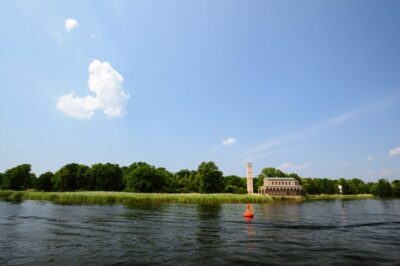
Berlin: 3-Hour World Heritage Cruise to Potsdam
Read our review →
Berlin: History of the Third Reich Guided Walking Tour
Read our review →
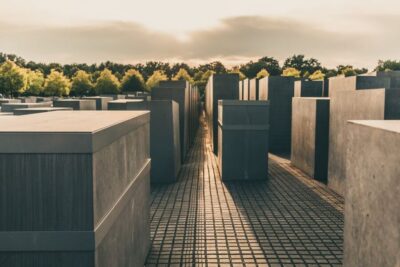
Berlin Private Complete History All Day Walking Tour
Read our review →
Berlin: Cold War & Berlin Wall History Guided Bike Tour
Read our review →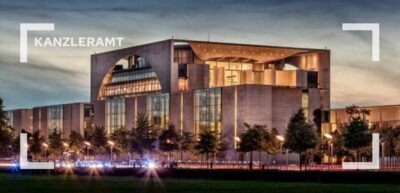
Berlin: Historic Boat Sightseeing City Center Tour
Read our review →
Small group Potsdam: A Journey Through History and Palaces
Read our review →Browse the lists this tour appears in