
Review · LISBON
Lisbon city tour on history, culture and current topics
Lisbon reveals itself best on foot, one steep street and tiled facade at a time. This small-group walking tour links four central districts, from grand Baixa to winding Alfama, while guides such as Sara, Melina, and Pedro explain Portuguese history, local habits, and present-day life. I like the route’s variety, especially the change from the open squares of the lower town to the narrow lanes above.
I also like the practical touch: you get a local tasting, often a pastel de nata or ginjinha, plus tips for restaurants and the rest of your stay. The main consideration is the hills. You need a moderate to good level of fitness, and the tour is not suitable if walking is difficult.
Key points at a glance
- Four central districts in one walk: See Baixa, Chiado, Bairro Alto, and Alfama in a single route.
- A useful first-day orientation: The 3.5-hour tour gives you a clear sense of Lisbon’s layout and helps you plan the rest of your visit.
- Small groups of up to 12: The guide can answer questions and keep the walk personal.
- Two different views of Santa Justa: Admire the famous elevator from street level, then from its observation area.
- Local flavor included: The tasting may be a Portuguese pastry or liqueur such as ginjinha.
- A hill-and-stair workout: Expect uphill streets, downhill stretches, winding lanes, and cobbled surfaces.
Why this Lisbon walk works so well as a first outing
The route begins at Praça Dom Pedro IV, usually called Rossio, and ends beside the Tejo River at Praça do Comércio. That gives you a useful north-to-south sweep through the old center rather than a tour that circles one small area.
I like that the route is not built around a long list of paid entries. The focus is on streets, squares, viewpoints, architecture, and the stories that connect them. You are not rushed through several museums. Instead, you get a working picture of Lisbon that can guide your choices for the next few days.
The German-speaking format is important if you prefer to ask detailed questions in German. The guides named for this tour include Sara, Melina, and Pedro. Their approach, as reflected in the tour description and guest feedback, combines historical explanation with everyday topics, food suggestions, and local customs.
The timing also makes sense. At about three and a half hours, the walk is long enough to cover real ground but short enough to leave time for lunch, a museum, or an afternoon ride on public transport. I would book it near the start of a Lisbon visit, not on the final day. The restaurant suggestions and neighborhood orientation are more useful when you still have time to act on them.
More Local Culture and Traditions Tours in Portugal
- Lisbon Fado History Cultural Walking Tour
★ 5.0 · 118 reviews - Taste Funchal: food, wine & cultural tour
★ 5.0 · 906 reviews - Taste Funchal: food, wine and cultural tour
★ 4.8 · 680 reviews
Rossio and Baixa: Lisbon’s grand lower town
Meet at the north fountain of Rossio, between the statue of King Pedro IV and the National Theatre. This is an easy central starting point, close to public transportation and surrounded by some of Lisbon’s most important pedestrian routes.
Rossio is a good place to begin because it introduces the city’s mix of ceremony and daily movement. The square is broad and formal, while the streets leading away from it quickly become more commercial and practical. Your guide uses the opening section to establish the city’s history and explain how Lisbon’s lower town fits into the larger center.
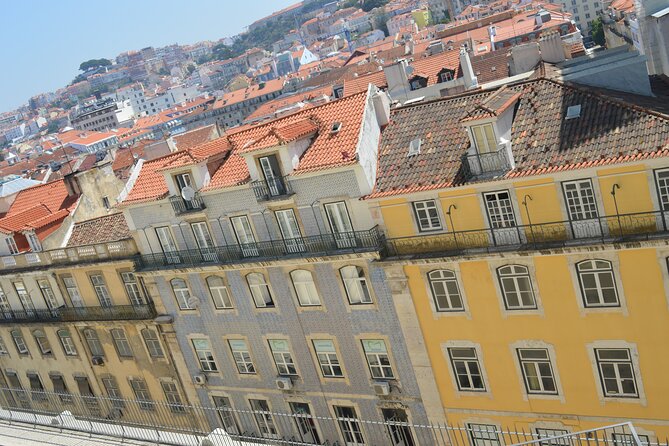
From here, the group enters Baixa, the planned lower town. The streets are more orderly than those in Alfama, and the scale changes noticeably as you walk toward the river. This contrast is one of the tour’s strengths. You see that Lisbon is not one uniform old town. Its neighborhoods have different patterns, moods, and purposes.
The stops in Rossio and Baixa are short, around ten minutes each. That is enough for an introduction, not a detailed architectural lecture. If you want extended time for photographs or shopping, plan to return later.
Santa Justa and Carmo: two memorable views of the old center
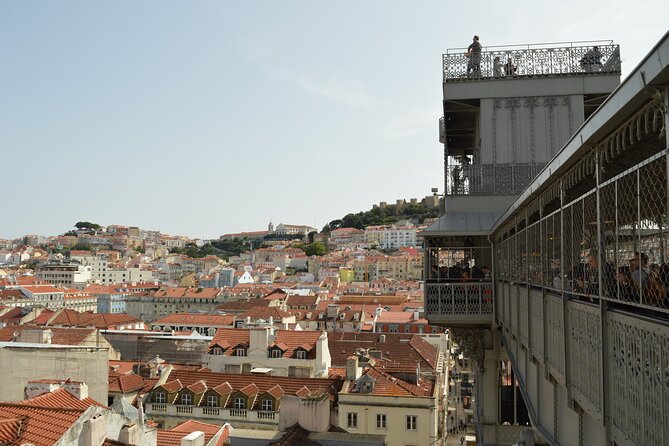
The Elevador de Santa Justa is one of Lisbon’s most recognizable landmarks. Rather than simply pointing it out, the tour takes you to see it from below and then from the observation area, where the view opens across the lower town toward Lisbon Castle.
That change of angle is useful. From street level, you can appreciate the elevator’s iron structure and its vertical link between Baixa and the higher Chiado area. From above, the point is less about the elevator itself and more about understanding Lisbon’s steep geography.
The tour information describes access to the observation deck, while the listed stops do not include a separate admission charge. Still, exact access arrangements can vary, so check the meeting instructions and current details before setting out. The stop lasts about 15 minutes, which means this is a quick view rather than a long stay.
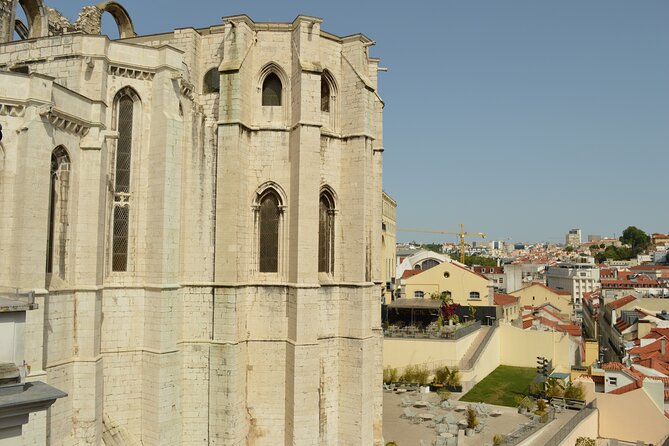
Next comes the Carmo monastery ruins, seen from outside. The roofless Gothic remains are among Lisbon’s most striking sights, and they also help explain how the city’s past is still visible in its streets. The stop is another 15 minutes.
Because the group admires the ruins from outside, you should not book this walk expecting a full interior visit. The value here is the guide’s explanation and the chance to place Carmo within the surrounding neighborhood. If the ruins catch your interest, you can return independently for a closer look.
Chiado and Praça Luís de Camões: Lisbon’s literary side
Chiado is known as Lisbon’s poets’ quarter, and the walk spends about 20 minutes exploring it. This section shifts away from the wide avenues of Baixa and into a district associated with writers, cafes, shops, and city culture.
A guide can make this part more useful than a simple stroll. You learn why Chiado matters, how it connects the lower town with Bairro Alto, and how literature and public life shaped the area. The tour is designed to cover both history and current topics, so you should expect more than dates and building names.
The route then reaches Praça Luís de Camões, the largest square in Chiado. It is a natural pause point between neighborhoods. The square gives you room to look around before the route climbs toward Bairro Alto.
I like this transition because it shows how quickly Lisbon changes. In a few blocks, the atmosphere moves from formal commercial streets to a more residential and nightlife-oriented district. Wear shoes with a firm sole. Lisbon’s paving can be uneven, and the hills become more noticeable here.
More Local Culture and Traditions Tours in Lisbon:
- Amsterdam Food and Cultural Tour with Tastings
★ 5.0 · 4,315 reviews - Sevilla Food Tour: Tapas, Wine, History & Traditions
★ 5.0 · 3,468 reviews - Tromsø: Reindeer Camp and Sami Cultural Tour with Lunch
★ 4.7 · 3,326 reviews - Half Day Dominican Republic Cultural Tour : Small Group
★ 4.5 · 1,862 reviews
Bairro Alto in daylight, before the bars open
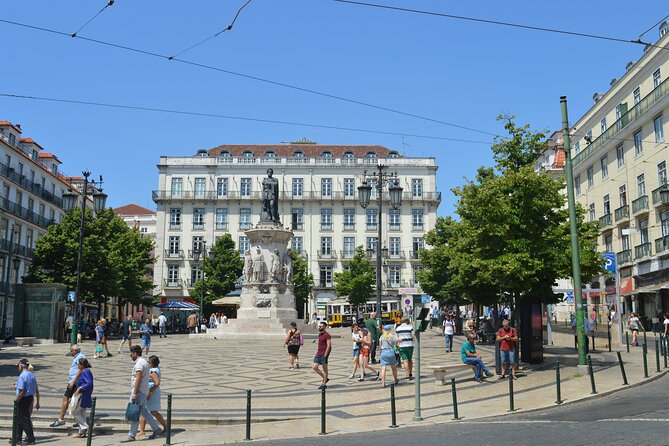
Bairro Alto is famous for its evening nightlife, but this tour visits during the day, when the area is quieter. That timing lets you see it as a residential quarter rather than only as a bar district.
The group spends about 20 minutes walking through the neighborhood. During the day, the narrow streets and compact buildings offer a calmer view of an area that changes character after dark. Your guide can also explain how local life and nightlife share the same small streets, an important point if you plan to return in the evening.
This is one place where the tour’s focus on current topics adds value. You are not only looking at old buildings. You are also learning how Lisbon’s central neighborhoods function now, including the tension between everyday residential life and evening entertainment.
The route continues uphill to Miradouro de São Pedro de Alcântara. The climb is part of the experience, but it is also the clearest physical challenge so far. If you have knee, balance, or mobility concerns, take the fitness warning seriously.
São Pedro de Alcântara: the tour’s generous pause
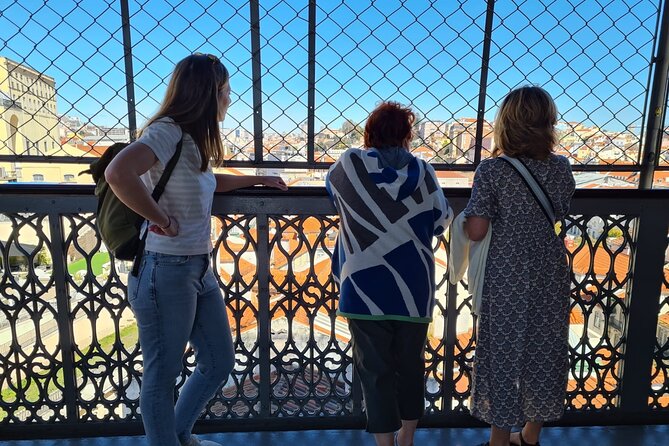
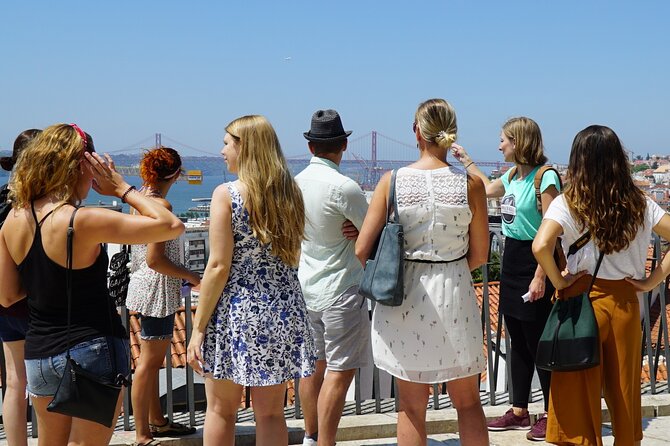
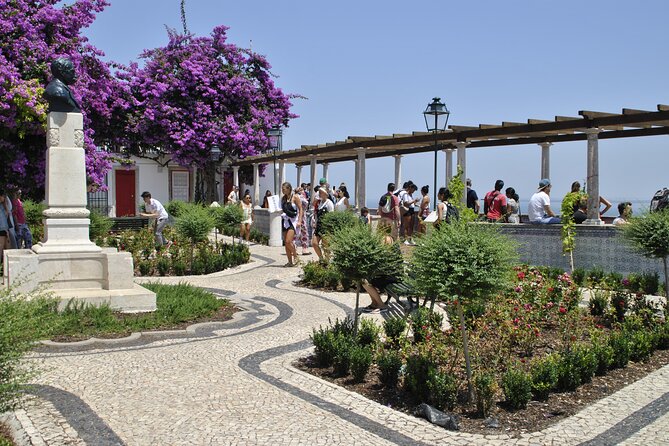
The viewpoint stop lasts about 40 minutes, making it the longest pause on the route. This is where you can slow down, take photographs, enjoy the view, and have the included tasting.
The panorama helps you make sense of the city. From the higher ground, the lower town, Lisbon Castle, and the slopes between neighborhoods become easier to understand. A map can show you Lisbon’s layout, but a viewpoint lets you see why the city feels so vertical.
The tasting is listed as a local pastry or liqueur. Pastéis de nata and ginjinha are specifically associated with this experience in the supplied information, so you may receive one of those. Ginjinha is a sour-cherry liqueur, often served in a small portion. It is a modest extra, but it gives the break a local touch without turning the tour into a food walk.
The 40-minute pause also prevents the experience from becoming a march. That matters on a hilly route. You can rest before the second half, which passes through Rua Augusta and Alfama.
Rua Augusta and the route toward the river
After the viewpoint, the walk passes along Rua Augusta, Lisbon’s main shopping street. The stop is brief, about ten minutes, and is described as a taste rather than a shopping session.
That short visit is sensible. Rua Augusta is central and easy to find on your own, so the guide does not need to spend a large part of the tour there. Instead, you get a look at the street’s role as a link between Baixa and the river.
This is also a practical point in the walk. You are moving from the higher districts back toward the historic riverfront, then turning into Alfama before the final stop. The route does not simply head downhill and finish. It continues through one of Lisbon’s oldest and most distinct quarters.
Alfama: winding lanes and Lisbon’s oldest quarter
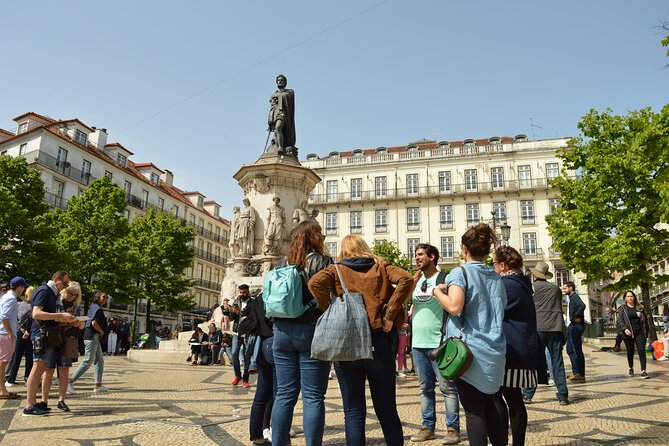
Alfama is the part of the route where the city becomes most maze-like. The group spends about 30 minutes exploring its winding streets, with stops at viewpoints along the way.
Compared with Baixa’s planned grid, Alfama feels irregular and layered. The value of a guide is especially clear here because it is easy to lose your sense of direction. You can focus on the details around you while the guide explains how the quarter fits into Lisbon’s past and present.
The walk reaches Miradouro de Santa Luzia, described as Lisbon’s most beautiful viewpoint. Allow about ten minutes there. The stop is short, so keep your camera ready and listen closely while the guide explains what you are seeing.
Alfama is also where the physical demands return. The route includes narrow lanes and likely changes in elevation, and the surface can be uneven. You should carry water, wear comfortable shoes, and avoid bringing a heavy bag. The route is made for walking, not for a relaxed ride between sights.
Ending at Praça do Comércio and the Tejo
The tour ends at Praça do Comércio, directly beside the Tejo River. The square’s open waterfront setting feels very different from Alfama’s tight lanes and gives the walk a strong finish.
The imposing triumphal arch frames the entrance to Rua Augusta, tying together two parts of the route. You began in the city center and now reach the riverfront, with public transportation and more places to eat or continue exploring nearby.
Ending here is useful for your own plans. You can stay by the river, continue along the waterfront, or use the square as a reference point for the rest of the afternoon. The tour does not include private transportation, so you should be comfortable reaching the starting point and continuing from the end on foot or by public transit.
The small-group format and guide style
The maximum group size is 12 people. That is small enough for you to hear the guide more easily on busy streets and ask questions without waiting through a long line of other people.
The named guides, Sara, Melina, and Pedro, are repeatedly associated with the experience. Pedro is described as especially good at explaining Portuguese people and daily life, while Sara is praised for historical context and practical suggestions. Melina is associated with a friendly, personal style and useful help during the walk.
The most valuable feature is not simply the amount of information. It is the mix of city history, local life, and usable advice. You can ask about restaurants, neighborhoods, or what to do next, then use those suggestions during your stay. Several specific accounts also point to restaurant recommendations that worked well later that same evening.
The tour is conducted in German. If you are looking for an English-language walk, this is not the right choice. If German is your preferred language, the small group and question-friendly format are strong reasons to consider it.
Is $45.86 a fair price?
At $45.86 per person, this is not the cheapest way to walk around Lisbon. You can explore all four districts independently for the cost of your own food and transport.
The price makes more sense if you value a guide who connects the neighborhoods, explains the city’s history, provides a tasting, and gives suggestions for the rest of your trip. You also get a fixed route that covers a lot of ground without spending time deciding where to turn next.
There are no major paid attractions included as full visits, so the price is mainly for the guide’s time and interpretation. I would consider it good value for a first day, particularly if you want a German-speaking guide and prefer a small group over a large public walk.
The free cancellation policy adds flexibility. You can cancel up to 24 hours before the start for a full refund. Within 24 hours, changes and refunds are not accepted. The experience also depends on good weather, with a different date or full refund offered if poor conditions cause cancellation.
Who should book this walking tour?
I would recommend it to first-time Lisbon visitors who want a clear introduction before exploring alone. It also suits couples, friends, and solo visitors who like asking questions and picking up restaurant tips along the way.
You should be ready for a real walk. The route takes about three and a half hours, includes hills, and is not suitable for people with walking difficulties. The tour is a poor match if you want extended interior visits, private transport, or a slow food-focused experience.
Book it early in your stay if you can. The route gives you a useful map in your head, and the advice from guides such as Sara, Melina, and Pedro can shape the rest of your Lisbon plans.
Should you book it?
Book this tour if you want Lisbon explained through its neighborhoods rather than reduced to a checklist of monuments. The route covers the city’s main historic center, includes excellent viewpoints, and adds a local tasting without taking up an entire day.
Skip it if steep streets are a problem or if you prefer exploring at your own pace. For everyone else, the combination of a maximum 12-person group, German-language guidance, current city topics, and practical food suggestions makes this a strong opening tour for Lisbon.
FAQ
How long does the Lisbon walking tour last?
The tour lasts approximately 3 hours and 30 minutes.
Where does the tour start?
It starts at the north fountain of Rossio, or Praça Dom Pedro IV, between the King’s Statue and the National Theatre in Lisbon.
Where does the tour end?
The tour ends at Praça do Comércio, also called Terreiro do Paço, beside the Tejo River.
What language is the tour conducted in?
The walking tour is conducted in German.
How many people can join the tour?
The group has a maximum of 12 participants.
Is food or drink included?
One local tasting is included. It may be a Portuguese pastry or a liqueur. Pastéis de nata and ginjinha are specifically associated with the experience.
Is the tour suitable for people with walking difficulties?
No. The route requires a moderate to good level of fitness and includes uphill and downhill walking through Lisbon. It is not suitable for people with walking difficulties.
Latest history tours reviewed in Lisbon
- Lisbon on a Tuk Tuk Tour: History & Viewpoints★ 4.9 · 204 reviews
- Lisbon Fado History Cultural Walking Tour★ 5.0 · 118 reviews
- Lisbon: Jewish History Tour of Lisbon★ 4.8 · 84 reviews
- Lisbon Jewish Heritage and History – Private Tour Van★ 5.0 · 294 reviews
- Lisbon: Private Dark History Walking Tour with Drinks★ 4.8 · 387 reviews
- Lisbon Essential Walking Tour: History, Stories and Lifestyle★ 5.0 · 316 reviews
- Historic Walking Tour Through Lisbon’s Oldest Neighborhood★ 5.0 · 233 reviews
- Lisbon: Guided Tuk-Tuk Tour Along the Historic Tram Line 28★ 4.8 · 475 reviews
Lisbon History Tours, compared.

Lisbon: History, Stories and Lifestyle Walking Tour
Read our review →
Lisbon: Live Fado Show with Port Wine in Historic Center
Read our review →
Lisbon: Fado Show with Wine in a Historic Venue
Read our review →
Lisbon: Daytime or Sunset Boat Cruise with History and Wine
Read our review →
Explore Lisbon by Tuk Tuk: History and Viewpoints
Read our review →
Private Tuk Tuk Tour Through Lisbon’s Historical Streets
Read our review →
Lisbon Highlights – Private Tour with Van and Local Guide
Read our review →
Templar Tour Convent of Christ & Almourol Castle from Lisbon
Read our review →Browse the lists this tour appears in