
Review · BUCHAREST
Guided Walking Tour of Historical Bucharest
Bucharest’s story is written across its streets: medieval princely ruins, ornate churches, grand banks, communist monuments, and the enormous Palace of Parliament. This private walking tour ties those pieces together, with a local guide such as Alina explaining how dictatorship, revolution, monarchy, and the Cold War changed the city.
I like the wide sweep of the route, which moves from Manuc’s Inn and the Old Princely Court to University Square and the 1989 Revolution sites. I also like the personal, energetic guiding style, especially when Alina brings in her own memories of growing up in Romania.
The main caution is simple: this is a lot of ground for three hours. You may walk 17,000 steps, and the tour can run longer than planned. A fast pace, warm weather, strong opinions about politics, and occasional difficulty understanding the guide’s English may not suit everyone.
Key points to know before you book
- The route covers Bucharest’s central landmarks: Manuc’s Inn, the Old Princely Court, Union Square, the Palace of Parliament, the old center, University Square, and Revolution Square.
- The history reaches from the 14th century to today: expect medieval Wallachia, royal Bucharest, communism, Ceaușescu’s dictatorship, and the 1989 uprising.
- This is a private tour: only your group participates, which allows room for questions and some flexibility.
- The walk is longer and faster than the headline suggests: three hours is the estimate, but some outings have lasted an extra hour.
- The guide’s personality matters: Alina is frequently praised for energy and local insight, though a few people found her English difficult or her political views too prominent.
- The price is reasonable for a private introduction: at $30.77 per person, the value is strongest if you want an orientation early in your Bucharest stay.
Starting at Manuc’s Inn in the old center
The tour begins outside the main entrance of Manuc’s Inn, Hanul lui Manuc, at 62 Strada Franceză. This is a fine starting point. The inn is one of Bucharest’s best surviving links to its trading past, and the opening talk sets up the city before you begin covering ground.
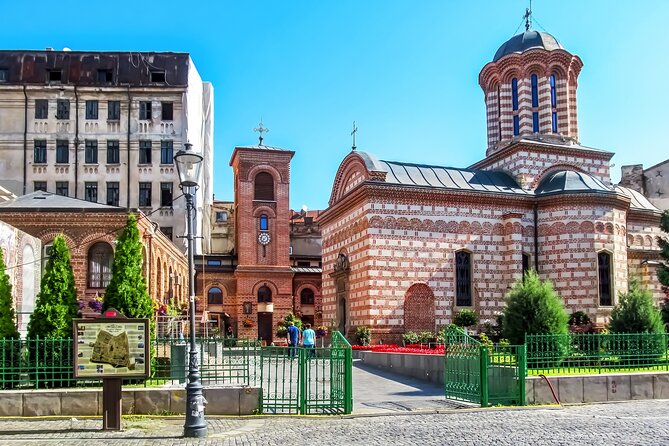
You also hear about nearby St. Anton Orthodox Church, once the coronation church of Wallachian rulers. That detail gives the first part of the walk a useful focus: Bucharest was not simply built as a modern capital. It grew from princely power, trade, faith, and shifting rulers.
The old center is compact in places but easy to muddle in. Several walking tours may meet around Manuc’s Inn, so you should keep your phone handy and check the guide’s name and contact details before you arrive. Pickup is offered, but the stated meeting point is Manuc’s Inn and the activity is listed as ending back there. Confirm the exact pickup arrangement when booking if you plan to use hotel transport.
More History Walking Tours in the world:
- History and Hauntings of Salem Guided Walking Tour
★ 5.0 · 14,564 reviews - Lisbon: History, Stories and Lifestyle Walking Tour
★ 4.8 · 10,902 reviews - Boston: Freedom Trail History Small Group Walking Tour
★ 5.0 · 6,450 reviews
Vlad the Impaler and the Old Princely Court
The first major stop is the Old Princely Court, where you see the remains of the former palace of Wallachian rulers. It is also linked to Vlad the Impaler, the 15th-century ruler whose name later inspired the Dracula legend.
Do not expect a grand palace interior here. The appeal lies in the fragmentary ruins and the stories attached to them. Your guide explains how this center of power fits into Bucharest’s early development and why Vlad remains such a strong part of the city’s popular identity.
The stop is brief, listed at about five minutes. That is enough for an introduction, but not for a long archaeological visit. Think of it as one chapter in a moving history lesson rather than a stand-alone museum stop.
Union Square and the grand scale of socialist Bucharest
From the old court, the route reaches Union Square, or Piața Unirii. This is one of the city’s major open spaces, with refurbished fountains and broad views that make it a good place for photographs.
Here the tour shifts from medieval Bucharest to the city’s 20th-century transformation. You walk along Unirii Boulevard, once called the Boulevard of Socialist Victory and often compared with Paris’s Champs-Élysées. The comparison tells you something about the ambition of Ceaușescu’s regime, which wanted monumental avenues and huge public buildings to display state power.
The scale is difficult to grasp from a book or photograph. Walking it helps you see the long sightlines and the way the boulevard directs attention toward the Palace of Parliament. Your guide also discusses how Ceaușescu’s dictatorship and the Cold War affected Bucharest, including the political ideas behind the city’s rebuilding.
Facing the Palace of Parliament
The Palace of Parliament is the route’s most eye-popping landmark. You see it from the outside, particularly from Constitution Square at the top of Unirii Boulevard. The building dominates its surroundings, and the open space provides several strong photo angles.
This is not a palace tour. The itinerary describes exterior views and photo stops, with no interior admission included. That distinction matters if you are hoping to see the grand halls inside. The value here is the explanation of how the building fits into Ceaușescu’s redesign of central Bucharest and the enormous social and physical cost of that project.
The guide may spend time on the political history behind the building. For some people, this is the strongest part of the experience, since the Palace of Parliament becomes more than a striking facade. For others, the talk may feel too political, especially if they prefer architecture without extended commentary on current government or ideology.
More Guided Tours in the world:
- Edinburgh: Edinburgh Castle Guided History Tour with Tickets
★ 4.8 · 9,933 reviews - Historic Charleston Guided Sightseeing Walking Tour
★ 5.0 · 6,216 reviews - Rome: Colosseum with Arena, Roman Forum and Palatine Guided Tour
★ 4.0 · 5,598 reviews - Venice: St. Mark’s Basilica Guided Tour & VR History Intro
★ 3.9 · 4,880 reviews
Churches, banks, and the old center’s many layers
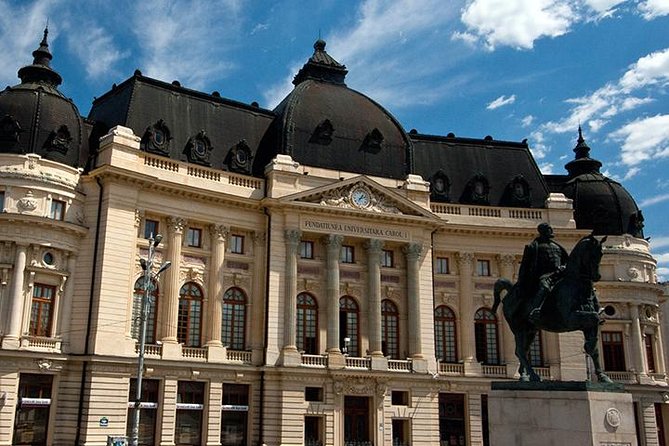
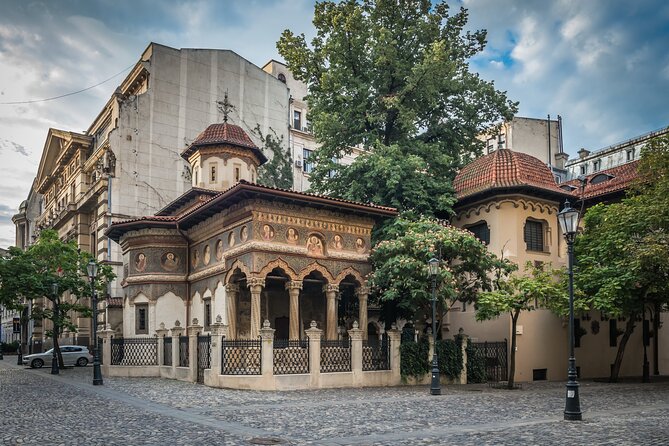
The walk returns toward the historic center, stopping at several buildings that can be easy to miss if you explore alone. One is a church built in 1724, with a story connected to Bucharest’s religious and urban past. Another is the CEC Palace, whose ornate facade makes it one of the city’s most memorable financial buildings.
You also walk along part of Calea Victoriei, or Victory Avenue, lined with shops and historic buildings. This road helps connect the old center with the grander civic core. It is a useful place to notice how Bucharest mixes restored facades, active businesses, old religious buildings, and later additions without a single uniform style.
Macca and Villacrosse Passage adds a smaller-scale stop. The covered passage has a distinctive architectural character, and the guide explains its past rather than simply pointing out its appearance. Nearby, the National Bank of Romania provides another lesson in the city’s financial and political growth.
This section is where the tour’s strength becomes clear. It is not only a checklist of famous sights. You are shown how commerce, religion, royal ambition, and public institutions occupied the same central streets.
University Square and the city’s public life

University Square brings the route into one of Bucharest’s key civic spaces. You see the University of Bucharest, founded in 1864 by Alexandru Ioan Cuza, and hear about the university’s place in the capital.
The surrounding sights include Suțu Palace, now the Museum of the Municipality of Bucharest, and Colțea Hospital and Church. The National Theatre is also on the route. Its design has changed several times, making it a useful example of how Bucharest has repeatedly rebuilt and revised its public buildings.
These stops are less about entering each attraction than about understanding the city center as a whole. You get the exterior history and urban context, then decide which museums or interiors deserve a separate visit. That makes this tour especially useful on your first day, when you need help choosing where to return.
The pace can be brisk here. The guide has a great deal to cover, and some people found the amount of information almost too much. If you prefer slow photography and long pauses, ask for a little time at the start. If you enjoy moving from one story to the next, the pace will feel productive.
Revolution Square and the end of Ceaușescu’s rule
The most politically charged part of the walk comes at Revolution Square. You see the area where the 1989 revolution began and the memorials connected with those events.
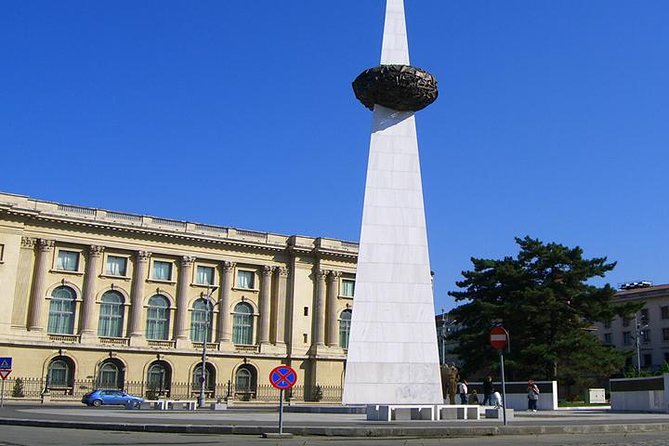
The route includes the balcony where Nicolae Ceaușescu gave his final speech, the former Communist Party headquarters, the Memorial of Rebirth, King Carol I’s equestrian statue, and the University Library. The Memorial of Rebirth rises 25 meters and commemorates the victims and struggles of the December 1989 revolution.
This is where the city’s recent past becomes physical. A balcony, a former party headquarters, and a monument can look like ordinary urban features until you understand what happened around them. The guide explains how Ceaușescu’s rule ended and how the events changed Romania.
You should expect a strong point of view here. Alina is praised for bringing personal and family memories to the story, including what it was like to grow up in Romania during and after communism. That can make the history more immediate than a standard date-filled explanation.
At the same time, the guide’s politics are not for everyone. One person found the discussion of political subjects and conspiracy claims unacceptable, while another felt the personal perspective added useful contrast to familiar accounts. I would book this tour if you want a lively, opinionated explanation, not if you want a strictly neutral lecture.
Military Circle and the final photo stops
The route continues to the Military Circle and the Sărindar Fountains. These provide another look at Bucharest’s formal civic architecture and broad public spaces.
The final stop is described as a place built for the people of Bucharest by the people of Bucharest more than 100 years ago, with gardens and a historic building. The exact emphasis may depend on the day and the guide, but the point is consistent: the tour closes by showing you more than the headline monuments.
The listed endpoint is back at the meeting point. Still, one person found the route’s winding streets confusing and wished for clearer orientation at the end. If you need to catch a bus or timed reservation, allow extra time and ask the guide to point out the best route back to your hotel or transport stop.
How much walking and talking to expect
The tour lasts about three hours, but it may run longer. One outing lasted at least another hour, and another was recorded at more than 17,000 steps. That is not a gentle stroll, even if the guide does not move at a race pace.
Wear comfortable shoes and bring water. Heat can make the walk demanding, especially across the large open spaces near Union Square and the Palace of Parliament. The activity asks for moderate physical fitness, and children must be accompanied by an adult.
The walk is offered in English. Most people found the information clear and engaging, but one person had trouble understanding the guide’s English and another had difficulty getting questions across. That seems worth considering if clear language is especially important to you.
The guide’s style and the private format
Alina is the guide most often identified in the available comments, though Elena is also named for one outing. Alina’s strengths are her energy, humor, local memories, and broad command of Romanian history, architecture, religion, and politics.
She may challenge familiar Western views of Eastern Europe and spend time explaining how Romania’s past still affects daily life. That approach can give you a fuller sense of the country, but it can also feel personal or politically charged. You should be comfortable asking the guide to return to the sights if the discussion wanders too far.
The private format is a real advantage. Your group participates alone, so you have more room to ask questions than on a large city walk. It also means the guide can respond to your interests, though the pace and amount of material may still be ambitious.
Is $30.77 good value?
At $30.77 per person, this is a fair price for a private, three-hour introduction to central Bucharest. The tour includes many separate areas and explains the connections between them, which would take effort to piece together on your own.
The value is highest if you are new to Bucharest and want an early orientation. You can use the walk to decide which churches, museums, restaurants, and neighborhoods deserve another visit. The guide has also provided lunch, dinner, and drink suggestions to some participants.
It is less valuable if you want paid interior admissions, a slow architectural photography walk, or a tightly timed three-hour schedule. The Palace of Parliament is viewed from outside, and several stops are short explanations rather than full visits.
The experience has a 4.8 rating from 84 reviews, with 94 percent recommending it. Those figures point to a strong overall experience, but the lower ratings and detailed comments identify the main risks clearly: long walking, strong political opinions, possible English-language difficulty, and occasional confusion around meeting or finishing points.
Who should book this Bucharest walk?
I would choose this tour for a first full day in Bucharest, especially if you want the city’s history explained through its buildings. It suits adults who like politics, architecture, monarchy, communism, religion, and personal stories mixed together.
It is also a good fit for a private group that wants to ask questions and move beyond the usual old-town photo stops. The route gives you a useful map of the center and a sense of which places deserve a longer visit.
I would hesitate if you dislike long walks, hot weather, fast pacing, or guides who share strong opinions. In that case, a shorter old-center walk or a museum visit may feel more comfortable.
Free cancellation is available up to 24 hours before the start time. Changes or cancellations inside that window are not refunded, and poor weather can lead to a different date or a full refund.
Should you book it?
Book this walk if you want Bucharest explained as a city shaped by rulers, trade, religion, royal ambition, dictatorship, and revolution. The route covers a remarkable amount, and a lively guide such as Alina can make the past feel close and human.
Go prepared for plenty of walking, a packed stream of information, and political discussion. Bring water, wear good shoes, and confirm pickup and the finishing point. For the right personality, $30.77 buys a useful first look at Bucharest and a much better sense of what you are seeing afterward.
FAQ
How long does the Bucharest walking tour last?
The advertised duration is approximately three hours. It may last longer, depending on the guide, pace, questions, and group.
Where does the tour begin?
The meeting point is outside the main entrance of Manuc’s Inn, Hanul lui Manuc, at 62 Strada Franceză in Bucharest’s old center.
Where does the tour end?
The activity is listed as ending back at the meeting point.
Is hotel pickup available?
Pickup is offered, and the tour information states that hotel pickup and drop-off are included. Since the main meeting point is Manuc’s Inn, confirm the exact pickup details when booking.
Is the tour private?
Yes. Only your group participates in the activity.
What language is the tour offered in?
The tour is offered in English.
What sights are included?
The route includes the Old Princely Court, Union Square, Unirii Boulevard, Constitution Square, the Palace of Parliament from the outside, the old center, Macca and Villacrosse Passage, Victory Avenue, University Square, Suțu Palace, Colțea Hospital and Church, the National Theatre, Revolution Square, the Memorial of Rebirth, the Military Circle, and Sărindar Fountains.
Does the tour enter the Palace of Parliament?
The stated route provides exterior views and photo opportunities at the Palace of Parliament. No interior admission is listed.
How physically demanding is the walk?
You should have moderate physical fitness. The route involves substantial walking, and one account recorded more than 17,000 steps. Water and comfortable shoes are sensible.
Can I cancel for a refund?
You can cancel at least 24 hours before the start time for a full refund. Cancellations or changes made less than 24 hours before the start time are not refunded. If poor weather causes the tour to be canceled, you are offered another date or a full refund.
Latest history tours reviewed in the world
- From Athens: Explore Ancient Corinth & Charming Nafplion★ 4.6 · 102 reviews
- From Athens: Explore Ancient Greece 4-Day Tour★ 4.7 · 73 reviews
- From Athens: Ancient Olympia Full-Day Private Tour★ 4.8 · 22 reviews
- From Albufeira: Wine Tasting & Historic Silves Tour★ 4.9 · 421 reviews
- From Albufeira: Historical Algarve Region Tour★ 4.7 · 585 reviews
- From Alexandria: Full-Day Guided Tour of Historical Sights★ 4.5 · 54 reviews
- Franklin: Ghost Tour in Historic Franklin★ 4.8 · 65 reviews
- Freiburg: Exciting City Tour with sightseeing and history★ 4.3 · 103 reviews
Bucharest History Tours, compared.

Bucharest: Communism and History Guided City Walking Tour
Read our review →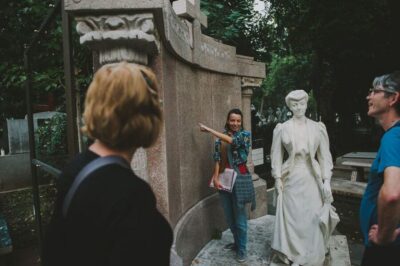
Bucharest: 3-Hour Dark History Tour with a Local
Read our review →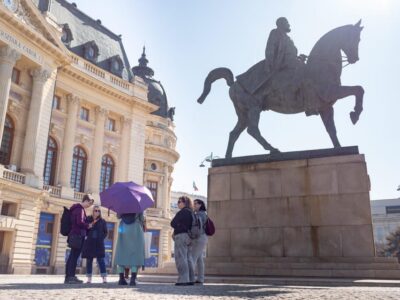
Bucharest: Small Group History, Art & Secrets Tour
Read our review →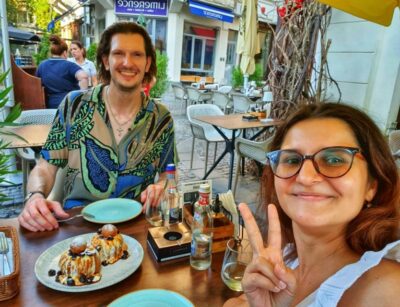
Bucharest: Sweet Delights History and Desserts Walking Tour
Read our review →Browse the lists this tour appears in