
Review · SPAIN
Caceres: Highlights, History and Jewish Quarter Walking Tour
Cáceres changes character as you move from its grand medieval palaces into the Jewish Quarter. Wide squares give way to narrow lanes, tall stone towers to low plastered houses, and formal facades to a quieter corner shaped by local Jewish traditions. That shift is the heart of this tour.
I like the way the walk combines major sights, including the Palace of Carvajal and Becerra Palace, with a less polished but more intimate part of the old city. I also like the price: $16 for two hours, with admission to several interiors when they are open. The main caution is pace. There is a lot of history to explain, and some visitors found the guide spent too long talking at certain stops.
Key points to know before booking
- The Jewish Quarter gives the tour its strongest sense of place: See the former synagogue, now the Hermitage of San Antonio de Padua, and the surviving traces of a once-large Jewish community.
- You also visit Cáceres’s grandest medieval core: The route includes the Palace of Carvajal and Becerra Palace when open.
- The tour is led in Spanish: Guides such as Manuela and Javier have been praised for clear explanations, questions, and friendly conversation.
- Two hours is enough for an overview, not a full study: The route covers a lot, so expect regular stops for history and interpretation.
- The cost is strong value: At $16, the tour includes selected interior admissions and a discount card for the Co-Cathedral of Santa María.
- The route is wheelchair accessible: Meet the Pasearte Cáceres guide beside the tourist information office.
Starting beside Cáceres’s monumental walls
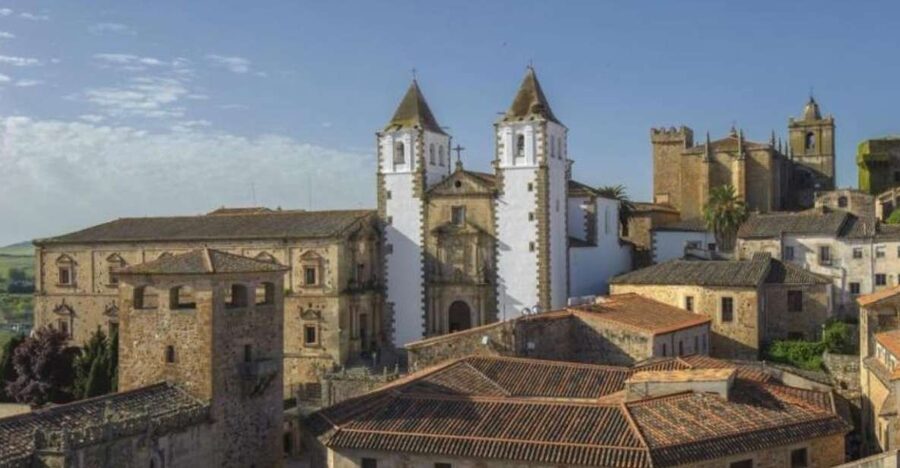
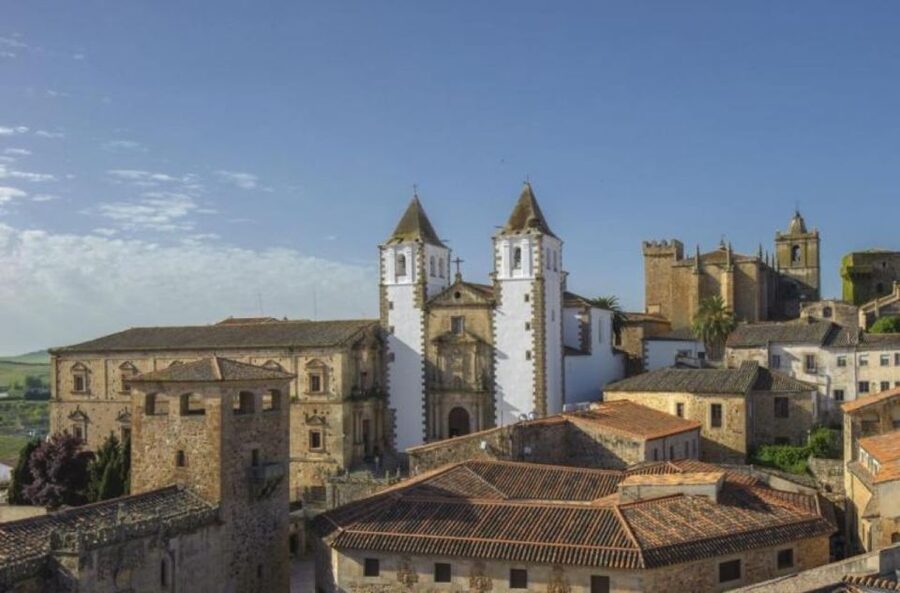
The meeting point is next to the tourist information office, a practical place to begin because you are already close to the walled historic center. From here, the guide sets the scene for Cáceres as a medieval city shaped by several cultures and later recognized as a UNESCO World Heritage site in 1986.
I like starting with context before reaching the Jewish Quarter. Without it, the area can seem like a collection of old lanes and modest houses. With the wider story in place, you can read the change in architecture as you walk: the city’s grand public and aristocratic spaces give way to a smaller, more private neighborhood.
The guide is an Official Tourism Guide of Extremadura, authorized by the regional administration. That matters here because Cáceres has layers of Roman, medieval, Christian, and Jewish history, and the tour is designed to interpret those layers rather than simply point out old buildings.
The route is described as relaxed and unhurried, but the amount of material packed into two hours can make it feel full. If you enjoy historical explanation, this is a plus. If you prefer to keep moving and photograph every stop, you may find the frequent talks a little slow.
More History Walking Tours in Spain
- Barcelona: Tapas Walking Tour with Food, Wine, and History
★ 4.8 · 4,261 reviews - Barcelona Tapas Walking Tour: Food, Wine & History
★ 4.5 · 1,928 reviews - Madrid Historical Walking Tour
★ 5.0 · 721 reviews
The grand palaces of the old city
Before entering the Jewish Quarter, you visit some of the most monumental parts of the historic center. The Palace of Carvajal is one of the key stops, and its inclusion helps show the power and wealth of the families who shaped medieval Cáceres.
The Becerra Palace is another important stop. It houses the Mercedes Calles-Carlos Ballestero Foundation, and admission is included when the interior is open. These buildings give the first part of the walk a formal tone, with grand architecture and the feel of an old aristocratic quarter.
I appreciate this contrast. A tour focused only on the Jewish Quarter could leave you with a narrow view of Cáceres. By beginning with the larger monumental complex, the guide can show how Jewish life existed within a city also controlled by noble families, Christian institutions, and fortified urban spaces.
The interiors depend on opening conditions, so you should not treat entry as guaranteed at every departure. When open, however, the included admissions add real value to a $16 tour. You are not paying only for a short street walk. You also have the chance to step inside two notable buildings and the former synagogue site.
The tour does not appear to include a long independent visit inside each palace. The guide has only two hours to cover the route, so expect focused stops rather than unlimited time to wander through every room.
Turning into the Jewish Quarter
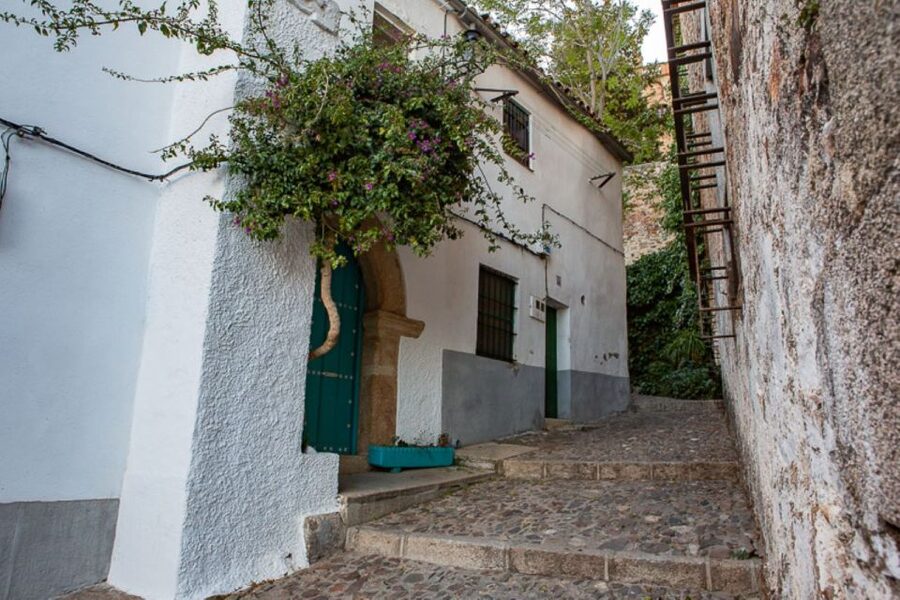
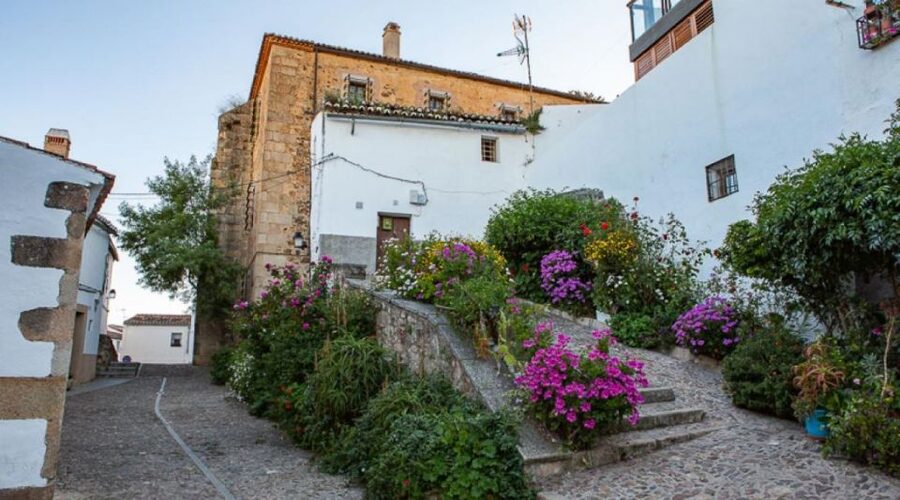
The most memorable moment comes when the route turns into the eastern part of the walled enclosure. The physical change is immediate. Instead of broad squares, you find narrow alleys. Instead of tall defensive towers, you see lower homes. Instead of large blocks of dressed stone, the buildings use brick, plaster, or roughly finished stone in the style of traditional Extremaduran houses.
This is not just a visual change. The neighborhood reflects a different way of living within the medieval city. Its lanes and small-scale buildings feel more domestic than ceremonial, and the area has kept much of its older character.
The Jewish Quarter of Cáceres belonged to the Caminos de Sefarad network, which connects some of the best-preserved Jewish quarters in Spain. That connection gives the tour a wider purpose. You are not only looking at one neighborhood in Extremadura. You are also seeing part of the surviving record of Sephardic Jewish life on the Iberian Peninsula.
The guide explains Jewish traditions and the customs that remained rooted in local life. This is where a live guide earns the price of admission. A self-guided walk could show you the lanes, but it would be harder to understand why the buildings look different or how the neighborhood fitted into the history of the city.
The Hermitage of San Antonio and the former synagogue
The Hermitage of San Antonio de Padua is one of the central stops in the Jewish Quarter. It is understood as the site of the former synagogue, later Christianized and given its present religious identity.
That change tells you much about the upheaval faced by Jewish communities in medieval Spain. The building is not presented as a perfectly preserved synagogue. Instead, it offers material evidence of a persecuted culture and of the later religious changes that reshaped the old quarter.
Admission to the hermitage is included when it is open. The interior visit is useful because the building’s meaning is easier to grasp when you hear the guide connect its present form with its earlier role. You should also expect this stop to involve explanation rather than a large collection of objects or displays.
The tour’s focus is on traditions, urban form, and surviving traces. It is not advertised as an extended museum visit, so you will likely spend more time understanding the site than examining a large exhibit.
More Jewish Heritage Tours in Spain:
- Private Jewish Heritage Journey by Barcelona Dreaming
★ 4.8 · 383 reviews - Budapest Jewish Heritage Memorial Walking Tour & Synagogue Entry
★ 5.0 · 568 reviews - 3-Hour Porto Jewish Heritage Walking Tour with Local Guide
★ 4.5 · 396 reviews - Warsaw: Jewish History Guided Walking Tour in English
★ 4.7 · 324 reviews
How the guide shapes the experience
This is a Spanish-language tour, and your experience will depend heavily on how comfortable you are following spoken Spanish. The guide is trained to interpret the Jewish Quarter through the RASGO project, a program connected with specialist training for Jewish heritage sites in Spain.
Several guides have made a strong impression. Manuela has been praised for handling a large amount of material well, even though the pace felt fast to one participant. Javier has been singled out for taking time with questions and making the visit interesting. Another description highlighted close explanations and an easy conversation in a small group.
Those details point to the tour’s best quality: personal interpretation rather than a memorized list of dates. You can ask questions, and the guide may adjust the explanation to the group. The small-group feel also helps when entering compact buildings or standing in narrow streets.
The weakness is equally clear. One participant wanted fewer long historical talks and more movement. Another felt the guide tried to cover too much in the available time. I would book this tour if you want the story behind the stones, but I would choose a different format if your priority is a quick photo walk.
A useful approach is to tell the guide early that you would like time for questions or that you prefer a faster rhythm. The tour is in Spanish, so make sure you can follow a continuous explanation before booking.
What the $16 price really includes
At $16 per person, this is a reasonably priced way to see the old center with a guide. The value comes from three parts: the two-hour interpretation, access to the listed interiors when open, and a card giving you 20 percent off entry to the Co-Cathedral of Santa María de Cáceres.
The discount for the Co-Cathedral is separate from the tour itself. You do not get full admission included, but the card can reduce the cost if you plan to visit the church afterward.
Food and drinks are not included, though that is hardly a concern for a two-hour city walk. You should plan any meal or café stop separately.
The price is especially fair if the Palace of Carvajal, Becerra Palace, and Hermitage of San Antonio are open during your visit. If some interiors are closed, the tour still provides the guide and the old-city route, but the value is slightly less than the full advertised experience.
The booking terms are flexible. You can cancel up to 24 hours before the start for a full refund, and you can reserve now and pay later. Starting times vary, so you need to check availability for the date you want.
Who will get the most from this walk
I would recommend this tour to anyone who wants a short introduction to Cáceres with more substance than a basic sightseeing loop. It suits you especially well if you are interested in Jewish heritage, medieval urban design, or the way religious and cultural communities shaped the same city over time.
It also works for first-time visitors who want help choosing what to see inside the walled center. The guide introduces several essential buildings without requiring you to plan a complicated route.
You may enjoy it less if you want complete freedom to stop often, take photographs, or explore every interior at your own speed. The tour has a set two-hour structure and a lot of material. Some stops involve extended historical explanation, so the experience rewards attention more than constant movement.
Families and mixed-interest groups can also find value here because the route combines buildings, streets, traditions, and a clear change in atmosphere. The wheelchair-accessible format is another practical advantage, though the supplied details do not specify the exact surface conditions of every lane or interior.
Practical tips for a better visit
Arrive at the tourist information office meeting point with enough time to locate the guide. The tour is on foot and takes place inside the historic walled area, so comfortable shoes are sensible even though the route lasts only two hours.
If entering the palaces and hermitage matters to you, ask at the start which interiors are open that day. The inclusions apply when the buildings are open, and opening conditions can affect the balance of the visit.
Bring your questions. The strongest part of the tour is the chance to connect architecture with Jewish customs and local history, not simply to collect building names. Guides such as Manuela and Javier have shown that the experience can become more conversational when you engage with them.
Also keep the language in mind. The tour is offered in Spanish, with no other language stated in the available details. You should be comfortable listening to historical explanations in Spanish to get the full benefit.
Should you book the Cáceres Jewish Quarter walk?
Book it if you want an affordable, Spanish-language introduction to Cáceres that links its grand medieval palaces with the quieter Jewish Quarter. The former synagogue site, the change in architecture, and the included palace admissions give the walk a clear point of view rather than a random list of sights.
Skip it if you want a brisk route with minimal commentary. The history comes in steady portions, and two hours can feel tight when the guide tries to explain the city’s many layers.
For most visitors who enjoy history and can follow Spanish, I would consider this a good-value choice. Go in expecting a story-led walk, not a rapid sightseeing circuit, and check which interiors are open on your date.
FAQ
Where does the tour meet?
Meet the Pasearte Cáceres guide next to the tourist information office.
How long does the tour last?
The walking tour lasts two hours.
How much does the tour cost?
The listed price is $16 per person.
What language is the tour in?
The live guided tour is in Spanish.
Is the tour wheelchair accessible?
Yes, the activity is listed as wheelchair accessible.
Does the tour enter the Palace of Carvajal?
Admission to the Palace of Carvajal is included when the interior is open.
Does the tour enter Becerra Palace?
Admission to Becerra Palace, home of the Mercedes Calles-Carlos Ballestero Foundation, is included when open.
Can I enter the Hermitage of San Antonio de Padua?
Entry to the Hermitage of San Antonio de Padua is included when it is open.
Is the Co-Cathedral of Santa María included?
Full entry is not included, but the tour provides a card offering 20 percent off admission.
Are food and drinks included?
No. Food and drinks are not included.
Can I cancel the booking?
Yes. You can cancel up to 24 hours in advance for a full refund.
Can I reserve without paying immediately?
Yes. The reserve-now, pay-later option lets you hold a place without paying at the time of booking.
Latest history tours reviewed in Spain
- Barcelona Historic Guided Tour★ 4.8 · 24 reviews
- Essential Madrid: Walking Tour of the Historic Center★ 4.7 · 58 reviews
- Discover the fascinating Alcazaba: History and unique views★ 4.8 · 30 reviews
- Cordoba: Segway Tour historic center★ 4.5 · 21 reviews
- Private Jewish Heritage Journey by Barcelona Dreaming★ 4.8 · 383 reviews
- Cartagena: Ancient Roman Walking Tour with Entry Tickets★ 4.5 · 89 reviews
- Bilbao Historical Tour in small group★ 4.7 · 52 reviews
- Barcelona Tapas Tour, Taverns, History & Local Culture★ 5.0 · 25 reviews
Spain History Tours, compared.
Madrid Essential: Historic Center, Plaza Mayor & Royal Palace
Read our review →
Barcelona: Tapas Walking Tour with Food, Wine, and History
Read our review →
Sevilla Food Tour: Tapas, Wine, History & Traditions
Read our review →
Valencia Old Town Tour with Wine & Tapas in 11th Century Historic Monument
Read our review →
Madrid Tapas & Taverns Small Group Food & History Tour
Read our review →
Ultimate Seville Tapas, Wine & History Small Group Tour
Read our review →
Córdoba: Skip-the-Line Great Mosque-Cathedral History Tour
Read our review →
Barcelona: 2.5-Hour Bike or E-Bike Historical Tour
Read our review →Browse the lists this tour appears in