
Review · SPLIT
Walking Tour of Split with a ‘Magister’ of History
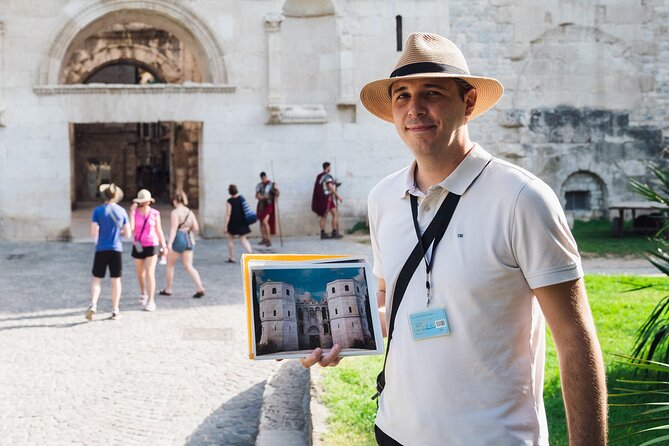
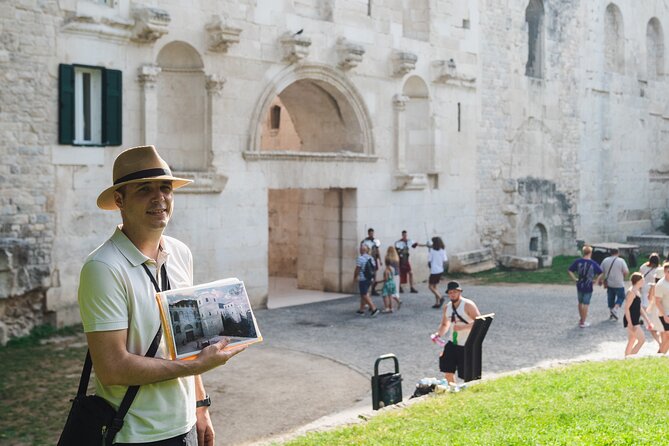
Split’s Roman core is easy to walk through and surprisingly easy to misunderstand. This tour helps you see the difference between an ancient emperor’s retirement palace, a medieval town built into its walls, and the living city that still uses the same streets. Toni Šare, a local historian and the owner of DiocleSpot Tours, uses his own 3D reconstructions to show what Diocletian’s Palace looked like before centuries of change.
I like the tour’s focus on small details, from construction errors in the Temple of Jupiter to the way medieval residents reused Roman defenses. I also like that Toni connects architecture with Croatian language, religion, politics, and daily life instead of treating each monument as an isolated stop. The main consideration is that paid sites are not entered, so you will need a separate visit if you want to go inside the cathedral, temple, museums, or other ticketed attractions.
Key points to know before you book
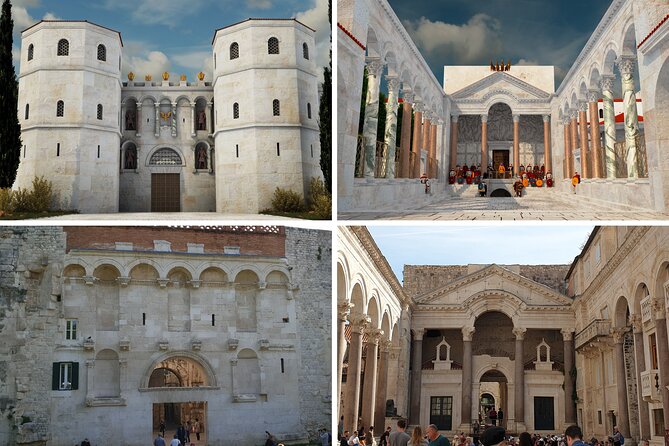
- Toni’s 3D reconstructions make the vanished decorations and buildings of Diocletian’s Palace easier to picture.
- The route covers several eras, including Roman, medieval, Renaissance, Venetian, and early modern Split.
- You finish at Pjaca, the city’s main medieval square, a useful place to continue exploring on your own.
- The walking tour lasts about 1 hour 40 minutes to 1 hour 50 minutes, with a maximum of 18 people.
- No attraction admissions are included, but the outside explanations are detailed enough to help you choose later visits.
- A private upgrade is available, while the group format keeps the price to $34.83 per person.
Why Split makes a historian-led walk worthwhile
Split does not present its past in a tidy museum district. Roman columns support later buildings. Medieval homes fill spaces that once belonged to an imperial palace. A Renaissance courtyard may sit a few steps from a Roman gate, while modern cafés occupy rooms that were once part of Diocletian’s private quarters.
That mixture is the point, but it can be confusing if you explore without context. I like this tour because it treats Split as a city that changed over time rather than a collection of famous ruins. You hear how later residents adapted the palace instead of simply preserving it behind ropes.
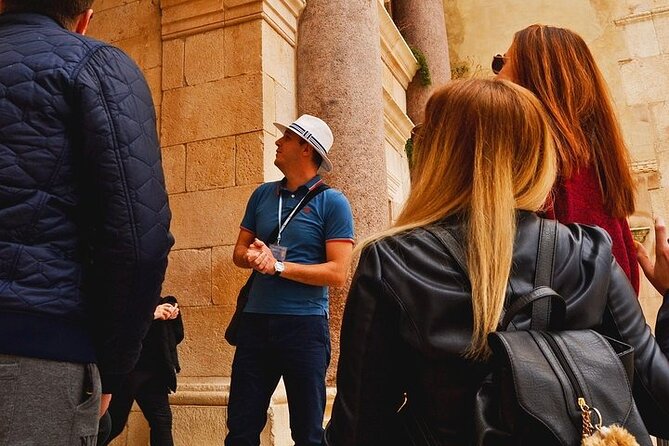
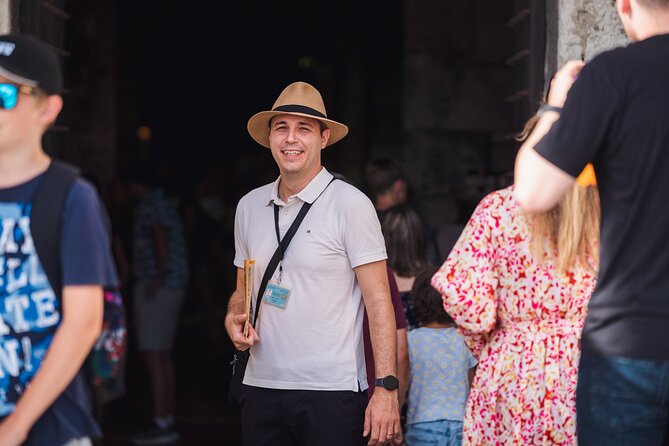
Toni’s background matters here. He was born and raised in Split, studied and taught history, and brings local memory into the walk. His explanations also reach beyond ancient Rome into Croatian culture, Venetian rule, religion, and the city’s more recent past. The result should suit you if you want the story behind the stones, not just a list of dates.
The route is also a sensible introduction to the old town. It moves from the waterfront through the palace, crosses the main Roman areas, and ends at a central square. I would book it early in a Split stay, then use the remaining hours to return to the places that caught your attention.
More History Walking Tours in Croatia
- Dubrovnik Old Town History Walking Tour
★ 5.0 · 1,684 reviews - Dubrovnik: Ancient City Walls & Wars Walking Tour
★ 5.0 · 1,270 reviews - Zagreb: City & History Walking Tour & WW2 Tunnels
★ 4.9 · 1,202 reviews
Starting at the Riva and the Brass Gate
The meeting point is the Brass Gate, also called Porta Aenea, at Obala Hrvatskog narodnog preporoda 22. It sits by the Riva, Split’s waterfront promenade and one of the city’s main gathering places.
The opening stop lasts about 15 minutes. That may seem long for a place you could simply walk past, but the Riva gives you a useful view of the palace’s southern wall. Toni uses graphic material and models here to explain what you are about to see inside the palace.
This is one of the stronger choices in the route. The southern wall looks more imposing from the harbor, and the waterfront helps you understand that Diocletian’s complex was built as a large imperial residence with direct access to the sea. You begin with the whole structure before moving into its tighter lanes and courtyards.
The tour is conducted in English. The group can include up to 18 people, so the Riva is also a practical place to gather before the walk moves into narrower spaces.
Peristyle: the palace’s central stage
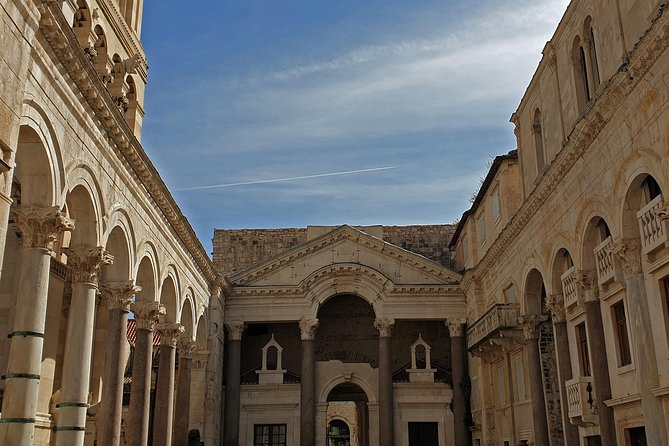
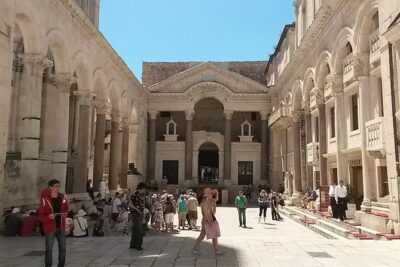
The Peristyle is the central square of Diocletian’s Palace and one of the most important open spaces in modern Split. The stop lasts about 10 minutes, though questions and the pace of the group may affect the exact timing.
Here you see some of the best-preserved Roman structures in the city. The columns, stonework, and surrounding walls make the square impressive on their own, but the 3D reconstructions add a useful second layer. They show how much decoration and architecture has disappeared or changed.
I find this especially valuable because surviving Roman stone can be misleading. You see what remains, but not always the scale, color, or visual drama of the original space. Toni’s images help you picture the palace during its imperial period rather than as the weathered core you see today.
The Peristyle is also a place where modern life and ancient architecture meet. It is not presented as a sealed archaeological site. The square remains part of Split’s daily rhythm, which makes the explanation of its older uses more memorable.
Saint Domnius and the change from mausoleum to cathedral
The next stop is the Cathedral of Saint Domnius, originally built as the mausoleum of Emperor Diocletian. It is one of the best-preserved Roman structures in Split and is still used as a cathedral.
The tour does not go inside. Toni explains the mausoleum, the cathedral, the bell tower, and the way the building changed hands and purpose when Christians converted the emperor’s tomb into a place of worship. For some people, not entering will be a drawback, especially if this is your only planned visit to the cathedral.
Still, the outside discussion covers the central story. You learn to look at the building as both a Roman imperial monument and a Christian religious site. That change is one of the clearest examples of Split’s layered past.
The stop lasts about 10 minutes. If you want to climb the bell tower or see the interior, plan a separate visit and pay the applicable admission yourself.
Same old streets, another chapter:
- Dubrovnik Combo: Old Town & Ancient City Walls
★ 5.0 · 1,019 reviews - Split Walking Tour with Professor of History
★ 5.0 · 926 reviews - Game of Thrones & History of Dubrovnik Tour
★ 5.0 · 628 reviews - Dubrovnik: Old Town History Walking Tour
★ 4.9 · 474 reviews
The Temple of Jupiter and its Roman mistakes
The Temple of Jupiter receives about 15 minutes of attention. It is often described as one of the best-preserved late Roman temples in the world, but Toni does not present it as flawless imperial engineering.
From outside, he points out anomalies and mistakes made during construction. That detail gives the stop a welcome human touch. Roman buildings can appear impossibly precise when viewed from a distance, yet the builders had to solve practical problems with the materials and methods available to them.
You will not enter the temple. The exterior explanation is intended to cover the relevant features, which keeps the tour moving and avoids turning the walk into a series of admission lines. If you have a strong interest in Roman architecture, you may want to return later for a closer look.
I like this stop because it replaces the idea of perfect ancient construction with something more believable. Large monuments were made by people, and people sometimes made mistakes.
The Silver Gate and a surviving Roman road
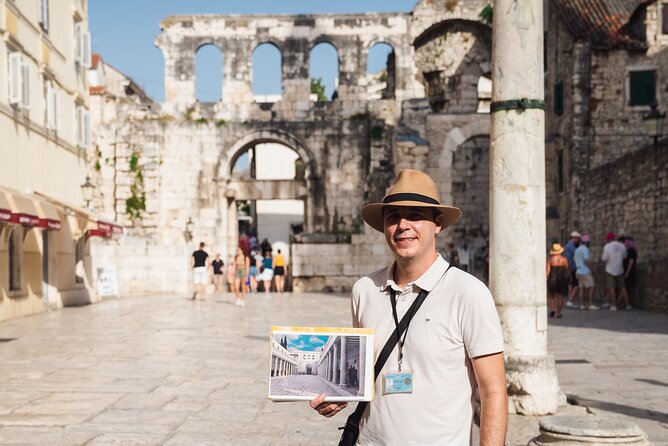
At the Eastern, or Silver, Gate, the route pauses for about five minutes. This is one of the best viewpoints for seeing how the palace’s structures fit together.
From here, you can look toward the cathedral and the gate while standing above the only preserved part of the original Roman road. The view brings the palace’s defensive and ceremonial sides together. You are not just seeing an entrance. You are seeing how streets, walls, and major buildings related to one another.
The short stop works well after the longer explanations at the temple and cathedral. It gives you a visual reset and a chance to understand the palace as a connected plan.
Grgur Ninski and Croatian identity
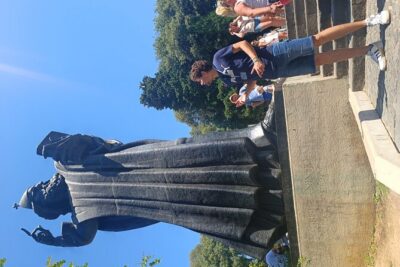
The statue of Grgur Ninski is a quick five-minute stop, but its subject reaches beyond Roman Split. The large statue is a familiar landmark, and Toni explains what it represents and why it matters to Croatian language and culture during the early medieval period.
This is a useful reminder that Split’s story did not end when Roman rule faded. The city’s identity was shaped by later religious, linguistic, and political changes. The statue gives Toni a natural opening to explain that transition without leaving the old town.
The stop is outside and free. It also provides a recognizable reference point if you want to continue exploring independently after the tour.
The Vestibule and Diocletian’s private residence
The Vestibule was an ancient entrance to the emperor’s private residence. From here, Toni leads you around the remains of Diocletian’s residential area for about 10 minutes.
This section helps separate the palace from the modern idea of a single grand building. Diocletian’s complex included formal spaces, private areas, entrances, defensive walls, and service zones. The surviving remains make more sense when you know which parts served the emperor personally.
As you walk, Toni also points out noble palaces and other buildings added in later periods. These are easy to overlook if you focus only on Roman remains. I appreciate that the route keeps returning to the later city, because those additions explain why Split feels like a lived-in town rather than an isolated ruin.
Depending on the group’s interest, the walk can also pass Game of Thrones filming locations and the related fan shop. This is not the main purpose of the tour, but it offers a useful extra for viewers who want to recognize the palace as a filming setting.
The Golden Gate and medieval reuse
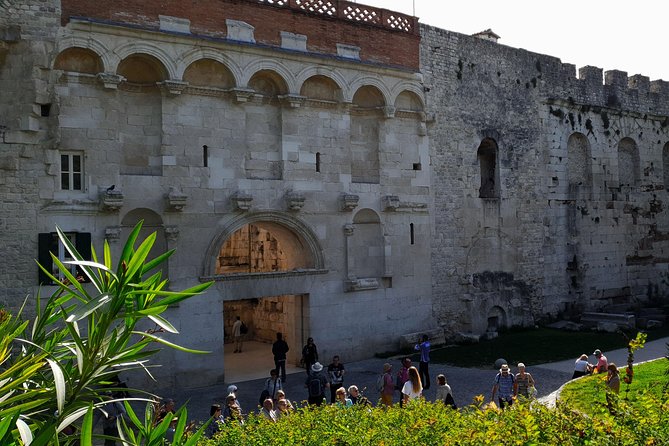
The Golden Gate is the main entrance to Diocletian’s Palace and the most decorated and best-preserved of the four gates. The stop lasts about 15 minutes and includes a view of the northern wall.
This is one of the route’s most revealing places. The Roman walls were not simply abandoned when the imperial period ended. Medieval residents continued to use them for defense, while removing or altering parts that no longer served a purpose.
That reuse is central to understanding Split. The city was built into the palace, not placed beside it. Homes, streets, churches, courtyards, and civic buildings all developed around the old Roman framework.
Toni’s 3D images are particularly useful here. They show the difference between the original palace and the later town, helping you see why the Golden Gate looks both Roman and medieval at once.
Renaissance palaces, Venetian influence, and Pjaca
The route passes several noble palaces and reaches the courtyard of the City Museum of Split. You do not enter the museum, but the courtyard lets you see one of the city’s fine Renaissance noble residences from within.
This is where the tour broadens again. Toni explains the Venetian period and why buildings of this kind began appearing in Split. The courtyard is a compact way to see how local wealth, outside rule, and changing architectural tastes shaped the city after the Roman era.
The final stop is the Old Town Hall on Narodni trg, also called Pjaca or Piazza Square. The square has served as the city’s main square since medieval times, and the 14th-century Town Hall remains one of its key buildings.
Ending here makes practical sense. From Pjaca, you can reach other parts of the old town easily, return toward the waterfront, or continue to restaurants and shops. The tour ends after about five minutes at the square, rather than leaving you beside a distant monument with no clear sense of direction.
What the $34.83 price delivers
At $34.83 per person, this is not the cheapest way to walk around Split, but the value depends on how much context you want. You are paying for roughly 100 minutes with a historian who uses original 3D reconstructions and covers several periods of the city’s past.
The price does not include museum or monument admissions. That keeps the tour cost lower and lets you decide which interiors deserve extra time. It also means you should not book this expecting a ticketed cathedral visit or a museum tour.
The group option is the sensible budget choice. With a maximum of 18 people, it remains small enough for questions, though a private upgrade may suit you better if you want a slower pace or more personal discussion. Group discounts are available, so the cost may work better for families or larger parties.
I would especially consider the price worthwhile if Split is a short stop on a larger Croatian trip. A good orientation can prevent you from wandering past important details and can help you choose how to spend the rest of your time.
Timing, comfort, and practical limits
The walk lasts between 1 hour 40 minutes and 1 hour 50 minutes. It is conducted outdoors through the old town, so choose a time that fits your tolerance for summer heat. One useful option is an evening departure, which can make the walk more comfortable during hot weather.
Wear shoes suitable for old stone streets. The route includes open squares, gates, narrow lanes, and uneven historic surfaces. The information provided says most people can participate, and service animals are allowed. The tour is near public transportation, but it begins and ends at different locations, so note both points before setting out.
The tour requires good weather. If poor weather cancels it, you can choose another date or receive a full refund. For other cancellations, you need to cancel at least 24 hours before the start time to receive a full refund. Changes made less than 24 hours before departure are not accepted.
Who will get the most from this walk?
I would recommend it to you if you enjoy architecture, local history, Roman sites, or the way old cities keep changing. It is also a strong first-day activity because it gives you a map of the old town and points out places you may want to revisit.
It suits curious adults, families with older children, and anyone who prefers explanation to simple sightseeing. Toni’s style includes humor, local stories, modern history, and personal insight, so the experience is not limited to ancient dates.
You may want a different option if you need wheelchair-smooth routes, want to enter every major monument, or prefer a fast photo stop at each attraction. The tour is built around listening and looking closely, not checking off a long list of interiors.
Should you book the Walking Tour of Split with a Magister of History?
Book it if you want Split to make sense. The strongest parts are Toni’s personal connection to the city, his ability to link Roman remains with medieval and Venetian changes, and his 3D reconstructions of the palace.
Choose the group tour for a reasonably priced introduction, or upgrade to private if discussion and flexibility matter more than budget. Just remember that the cathedral, Temple of Jupiter, museums, and other paid sites are viewed from outside.
For a first visit, I would schedule this walk early in your stay, ideally before spending a full afternoon inside the old town. You will leave with a better eye for the palace’s reused walls, hidden details, and long sequence of changes.
FAQ
How long does the Walking Tour of Split with a Magister of History last?
The tour lasts approximately 1 hour 40 minutes to 1 hour 50 minutes.
Where does the tour begin?
It begins at the Brass Gate, also called Porta Aenea, at Obala Hrvatskog narodnog preporoda 22 in Split.
Where does the tour end?
The tour ends at Narodni trg, known as Pjaca or Piazza Square, near the Old Town Hall.
Who leads the tour?
The guide is Toni Šare, owner of DiocleSpot Tours.
Is the tour offered in English?
Yes. The tour is offered in English.
Are attraction tickets included?
No. The tour does not include entry to museums or paid sites, and the cathedral and Temple of Jupiter are viewed from outside.
How many people can join the group?
The maximum group size is 18 people.
Is a private tour available?
Yes. You can upgrade to a private tour, while a group option is available for managing the cost.
What happens if bad weather cancels the tour?
If poor weather causes cancellation, you will be offered another date or a full refund. For a regular cancellation, you must cancel at least 24 hours before the start time for a full refund.
Latest history tours reviewed in Croatia
- Experience Split History Walking Tour With Local Historian★ 5.0 · 28 reviews
- Dubrovnik: Small-Group Guided Old Town History Walking Tour★ 4.9 · 37 reviews
- Dubrovnik: Game of Thrones & History Tour★ 4.7 · 72 reviews
- Dubrovnik History and Game of Thrones Locations Tour★ 4.8 · 49 reviews
- Dubrovnik Old Town: Night tour with History, Wine & Bites★ 4.7 · 59 reviews
- Dubrovnik: Historical Tour with Game of thrones details★ 4.9 · 43 reviews
- Dubrovnik Old Town: Easy paced and accessible History tour★ 4.9 · 20 reviews
- Dubrovnik: History and Game of Thrones Walking Tour★ 4.7 · 85 reviews
Split History Tours, compared.
SPLIT-PRIVATE Walking Tour of Diocletian’s Palace & Old Town
Read our review →
Split History and Gastro Small-Group Tour with Food and Drinks
Read our review →

Split: Historical Tour of Salona, Klis Fortress and Trogir
Read our review →
History & Cultural Walking Tour of Split and Diocletian’s Palace
Read our review →
Jewish Heritage & Diocletian’s Palace Private Split Tour
Read our review →
History Split Walking Tour in French -Small group
Read our review →Browse the lists this tour appears in