
Review · SPLIT
Split Walking Tour with Professor of History
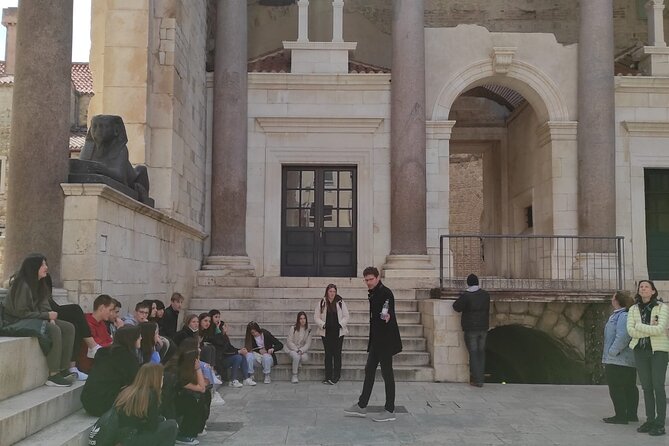
Split’s old town is not a museum set apart from daily life. It is a Roman palace still used as a city center, with cafés tucked into ancient walls, laundry above Roman streets, and locals crossing spaces built for an emperor. This walking tour makes that unusual mix easier to understand, especially when your guide is Mario or Anita, both praised for turning dates and ruins into lively stories.
I like the way the tour links Diocletian’s Palace with modern Split, rather than treating the palace as a single monument. I also like the small-group format, with a maximum of 17 people, which gives you a better chance to hear the guide and ask questions. The main consideration is pace: the advertised time is about 2 hours and 20 minutes, but the tour can run closer to three hours when the guide adds extra stories and advice.
Key points to know before booking
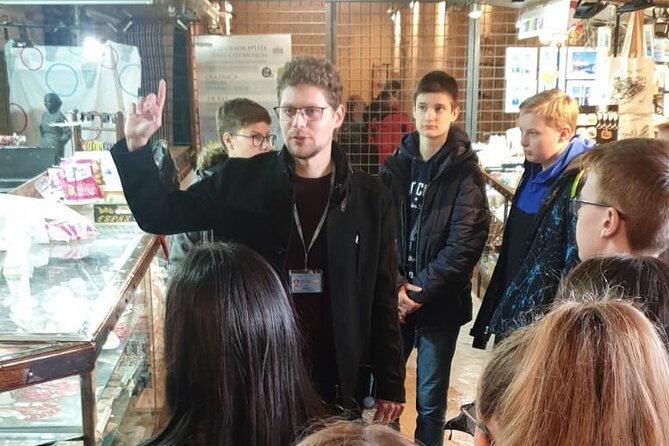
- A history professor leads the walk: Expect more context than you get from a simple photo stop, including Roman power, Croatian culture, local customs, and modern issues.
- The route covers the heart of Split: You visit the Riva, Diocletian’s Palace, the Golden Gate, Marmontova Street, Prokurative, and Fruit’s Square.
- The palace interiors are limited: You see the Cathedral of Saint Domnius and Temple of Jupiter from outside, while the substructures are included without a separate admission fee.
- Mario’s style is lively and detailed: He mixes history, humor, myths, local food advice, and practical suggestions for the rest of your stay.
- The tour is good for first-time visitors: It gives you a map of the old town and helps you decide which sites deserve a return visit.
- A private upgrade is available: Choose it if you want a more personal pace or more time for questions.
Why a professor changes the feel of a Split walking tour
Many city walks give you a sequence of facts, then move on before you can place those facts in context. Here, the point is to understand how Split grew around Diocletian’s palace and how the Roman structure still shapes the city.
A guide with a history background can explain why the palace was built, how its spaces were used, and how later generations adapted them. The reviews of this experience repeatedly praise Mario’s ability to combine solid historical detail with humor and questions that keep the group involved. Anita receives similar praise for her warmth, care with the group, and pride in Croatian culture.
That does not mean the tour is a formal university lecture. The strongest descriptions of Mario present him as funny, approachable, and willing to discuss food, banks, local life, and current issues as well as emperors and monuments. That mix matters in Split, where a ruined temple may be next to a café and an ancient corridor may lead to someone’s apartment door.
The route is also useful for orientation. It begins near the harbor and finishes in the old town, so you can use the walk to mark places for later. You might return to the palace substructures, pay to enter the cathedral, or use the guide’s suggestions to choose a restaurant and plan the rest of your time.
More History Walking Tours in Croatia
- Dubrovnik Old Town History Walking Tour
★ 5.0 · 1,684 reviews - Dubrovnik: Ancient City Walls & Wars Walking Tour
★ 5.0 · 1,270 reviews - Zagreb: City & History Walking Tour & WW2 Tunnels
★ 4.9 · 1,202 reviews
Starting on the Riva beside the Brass Gate
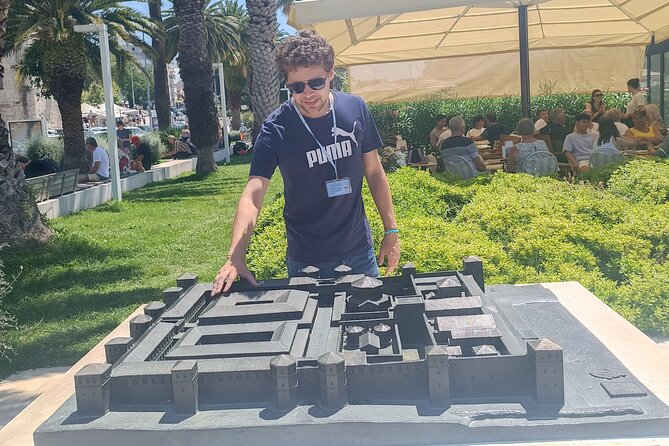
The meeting point is the Brass Gate, also called Porta Aenea, on Obala Hrvatskog narodnog preporoda 22. It is beside the Riva, Split’s broad waterfront promenade, where the tour begins near a model of Diocletian’s Palace.
The Riva is more than a scenic opening view. It is where people sit over coffee, enjoy the sun, and watch the city’s public life unfold. Starting here gives you a useful first lesson: Split’s old town is not cut off from the harbor or from ordinary local routines.
The opening stop lasts about 15 minutes. That is enough time for your guide to explain the basic shape of the palace and set up the story before you enter the old town. Arrive ready to walk and listen in an open public space, where shade and seating may vary.
The palace substructures reveal the Roman plan
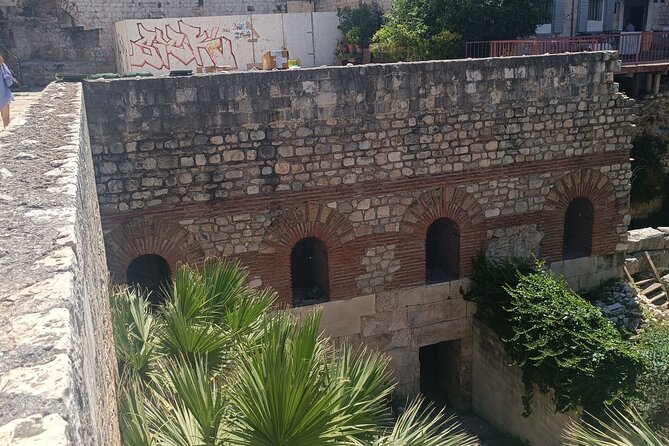
The basement halls beneath Diocletian’s Palace are among the best-preserved classical-era complexes of their kind. They are also one of the clearest places to see the original structure of the palace, because the lower level follows the layout of the imperial rooms above.
The tour allows about 15 minutes here. That is not a full archaeological visit, but it gives you a strong framework for understanding the palace. The substructures helped earn Split’s historic center UNESCO World Heritage status in 1979, and they make the palace feel like a complete Roman complex rather than a scattering of columns.
The practical advantage is that admission is included in the tour. You do not need to arrange a separate ticket for this portion. If you enjoy ancient architecture, you may want to return later for a slower look, since a short guided stop cannot cover every chamber.
Peristyle and Vestibul: the emperor’s public stage
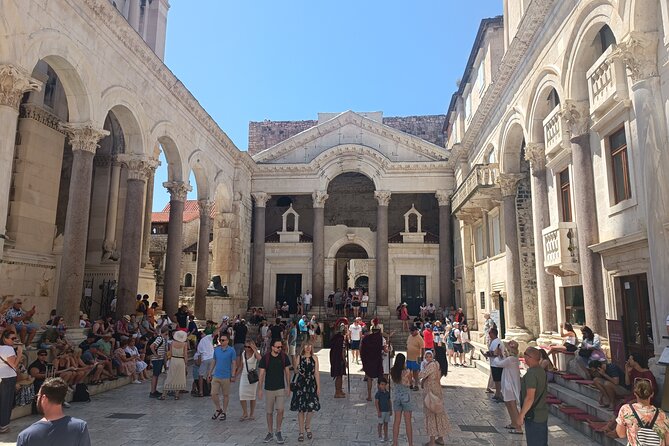
The Peristyle is the palace’s central square and one of the most memorable spaces on the route. In Diocletian’s time, this was a ceremonial setting where the emperor appeared beneath the central architrave. His subjects approached him in ways that reinforced his status as a living son of Jupiter.
Your guide spends about 10 minutes here. The value is not just seeing a dramatic square, but understanding the choreography of power. The architecture was designed to make the emperor seem remote, sacred, and larger than ordinary life.
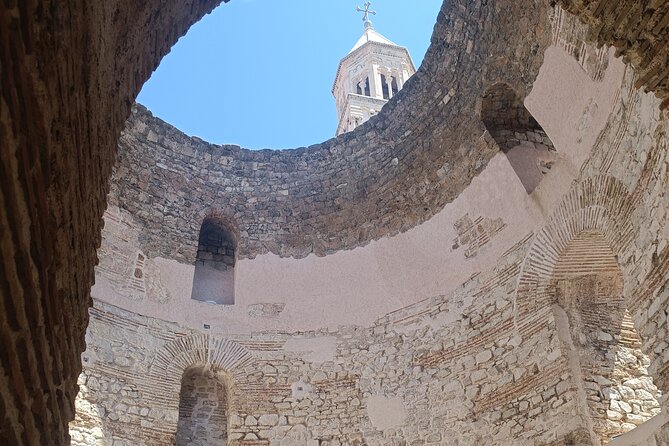
From there, the walk continues to the Vestibule, another 10-minute stop. This circular hall once formed part of the formal route to the imperial apartments. It was built by the beginning of the fourth century, measured about 17 meters high and 12 meters across, and originally had a dome.
The Vestibule was intended for selected audiences such as ambassadors. That detail helps you picture the palace as a working imperial residence, not simply a grand home. Look up when you enter, and listen for the explanation of how the space controlled movement toward the emperor.
Same old streets, another chapter:
- Walking Tour of Split with a ‘Magister’ of History
★ 5.0 · 1,122 reviews - Dubrovnik Combo: Old Town & Ancient City Walls
★ 5.0 · 1,019 reviews - Game of Thrones & History of Dubrovnik Tour
★ 5.0 · 628 reviews - Dubrovnik: Old Town History Walking Tour
★ 4.9 · 474 reviews
Saint Domnius Cathedral and the layered palace
The Cathedral of Saint Domnius is a perfect example of Split’s layers. Depending on how you look at it, the building began as a Roman temple and mausoleum before becoming a Christian church.
The tour spends about 20 minutes here, but the visit is from outside only. Admission is not included. That is an important distinction if you want to see the interior, treasury, or other paid areas. Your guide explains the building’s history and can give you enough context to decide if you want to buy a ticket after the walk.
I like this stop because it shows how old buildings change meaning. The same structure can represent imperial Rome, Christian worship, and modern heritage at once. You do not need a separate lecture on every period to see that Split was repeatedly reshaped rather than rebuilt from scratch.
Jupiter’s Temple and the narrowest street story
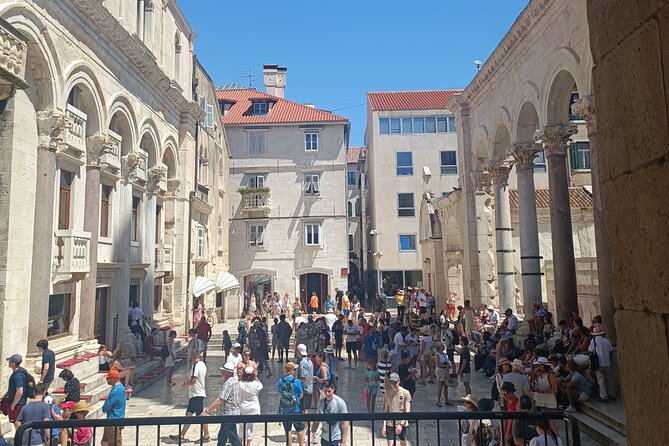
The Temple of Jupiter is another outside stop. Jupiter was the Roman god of the sky and thunder and the highest god in Roman religion. Over time, the temple became a baptistery dedicated to Saint John the Baptist.
This stop lasts about 10 minutes and does not include entry. The explanation is still useful because it connects Roman religion with later Christian use, a pattern you see throughout the palace.
On the way to the Golden Gate, the route passes through a very narrow lane called Let Me Pass Street. Local people believe it is the narrowest street in the world. The tour treats it as a small but memorable part of the walk, and it adds a bit of humor after the heavier stories of emperors and temples.
The Golden Gate and Gregory of Nin
The Golden Gate, or Northern Gate, was one of the palace’s four main entrances. It was the route through which Diocletian entered the complex and was decorated to signal its importance.
The gate was later sealed during the Middle Ages, and some of its columns and statues disappeared. It was reopened and repaired in modern times. The 15-minute stop gives you a chance to see how the palace changed after the Roman period rather than imagining it frozen in antiquity.
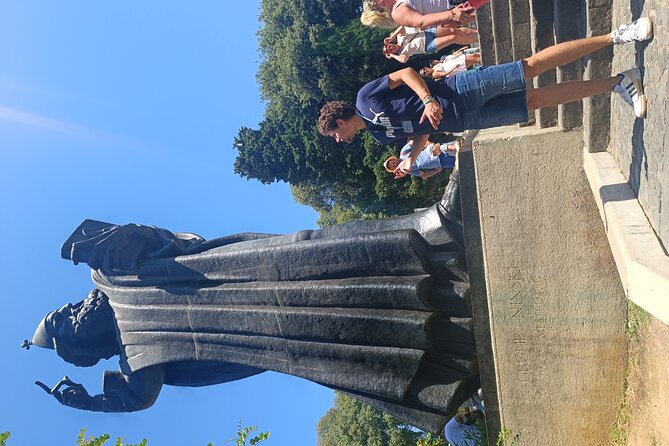
Nearby is the 8.5-meter statue of Gregory of Nin by Ivan Meštrović. The statue is one of Split’s busiest photo stops, especially because its toe has been rubbed smooth and shiny. Touching it is said to bring good luck.
You will spend about 10 minutes here. The stop is lighthearted, but Gregory of Nin also opens the door to Croatian religious and cultural history. It is a good example of how a public monument can work as both art and local ritual.
Marmontova Street and Prokurative
Marmontova Ulica shifts the subject from ancient Rome to the modern shaping of Dalmatian cities. It is named for Napoleon’s marshal Marmont, who is credited with helping urbanize parts of the region even though he was a conqueror.
The tour allows around 10 minutes on the street. That short stop helps you notice that Split’s story does not end with the palace. Later rulers and administrations also left their mark on the city’s streets, buildings, and public spaces.
Next comes Republic Square, better known as Prokurative. The large square is surrounded on three sides by elaborate neo-Renaissance buildings. Another 10 minutes here gives you a clean contrast with the tight Roman lanes and medieval passages nearby.
I find this change in scale useful. The palace can make Split feel entirely Roman, but Prokurative reminds you that the city continued to develop and express new styles long after Diocletian’s time.
Fruit’s Square ends the route with local flavor
The final stop is Fruit’s Square, officially Trg Braće Radić. It is a small, attractive square where women once sold fruit. The guide discusses important monuments here, including the statue of Marko Marulić, often described as the father of Croatian literature.
The stop lasts about 15 minutes and is a fitting place to finish. The square brings together food, literature, local commerce, and Croatian identity. It also gives the guide room to talk about local gastronomy and recommend places to eat.
Several accounts of the tour praise Mario for giving practical follow-up advice about restaurants, activities, onward travel, and even which ATMs or banks to use. Those details can be more useful than another date from Roman history, especially if this is your first day in Split.
The tour ends back at the meeting point. From there, you can return to any site that caught your attention, continue along the waterfront, or use the old town as your base for lunch.
What the $24.19 price gets you
At $24.19 per person, the cost is reasonable for a guided walk lasting about 2 hours and 20 minutes, particularly because all fees and taxes are included. The included access to the palace substructures adds value, while the Cathedral of Saint Domnius and Temple of Jupiter require separate admission if you later choose to go inside.
The price is best understood as payment for interpretation, not transport or a full collection of entrance tickets. You are buying a structured route, historical context, local orientation, and the chance to ask questions in a small group.
A private upgrade costs more, but it may make sense if you want a slower pace, more control over the discussion, or personal attention. The standard group can include up to 17 people, which is still manageable, but a private format will naturally feel more flexible.
Who will enjoy this walk most
I would choose this tour if you are visiting Split for the first time and want a solid introduction before exploring on your own. It is especially suited to people who enjoy history but do not want a dry lecture.
It also works well for anyone who wants practical help beyond monuments. Mario’s style, as described through the experience, includes food suggestions, local customs, humor, and modern topics. Anita’s approach is described as attentive and caring, with a strong connection to Croatian culture.
You should allow extra time if you dislike long walks or standing while listening. One account found the experience closer to three hours than the stated 2 hours and 20 minutes. That extra time may be welcome if you like detail, but it can matter if you have a ship departure, restaurant reservation, or another scheduled activity.
The tour is offered in English. Service animals are allowed, and most people can participate. Since it is a walking experience through historic streets, wear comfortable shoes and be prepared for changing surfaces, though the supplied information does not specify a full accessibility assessment.
Booking timing, weather, and cancellation
The experience is often booked about 33 days ahead, so planning early is sensible during a busy season. Confirmation is provided at booking, and the activity is near public transportation.
Free cancellation is available up to 24 hours before the start time for a full refund. Changes or cancellations inside that 24-hour window are not accepted for a refund. The tour also needs good weather. If poor weather causes cancellation, you are offered another date or a full refund.
Should you book the Split history professor tour?
Book it if you want to understand Split rather than simply photograph it. The route covers the essential old town, and the guide’s historical training gives the Roman palace, medieval lanes, Croatian culture, and later architecture a clear connection.
The strongest reason to choose it is the teaching style. Mario is repeatedly described as funny, generous with information, and able to make history feel alive. Anita is praised for her preparation, warmth, and attention to the whole group.
Skip it if you prefer to explore entirely alone, want long interior visits at the cathedral and temple, or need a tightly fixed two-hour schedule. For most first-time visitors, though, the combination of palace history, local advice, and a manageable group makes this a smart first activity in Split.
FAQ
How long does the Split walking tour last?
The advertised duration is approximately 2 hours and 20 minutes. It may run longer, with one account describing a total closer to three hours when the guide added extra information.
Where does the tour begin?
The meeting point is the Brass Gate, also called Porta Aenea, at Obala Hrvatskog narodnog preporoda 22 in Split.
Where does the tour end?
The activity ends back at the meeting point.
Is the Cathedral of Saint Domnius included?
The cathedral is visited from outside only. Entry is not included, though the guide provides information if you want to visit it afterward.
Is the Temple of Jupiter included?
The temple is viewed from outside only, and admission is not included.
How large can the group be?
The tour has a maximum of 17 participants. A private upgrade is also available.
What happens if the weather is poor?
The experience requires good weather. If it is canceled because of poor weather, you can choose another date or receive a full refund.
Latest history tours reviewed in Croatia
- Experience Split History Walking Tour With Local Historian★ 5.0 · 28 reviews
- Dubrovnik: Small-Group Guided Old Town History Walking Tour★ 4.9 · 37 reviews
- Dubrovnik: Game of Thrones & History Tour★ 4.7 · 72 reviews
- Dubrovnik History and Game of Thrones Locations Tour★ 4.8 · 49 reviews
- Dubrovnik Old Town: Night tour with History, Wine & Bites★ 4.7 · 59 reviews
- Dubrovnik: Historical Tour with Game of thrones details★ 4.9 · 43 reviews
- Dubrovnik Old Town: Easy paced and accessible History tour★ 4.9 · 20 reviews
- Dubrovnik: History and Game of Thrones Walking Tour★ 4.7 · 85 reviews
Split History Tours, compared.
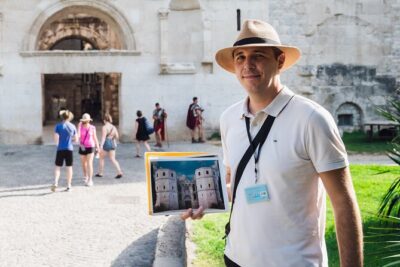
Walking Tour of Split with a ‘Magister’ of History
Read our review →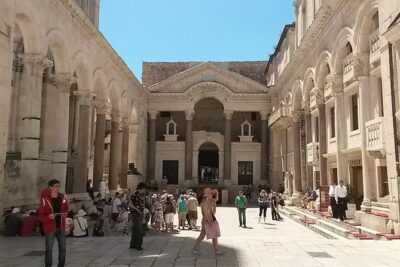
SPLIT-PRIVATE Walking Tour of Diocletian’s Palace & Old Town
Read our review →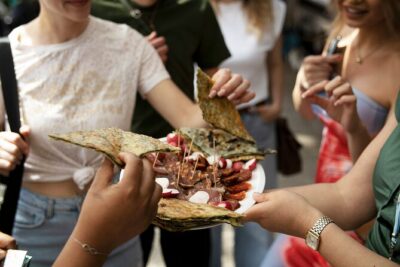
Split History and Gastro Small-Group Tour with Food and Drinks
Read our review →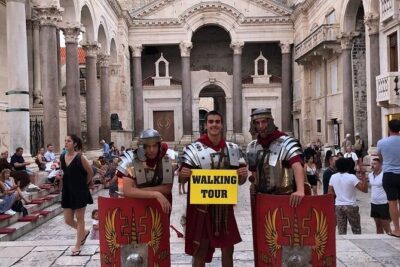

Split: Historical Tour of Salona, Klis Fortress and Trogir
Read our review →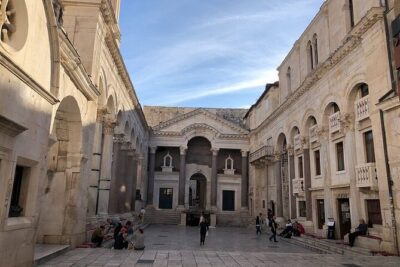
History & Cultural Walking Tour of Split and Diocletian’s Palace
Read our review →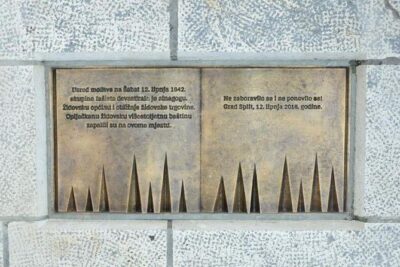
Jewish Heritage & Diocletian’s Palace Private Split Tour
Read our review →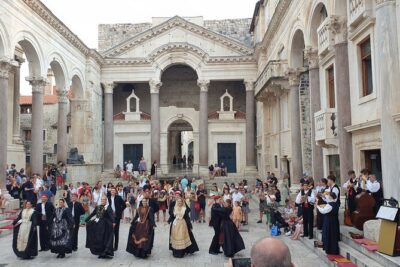
History Split Walking Tour in French -Small group
Read our review →Browse the lists this tour appears in