Review · ITALY
Ancient Pompeii Private Tour: Skip the Line & Kid-Friendly Option
Pompeii is easiest to understand when someone helps you read its streets. This private walking tour takes you from the Forum and Temple of Apollo to bathhouses, shops, theaters, wealthy homes, and the haunting plaster casts of eruption victims. You see more than old stones. You see how Romans worked, worshipped, washed, ate, and spent their free time.
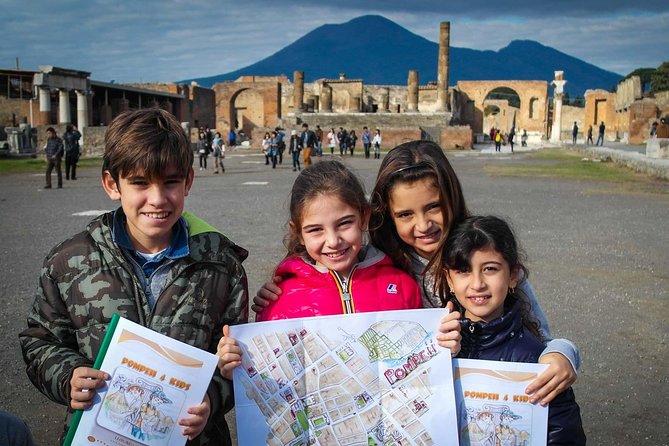
I like the private format, which lets you ask questions and adjust the pace instead of following a large group. I also like the family option, with its map, stickers, puzzles, and clues. Guides including Francesca, Anna, Natalia, Viviana, and Fabrizio have been especially good at keeping children involved while still giving adults solid historical detail.
The main caution is timing. The advertised visit is about two hours, which is enough for key sights but not the whole archaeological park. Some families have spent longer with their guide, while one party with mobility concerns found the pace too quick. Also, the booking information is unclear about admission fees, so confirm exactly what your price includes before you pay.
Key things to know before booking
- The private guide changes the experience: You can request specific sights, ask questions, and slow down for photographs or children.
- The family option is more than a shorter tour: Children receive a special map, stickers, activities, and puzzles connected to the buildings you visit.
- The route covers Pompeii’s major themes: public life at the Forum, shopping along Via dell’Abbondanza, bathing, religion, theater, private luxury, and the eruption.
- The House of the Vettii is a major prize: This lavish home reopened in 2023 after a long restoration and contains some of Pompeii’s finest decoration.
- Heat and hard walking matter: Wear good shoes, carry water, and consider an early start, especially in summer.
- Ticket details need checking: The tour information says both that admission is included and that fees are paid separately at the entrance.
Why a private Pompeii tour helps
Pompeii is huge, exposed, and easy to misread. A street can look like a pile of dark paving stones until a guide points out the raised stepping blocks, wheel ruts, shop counters, drainage channels, and doorways that reveal how the city worked.
A private guide also gives you a better chance to connect separate sights. The Forum tells you how public life worked. A bathhouse shows the daily routine. A home reveals status and taste. A bakery or food shop brings ordinary life into focus. Without that thread, you may see impressive ruins but miss the city behind them.
The tour is offered in English and is designed for only your group. That matters at Pompeii, where noise, heat, and crowds can make it hard to hear. Guides such as Natalia and Nandor have also been praised for finding quieter routes and avoiding the worst congestion when possible. This cannot guarantee an empty street, but a private guide can react to conditions more easily than a fixed large-group itinerary.
The stated duration is approximately two hours. Treat that as a focused highlights visit. Pompeii covers a broad area, and you cannot see every house, shop, temple, and theater in one short walk. If you want extra time for photographs, questions, or a slower family pace, ask about the expected length when booking.
More Ancient History Tours in Italy
- Colosseum: Underground and Ancient Rome Tour
★ 4.7 · 12,691 reviews - Colosseum & Ancient Rome with Arena Floor Option I Max 6 People
★ 5.0 · 3,306 reviews - Rome: Colosseum, Ancient Rome Tour or AudioGuided Tour
★ 4.4 · 2,879 reviews
Starting at Porta Marina and the city walls
You meet at Via Villa dei Misteri, 2, near the archaeological park entrance. The tour begins by orienting you to Pompeii, its city walls, and Porta Marina, the gate once connected with the harbor area.
This is a useful opening because Pompeii was not just a frozen town. It was a working Roman city with trade, public buildings, religion, entertainment, and a clear social order. The walls and gate help you picture its position and scale before you head toward the central sights.
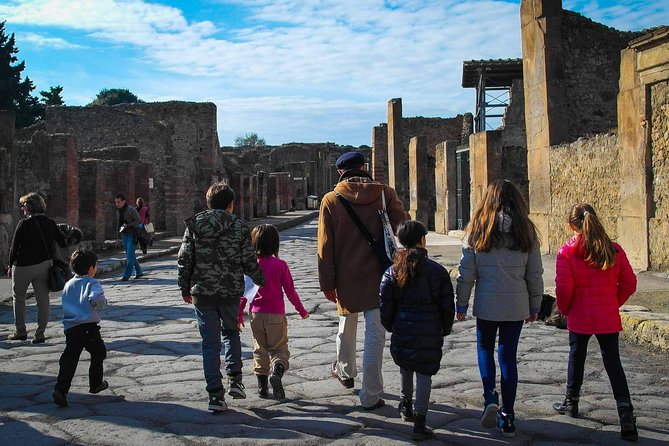
Take a moment here to settle your shoes and water bottle. The route uses uneven ancient paving, and the site offers little shade in several areas. The official advice calls for moderate physical fitness and good walking shoes. That is sensible guidance, not a formality.
The Forum and Temple of Apollo
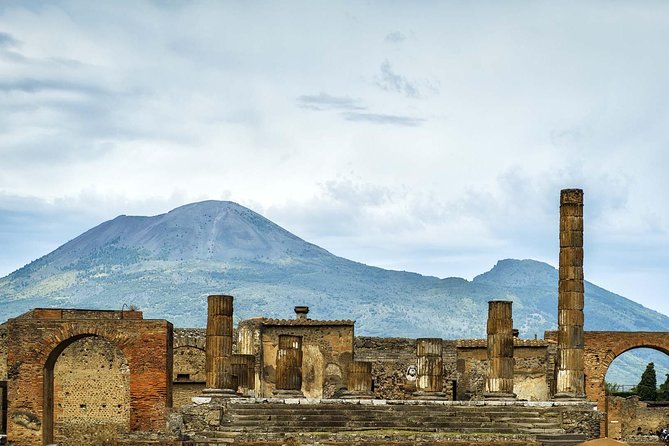
The Forum was Pompeii’s main public square. It served political, religious, and commercial purposes, and its broad rectangular space was reserved for pedestrians rather than chariots. Your guide can explain how the buildings around it worked together and how public decisions, worship, and trade met in one place.
The Temple of Apollo is among the oldest religious sites in Pompeii, with origins reaching back to the sixth century BC. Its raised podium, broad stairs, and 48-column portico show the blend of Greek and Italic influences that shaped the city.
You will see bronze replicas of Apollo and Diana. The original Hellenistic sculptures are held in Naples, so do not expect every famous object to remain at the ruin itself. Still, the temple gives you a clear picture of Pompeii’s long religious life before the eruption.
Nearby, the Basilica was the city’s most imposing public building. Dating from the second century BC, it once handled legal and business matters. Its scale helps explain that Pompeii was not a sleepy village. It was an organized urban center with serious civic machinery.
Via dell’Abbondanza and everyday Roman life
Via dell’Abbondanza was Pompeii’s main commercial and social street. Walking here is one of the most useful parts of the tour because the city begins to feel practical rather than ceremonial.
Look for the blocks set across the street. They served as stepping-stones when rainwater, sewage, or other street mess made crossing unpleasant. The spaces between the stones were arranged so cart wheels could pass. A small detail like this says plenty about Roman engineering and daily inconvenience.
Your guide may also point out shops, bakeries, painted signs, fountains, and food counters. One of the most memorable stops is the ancient equivalent of a quick-service restaurant, with large storage jars still set into the counter. It is easy to picture a worker or resident stopping for a meal instead of cooking at home.
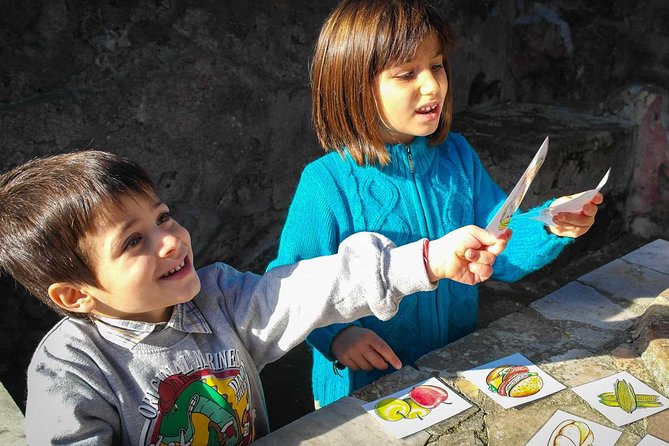
This section is particularly good for children because it answers concrete questions. Where did people buy food? How did they cross the street? What did a shop look like? The family version uses those details in games and clues rather than relying on a long lecture.
More Private History Tours in Italy
- Ancient Ostia Antica Semi-Private Day Trip from Rome by Train with Guide
★ 4.5 · 579 reviews - Colosseum & Ancient Rome Semi-Private Tour
★ 5.0 · 208 reviews - Skip-the-Line Half-Day Private Tour Ancient Pompeii Highlights with Native Guide
★ 5.0 · 146 reviews - Private Rome Food Tour in the Historic Centre with 8+Tastings
★ 5.0 · 135 reviews
The Forum Baths and Roman bathing
The Forum Baths, built around 80 BC, were the only public bath complex still operating when Vesuvius erupted in AD 79. You walk through the sequence of rooms used by bathers: changing room, cold bath, warm room, and hot room.
The rooms retain high barrel-vaulted ceilings, stucco reliefs, and terracotta figures called telamones. This is a compact stop, but it gives you a strong sense of how bathing served as both hygiene and social routine in Roman life.
I find bathhouses especially helpful because they make ancient life physical. You can see where people changed, warmed up, cooled down, and spent time with others. The guide can also explain the heating system and the design of the rooms, turning architectural fragments into a working public facility.
The floors can be uneven and the rooms can feel confined. Keep children close, and do not rush your footing while trying to keep up with the group.
Casa dei Vettii and Pompeian luxury
The House of the Vettii is one of the strongest reasons to choose a route that includes private homes. It reopened in 2023 after a 20-year restoration and is often treated as Pompeii’s finest decorated residence.
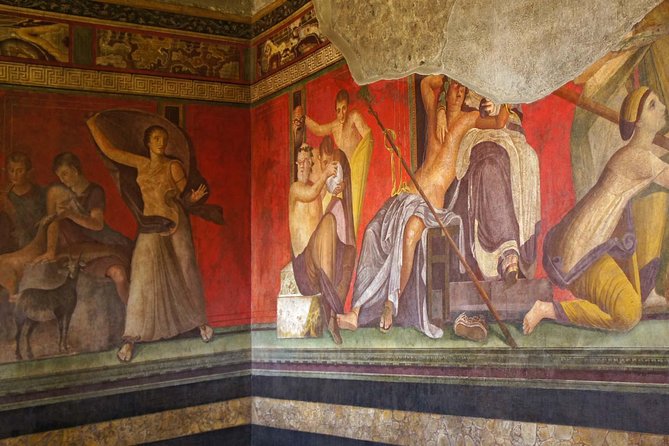
The house belonged to Aulus Vettius Conviva and Aulus Vettius Restitutus, two former slaves who became wealthy wine merchants. Their home was designed to display their success. That makes it useful for more than its paintings. It also opens a discussion about social movement, money, freed status, and the way wealth was advertised in Roman society.
Give yourself time to look at the wall paintings and floor mosaics. Details can be easy to miss if you move through quickly, so this is a place to tell your guide if you want more explanation or photographs.
For families, the house can become part of the map-and-sticker activity. Children can connect a building with the people who might have lived or worked there. That simple task helps them remember the site after the tour ends.
Teatro Grande and the shape of entertainment
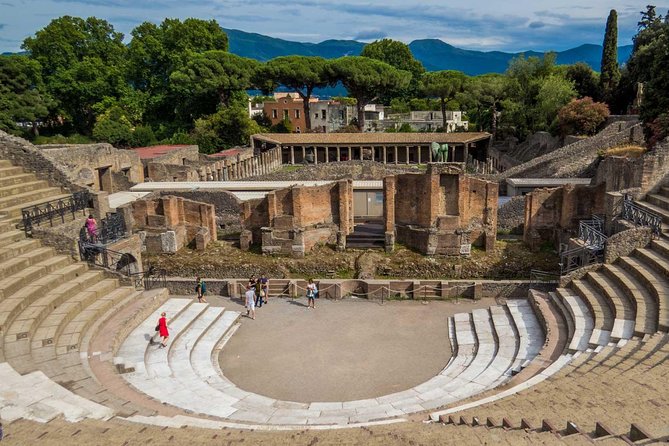
The Large Theater was first built in the second century BC and was carved into a natural lava slope. It shows the change from Greek-style theater design to Roman use.
This is a short stop, but the setting makes it memorable. You can see how the slope helped create seating and how public entertainment fitted into city life. Your guide may also connect the theater with the different social groups who attended performances.
The theater is a good place to pause and let children imagine the noise and movement of a performance day. It also breaks up the heavier material about politics, religion, and death.
The Antiquarium and the plaster casts
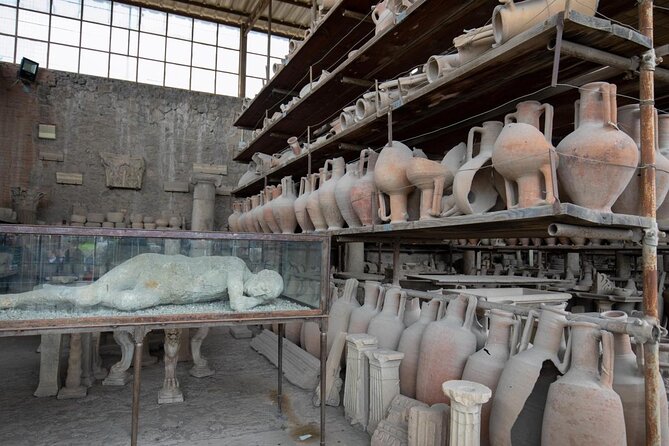
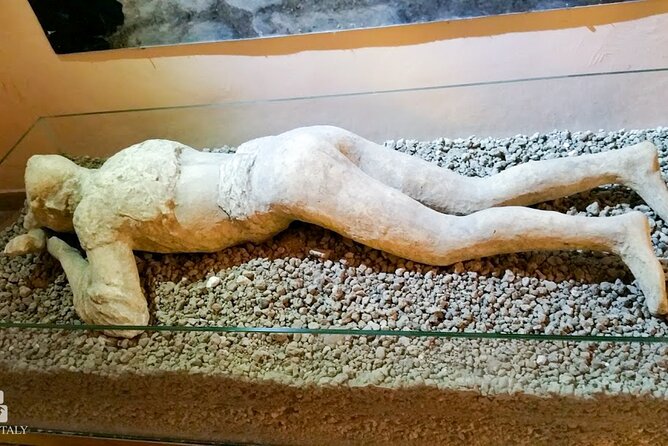
The Antiquarium is a modern, climate-controlled museum within the Pompeii site. It holds fragile objects and several plaster casts of people who died during the eruption, including children.
The casts are among Pompeii’s most difficult sights. They are not simply archaeological curiosities. They show the final positions of people caught by the eruption, making the disaster personal in a way that walls and columns cannot.
This stop deserves a quiet explanation. Younger children may need preparation, especially if they are sensitive to images of death. The family guide can adapt the discussion, but you should still decide in advance how much detail is right for your children.
The eruption date is traditionally given as August 24, AD 79, although the important point for your visit is the sudden destruction and preservation of the city nearly 2,000 years ago. Ash and volcanic material covered homes, streets, public buildings, and personal objects, leaving an unusually detailed record of Roman life.
How the family option works
The family version is aimed particularly at children from 6 to 11, though families with younger children have also found ways to enjoy it. You still visit the main sights, but the guide changes the delivery.
Children receive a Pompeii4Kids kit with a map, stickers, activities, and an activity book. The stickers represent people such as gladiators, actors, slaves, and politicians. After seeing a building, your child may place the related character on the map.
The guide can also use short quizzes and games. This is not a separate children’s attraction added beside the real Pompeii. It uses the actual streets, homes, baths, and public buildings to teach children how the city functioned.
Guides including Francesca, Sabrina, Viviana, Natalia, Anna, and Fabrizio have been especially praised for involving children without leaving adults behind. One family with children aged 7 and 9 found the activities held attention even in sweltering heat. Another family with children aged 8, 6, and 4 found that stories about ordinary life made the ruins feel real.
The family option is probably worth the added cost if your children lose interest during standard museum-style tours. If your children already enjoy ancient history and can listen for long stretches, the regular private tour may be enough.
Price, timing, and practical value
The listed price is $165.05 per person. That is a significant outlay, especially for a family, but private guiding can make sense at Pompeii because the site is large and the history is hard to read without context.
You are paying for a private English-speaking guide, a tailored route, and a focused visit. The value is strongest for families, first-time visitors, and anyone with only a short window in Pompeii. It is less compelling if you are happy to wander alone for several hours with your own guidebook.
Admission information requires care. The package details say admission fees are included, while the itinerary notes that admission is not included and that certified guides can buy tickets quickly at the entrance. Confirm this point before booking so the final cost does not surprise you.
The tour is usually booked well in advance, with an average lead time of about 48 days. That suggests you should not leave it until the last minute if you need a particular date, guide, or family option.
Start early if you can. One family booked at 11 a.m. and found the heat increasingly difficult by the end. A morning departure also gives you a better chance of walking the main streets before the hottest part of the day.
Bring water, sun protection, and shoes with firm soles. Pick-up and drop-off are not included, so you must reach the meeting point at Via Villa dei Misteri, 2, and return there after the tour. Public transportation is nearby.
Is this Pompeii tour worth booking?
I would choose this tour if you want Pompeii explained rather than simply photographed. The private format, strong family materials, and broad route make it a good fit for parents, couples, and small groups who want a clear introduction without committing to a full-day visit.
Choose the family option if your children are roughly 6 to 11, or if they need games and tasks to stay engaged. Request an early start, wear good shoes, and confirm the admission-fee wording before payment.
I would skip it if you want a slow, all-day exploration or prefer to set your own route. For a focused first look at Pompeii, though, this is a practical choice, especially with a guide such as Francesca, Natalia, Viviana, Anna, or Fabrizio who can adjust the pace and bring the city’s ordinary life into view.
FAQ
Where does the tour begin and end?
The tour begins at Via Villa dei Misteri, 2, 80045 Pompei, Italy. It ends back at the same meeting point.
How long does the tour last?
The stated duration is approximately two hours. Some private groups have spent longer with their guide, so confirm the expected timing when booking if you want extra time.
Is the tour private?
Yes. Only your group participates in the activity.
Is the tour offered in English?
Yes. The tour is offered in English.
Are admission fees included?
The provided tour details are inconsistent. One section lists admission as included, while another says admission fees are not included and explains that guides can purchase tickets quickly at the entrance. Confirm the current arrangement before booking.
What does the family option include?
The family option includes a Pompeii4Kids kit with a map, stickers, activities, and an activity book. The guide also uses games and clues and adjusts the route for younger visitors.
What sights are included?
The route includes the Forum, Via dell’Abbondanza, Forum Baths, Temple of Apollo, Basilica, House of the Vettii, Large Theater, and Antiquarium. It also covers city walls, Porta Marina, shops, streets, homes, mosaics, wall paintings, and plaster casts.
Can I cancel for a full refund?
You can cancel up to 24 hours before the experience start time for a full refund. Changes or cancellations made less than 24 hours before the start time are not accepted for a refund.
More Skip-the-Line Tickets in Italy
- Taormina: Ancient Theater Skip-the-Line Ticket & Audio Guide
★ 4.5 · 2,412 reviews - Historic Milan Tour with Skip-the-Line Last Supper Ticket
★ 4.5 · 1,976 reviews - Córdoba: Skip-the-Line Great Mosque-Cathedral History Tour
★ 4.7 · 1,690 reviews - Skip-the-Line Schonbrunn Palace Guided Tour and Vienna Historical City Tour
★ 3.5 · 940 reviews
More Pompeii and Vesuvius History Tours in Italy
- Discover the Ancient Ruins of Pompeii: Day Trip from Rome
★ 3.5 · 2,247 reviews - Small-Group Rome to Pompeii & Amalfi: Day of History & Sea
★ 5.0 · 239 reviews - Discover Herculaneum: A guided tour of the ancient Roman city
★ 4.9 · 34 reviews
Latest history tours reviewed in Italy
- Forte di Bard: history tour★ 4.5 · 31 reviews
- Florence Wine &Food: Taste Tuscan Flavors in Historic Cellar★ 4.6 · 31 reviews
- Florence Medici Bike Tour – Cycle Through History and Power★ 4.2 · 23 reviews
- Florence: Medici Family History Tour★ 4.3 · 93 reviews
- Florence: Fashion History Guided Walking Tour & Museum Visit★ 4.2 · 72 reviews
- Essential Florence Walking Tour to discover its history★ 5.0 · 21 reviews
- Discover Herculaneum: A guided tour of the ancient Roman city★ 4.9 · 34 reviews
- Day drinking in Rome – Scandalous Roman History★ 4.8 · 31 reviews
Italy History Tours, compared.
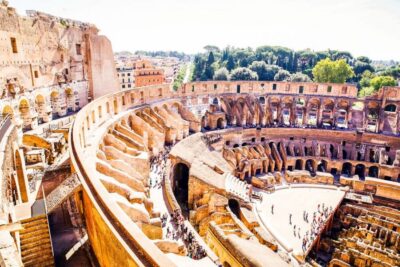
Colosseum: Underground and Ancient Rome Tour
Read our review →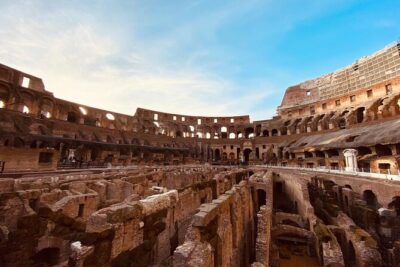
Rome: Colosseum with Arena, Roman Forum and Palatine Guided Tour
Read our review →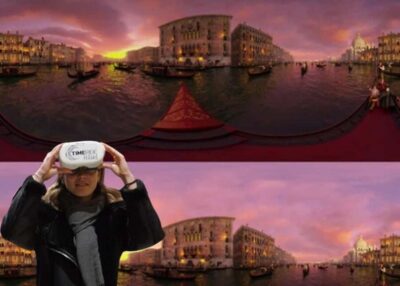
Venice: St. Mark’s Basilica Guided Tour & VR History Intro
Read our review →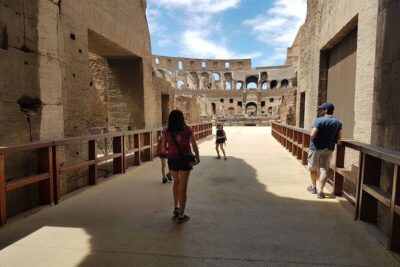
Colosseum & Ancient Rome with Arena Floor Option I Max 6 People
Read our review →
Rome: Colosseum, Ancient Rome Tour or AudioGuided Tour
Read our review →
Venice’s Best: Basilica, Doge’s Palace, Gondola & History Gallery
Read our review →
Taormina: Ancient Theater Skip-the-Line Ticket & Audio Guide
Read our review →