Review · ITALY
Skip-the-Line Half-Day Private Tour Ancient Pompeii Highlights with Native Guide
Pompeii is easier to understand when someone points out the small clues: raised sidewalks, old bakeries, painted walls, bathing rooms, and the layout of a Roman home. This private tour puts an art historian guide beside you and uses skip-the-line entry, so your limited time goes to the ruins rather than the entrance queue.
I like the private format, especially for families and first-time visitors who want to stop for questions or move quickly through crowded areas. I also like the focused route through the Forum, Via dell’Abbondanza, Stabian Baths, theatres, and Lupanare. The main drawback is time: two hours gives you a strong introduction, but Pompeii is enormous, and you will not see everything.
Key points to know before booking
- A private two-hour route: Only your group joins the tour, with room for questions and a pace that can suit your interests.
- Skip-the-line entry included: You avoid the long entrance wait and start exploring sooner.
- The Forum and Via dell’Abbondanza: These give you the clearest sense of Pompeii as a working Roman city.
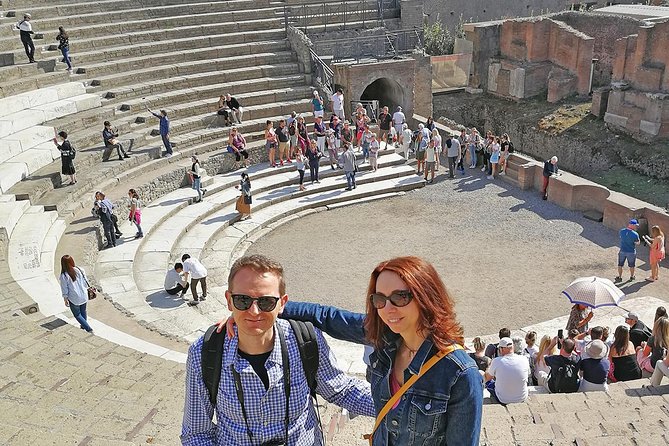
- Stabian Baths and the theatres: You see both public leisure and formal entertainment, including the acoustic design of the Teatro Piccolo.
- The Lupanare: Its famous erotic frescoes are one of Pompeii’s most talked-about stops, though the space may not suit every child.
- Strong guide-led storytelling: Guides named in tour feedback include Lello, Italo, Fabio, Rosanna, and a guide identified as Etaly, with Lello receiving especially warm praise for his humor and detail.
Why a private guide matters in Pompeii
Pompeii can feel confusing at first. You walk along broad stone streets, pass half-open doorways, and see walls that seem quiet until someone explains what they once held. A private guide gives those fragments a purpose.
The guide is described as both a professional guide and an art historian. That matters here because Pompeii is not simply a field of old stones. It is a city of homes, shops, public buildings, religious spaces, baths, theatres, and streets designed for everyday traffic.
A good guide can help you read the city in layers. You might learn how public baths worked, why a Roman house was arranged around inner spaces, how the Forum functioned, and what small details reveal ordinary life. The strongest guide experiences in the supplied feedback are praised for making Pompeii feel inhabited rather than frozen in time.
Lello receives especially high praise for being warm, funny, and full of unusual details. One family compared Fabio to a friendly university professor, while Italo is described as energetic and engaging. Rosanna reportedly kept teenagers involved with questions and moved her group through crowded areas with ease.
Those names are useful when comparing this tour, but you should not assume you will receive a particular guide unless the operator confirms it. The important point is the private, guide-led structure. A private tour gives the person leading it a chance to notice what interests your group.
More Ancient History Tours in Italy
- Colosseum: Underground and Ancient Rome Tour
★ 4.7 · 12,691 reviews - Colosseum & Ancient Rome with Arena Floor Option I Max 6 People
★ 5.0 · 3,306 reviews - Rome: Colosseum, Ancient Rome Tour or AudioGuided Tour
★ 4.4 · 2,879 reviews
Meeting at Hotel Vittoria and entering the ruins
The tour begins at Hotel Vittoria, at Piazza Esedra in Pompei. It ends back at the same meeting point, and hotel pickup and drop-off are not included.
That makes the meeting point an important part of your planning. You need to reach Hotel Vittoria yourself, and the area is near public transportation. Confirmation arrives at booking, so check the meeting instructions and allow enough time to arrive before the start.
The skip-the-line benefit is simple but valuable. Pompeii attracts large numbers of visitors, and a long wait at the entrance can eat up a large part of a short visit. Here, admission is included and the guide handles the entry process with your group.
Do not read skip-the-line as skip-the-security or skip-everything. You still need to arrive at the correct meeting point and follow the park’s entry rules. The value is that you are not paying for a private tour only to spend much of the allotted time in a public queue.
Via dell’Abbondanza: reading a Roman street
Via dell’Abbondanza is one of the best places to understand Pompeii as a lived-in city. The route takes you along one of the main streets, where the guide explains how Roman life worked at street level.
This is where the tour’s storytelling can make a major difference. On your own, you may notice paving stones and walls. With a guide, those features become part of a picture of movement, trade, homes, and public life.
The route is not only about famous monuments. It is about how people moved through the city and how the street connected important parts of Pompeii. You get a practical sense of scale, which helps the later visit to the Forum and public buildings make more sense.
The stop is listed as about 20 minutes, so expect a brisk introduction rather than a slow archaeological study. If you want every inscription, shopfront, and house explained, two hours will feel tight. If you need a clear orientation early in your visit, Via dell’Abbondanza is an efficient place to begin.
Stabian Baths: Roman public life in detail
The Stabian Baths are one of the tour’s most useful stops because they show an activity that was central to Roman public life. The guide explains the thermal baths and how people used these spaces.
You will see more than a pretty ruin. The baths help you think about daily schedules, social contact, and the importance of public buildings in Roman cities. They also offer a change of pace from walking along streets and looking into houses.
The supplied tour information gives this stop about 20 minutes. That is enough for a guided explanation of the main spaces, but not enough for every technical detail. If baths are a special interest, tell your guide early. In a private group, you have a better chance of receiving extra attention here than you would in a large coach group.
This stop also reminds you to wear practical shoes and bring water, especially in summer. Pompeii requires steady walking, and the open areas can be hot. A previous visitor specifically advised carrying water bottles during warm weather, a sensible tip for any visit to the site.
More Private History Tours in Italy
- Ancient Ostia Antica Semi-Private Day Trip from Rome by Train with Guide
★ 4.5 · 579 reviews - Colosseum & Ancient Rome Semi-Private Tour
★ 5.0 · 208 reviews - Ancient Pompeii Private Tour: Skip the Line & Kid-Friendly Option
★ 5.0 · 167 reviews - Private Rome Food Tour in the Historic Centre with 8+Tastings
★ 5.0 · 135 reviews
The Forum: Pompeii’s main square
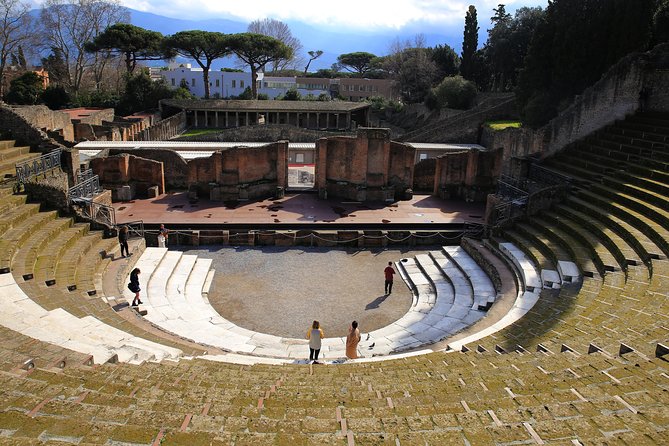
The Forum is the essential stop on this short visit. It was Pompeii’s main square, and the route presents it as the center of markets and public life.
I would pay close attention here, even if the ruins initially look spread out and incomplete. The Forum helps you connect the separate parts of Pompeii. Streets lead toward it, public buildings frame it, and the remains show how people gathered, traded, conducted civic business, and moved through the city.
The tour gives the Forum about 20 minutes. That can feel short because there is so much to see. Still, a guide can use the time well by explaining the excavated area and pointing out details you would likely pass without understanding.
One particularly useful aspect is the view from below in the excavated sections. A previous visitor found the underground portion especially effective for appreciating the full scale of the space. Availability and access can depend on the current park route, so treat that as a possible feature rather than a guarantee.
The Lupanare and Pompeii’s frank side
The Lupanare is famous for its erotic frescoes, and it is one of the most memorable stops on the route. The guide explains the building and its place within Pompeii, rather than leaving you to guess at the meaning of the paintings.
This is a brief but distinctive part of the tour. It shows how Pompeii’s preserved material can be direct, earthy, and sometimes startling. The frescoes are not presented as a polished museum display. They are part of an ancient urban setting, surrounded by streets, homes, shops, and public buildings.
Parents should decide in advance if the subject is suitable for their children. Children must be accompanied by an adult on this tour, but the information does not state a specific age restriction or family policy for the Lupanare itself.
Because the Lupanare is popular, the private guide may help you understand the site even if the area is busy. Still, do not expect a quiet, private viewing of every room. The tour can reduce confusion, but it cannot control the crowd inside the archaeological park.
Theatres, Gladiators’ Gym, mills, and houses
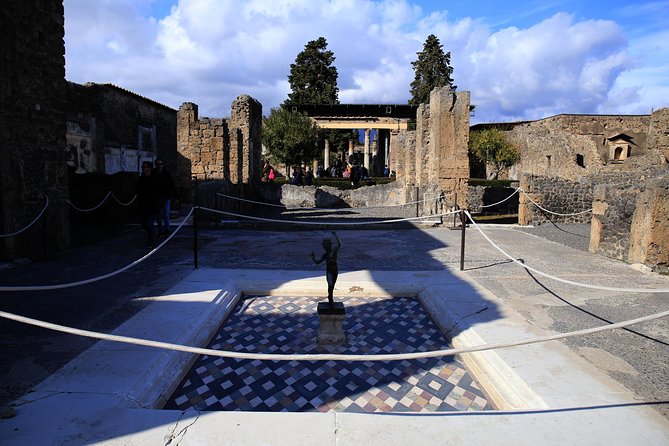
The route description also includes the Teatro Grande, Teatro Piccolo, Gladiators’ Gym, mills, and domus. These places add range to the visit.
At the Teatro Grande, you see one of Pompeii’s major entertainment spaces. At the Teatro Piccolo, the guide points out the excellent acoustics of the auditorium. That is a small but effective example of how a guide can turn a pile of ancient masonry into something you can imagine being used.
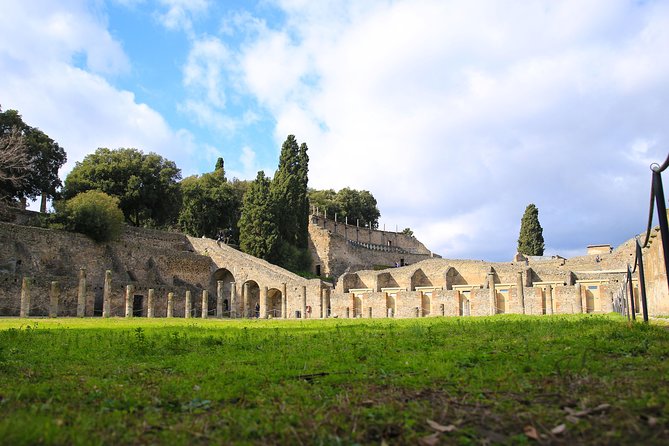
The Gladiators’ Gym brings another side of public life into view, while the mills and houses show work and domestic routines. These stops help balance the famous Forum and Lupanare with less glamorous parts of the city.
Not every stop receives an equal amount of time. The advertised route is packed, with each listed stop described in roughly 20-minute segments, while the overall experience lasts about two hours. Think of these places as highlights and orientation points, not a complete archaeological survey.
If you have a strong interest in theatre, architecture, domestic life, or gladiators, tell the guide at the beginning. The private format is most useful when you make your priorities clear.
What two hours can and cannot do
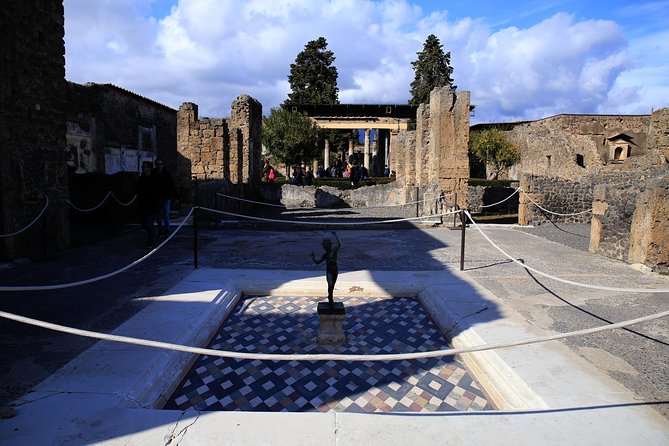
The stated duration is approximately two hours. That is long enough to build a useful mental map of Pompeii and see several major sites. It is not long enough to cover the whole archaeological park at a slow pace.
This is the central tradeoff. A short private tour is ideal if you have limited time, are visiting Pompeii as part of a larger trip, or want a clear introduction before exploring on your own. It is less suitable if you want to study many houses, inscriptions, and side streets.
One visitor had only two hours and felt the guide made good use of the restricted schedule. Another private group said the time passed quickly because the guide kept the visit engaging. That speed can be a benefit, but it also means you should expect regular walking and a fairly active route.
The tour requires a moderate level of physical fitness. Bring water, use sun protection, and wear shoes that can handle uneven archaeological paths. The information does not promise seating, shade, or a slower route, so plan for a mostly active visit.
Is the $83.48 price good value?
At $83.48 per person, the tour costs more than entering Pompeii alone, but you are paying for several practical advantages: a private guide, art historical interpretation, admission, and skip-the-line access.
The value is strongest for a small group that wants personal attention. If two or four people share the private experience, the cost buys a more direct conversation than a large group tour. You can ask questions, adjust the pace, and focus on the parts of Pompeii that matter most to you.
The price is less convincing if you have an entire day and enjoy researching sites independently. You may prefer to enter on your own and spend hours wandering. You should also consider that hotel transportation is not included, so you need to arrange your own way to Piazza Esedra.
The high overall rating and 97 percent recommendation suggest the format works very well for most bookings, but the experience depends heavily on the guide. Most of the supplied feedback praises the guides for energy, humor, historical context, and personal attention. One less favorable account found the tour rushed and the guide too focused on moving through the main areas. That criticism is worth taking seriously because the two-hour format naturally creates pressure.
Which visitors will get the most from it?
I would choose this tour if you have only a short window in Pompeii and want someone to make sense of the site quickly. It is also a good fit if you are visiting with children or teenagers who may lose interest without stories, questions, and a clear route.
Families may particularly like the private setting. A guide can explain things in plain language, answer questions without holding up a large group, and adjust the focus when younger visitors respond to theatres, gladiators, or the more unusual details of Roman life.
It also suits adults who have visited Pompeii before but felt lost on a previous large group outing. A private guide can provide a clearer route and more context than a rushed coach stop.
I would be cautious about booking it if you want a long, quiet archaeological study. Two hours is a sampler. Pompeii is too large for a complete visit in that time, and the route moves briskly between major highlights.
Booking, cancellation, and practical details
Confirmation is provided at the time of booking. The tour is offered in English, and only your group participates.
Free cancellation is available if you cancel at least 24 hours before the local start time. Changes or cancellations made inside that 24-hour window are not accepted for a refund. The experience requires good weather, and if poor weather causes cancellation, you are offered another date or a full refund.
Children must be accompanied by an adult. The tour is near public transportation, but hotel pickup and drop-off are not included. Plan your route to Hotel Vittoria, Piazza Esedra, before the day of the tour.
Should you book this Pompeii tour?
Book it if you want a fast, personal introduction to Pompeii and value a guide who can explain what you are seeing. The private format, skip-the-line entry, and strong guide feedback make it a sensible choice for a short visit.
I would book it especially for a family, a couple, or a small group with limited time. Ask at the start to prioritize the Forum, Stabian Baths, theatres, or houses if one area matters most to you.
Skip it if you want to spend half a day or longer wandering at your own pace. For everyone else, the $83.48 price is reasonable when you treat the tour as an efficient orientation to a huge site, not as the final word on Pompeii.
FAQ
Where does the Pompeii tour begin?
It begins at Hotel Vittoria, Piazza Esedra, 80045 Pompei, Italy.
Where does the tour end?
The activity ends back at the meeting point at Hotel Vittoria.
How long does the private Pompeii tour last?
The tour lasts approximately two hours.
Is skip-the-line entry included?
Yes. Guaranteed skip-the-line entry and admission are included.
Is this a private tour?
Yes. Only your group participates in the activity.
Is the tour offered in English?
Yes. The tour is offered in English.
Is hotel pickup included?
No. Hotel pickup and drop-off are not included.
Which Pompeii sites are included?
The route includes Via dell’Abbondanza, the Stabian Baths, the Forum, the Lupanare, the Pompeii Archaeological Park, and sites such as the Teatro Grande, Teatro Piccolo, Gladiators’ Gym, mills, and domus.
What happens if bad weather cancels the tour?
If the experience is canceled because of poor weather, you are offered a different date or a full refund.
More Skip-the-Line Tickets in Italy
- Taormina: Ancient Theater Skip-the-Line Ticket & Audio Guide
★ 4.5 · 2,412 reviews - Historic Milan Tour with Skip-the-Line Last Supper Ticket
★ 4.5 · 1,976 reviews - Córdoba: Skip-the-Line Great Mosque-Cathedral History Tour
★ 4.7 · 1,690 reviews - Skip-the-Line Schonbrunn Palace Guided Tour and Vienna Historical City Tour
★ 3.5 · 940 reviews
More Pompeii and Vesuvius History Tours in Italy
- Discover the Ancient Ruins of Pompeii: Day Trip from Rome
★ 3.5 · 2,247 reviews - Small-Group Rome to Pompeii & Amalfi: Day of History & Sea
★ 5.0 · 239 reviews - Discover Herculaneum: A guided tour of the ancient Roman city
★ 4.9 · 34 reviews
Latest history tours reviewed in Italy
- Forte di Bard: history tour★ 4.5 · 31 reviews
- Florence Wine &Food: Taste Tuscan Flavors in Historic Cellar★ 4.6 · 31 reviews
- Florence: Medici Family History Tour★ 4.3 · 93 reviews
- Florence Medici Bike Tour – Cycle Through History and Power★ 4.2 · 23 reviews
- Florence: Fashion History Guided Walking Tour & Museum Visit★ 4.2 · 72 reviews
- Essential Florence Walking Tour to discover its history★ 5.0 · 21 reviews
- Discover Herculaneum: A guided tour of the ancient Roman city★ 4.9 · 34 reviews
- Day drinking in Rome – Scandalous Roman History★ 4.8 · 31 reviews
Italy History Tours, compared.
Colosseum: Underground and Ancient Rome Tour
Read our review →
Rome: Colosseum with Arena, Roman Forum and Palatine Guided Tour
Read our review →
Venice: St. Mark’s Basilica Guided Tour & VR History Intro
Read our review →
Colosseum & Ancient Rome with Arena Floor Option I Max 6 People
Read our review →
Rome: Colosseum, Ancient Rome Tour or AudioGuided Tour
Read our review →
Venice’s Best: Basilica, Doge’s Palace, Gondola & History Gallery
Read our review →
Taormina: Ancient Theater Skip-the-Line Ticket & Audio Guide
Read our review →