

Review · NEW YORK CITY
Hamilton and Washington Revolutionary Walking Tour
New York’s financial district can look like a canyon of glass and steel, but under your feet are the places where the new American government took shape. This three-hour walking tour connects Hamilton and Washington to Bowling Green, Wall Street, Federal Hall, and Trinity Church, turning familiar streets into a working map of the Revolution and early republic.
I like two things here. First, the route stays in a compact part of Lower Manhattan, so you get a lot of history without spending the day crossing town. Second, the small group, limited to 16 people, gives a guide such as Bruce room to answer questions and adjust the pace. The main consideration is simple: you will stand and walk outdoors for most of three hours, and admission to some buildings is not included.
Key points to know before you book
- Hamilton’s New York is the focus: Follow his rise from Revolutionary officer to Treasury secretary and financial planner.
- Washington’s public and private life comes forward: Fraunces Tavern is tied to his farewell to his officers, while Federal Hall marks his inauguration.
- The musical is a starting point, not the whole tour: You see places connected with Hamilton, but the subject is broader American history.
- The group stays small: No more than 16 people makes it easier to hear the guide and ask questions.
- The route is compact but not effortless: Expect regular walking and standing, with little indoor shelter.
- The strongest part is the storytelling: Bruce is repeatedly named as a funny, clear, and passionate guide, while George is also identified as a guide on one outing.
Why Lower Manhattan makes a fine history classroom

This tour works because the setting does much of the teaching. Lower Manhattan is not an open-air Revolutionary village. Modern office towers, traffic, fences, and busy sidewalks surround the sites. That contrast is useful. You have to listen, picture the earlier city, and understand how a few blocks once carried an outsized share of the nation’s political and financial life.
The walk follows the southern end of Manhattan and finishes at Trinity Church. It covers the lives of Alexander Hamilton and George Washington, but it also brings in Aaron Burr, Eliza Hamilton, Hercules Mulligan, early Congress, banking, the Revolution, and the beginnings of the federal government.
I would not book this only because you like the musical. The musical provides an easy doorway into the subject, but the tour is built around people and events rather than songs or performances. You get the real places, the political arguments, and the financial choices behind the drama.
The guide matters a great deal here. Bruce is named often in the supplied feedback, with praise for his clear explanations, humor, patience, and ability to work with children and adults in the same group. One account names George instead and describes him as skilled with a multigenerational group. The provider presents its guides as licensed New York City guides and historians, and the tour leader is said to have more than 20 years of experience.
More History Walking Tours in New York City
- #1 Rated NYC Chinatown Food and History Walking Tour with FNYT
★ 5.0 · 171 reviews - Tribeca Architecture And History Walking Tour
★ 5.0 · 141 reviews - Lower Manhattan Secrets And History Walking Tour
★ 5.0 · 96 reviews
Starting at the Alexander Hamilton U.S. Custom House
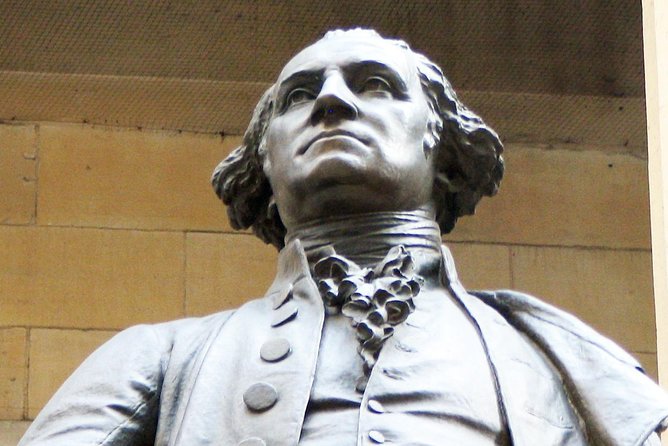
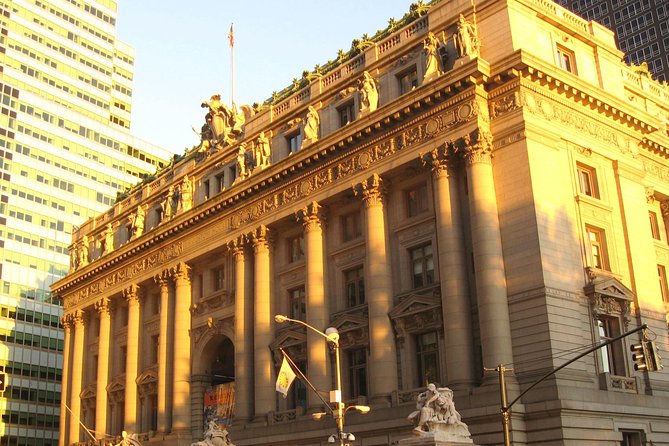
The meeting point is at 1 Bowling Green, beside the Alexander Hamilton U.S. Custom House. The first stop gives you the basic question for the day: how did a young man connected to the Revolution become the first Secretary of the Treasury?
The building itself is later than Hamilton’s lifetime, so this is not a preserved Revolutionary interior. Its value is its connection to Hamilton’s work and reputation. The guide explains why the Treasury role mattered and how Hamilton’s financial thinking helped shape the new United States.
Allow about 20 minutes here. Admission is not included, so you should not assume that an indoor visit forms a major part of the experience. The stop is mainly about the building, its name, and the political and financial story attached to Hamilton.
This is a good opening because it moves Hamilton beyond the musical character. You begin to see him as an ambitious public official dealing with debt, national finances, and the difficult task of making a young country function.
Bowling Green and the fall of King George III
The tour then turns to Bowling Green, the official starting point listed for the walk. This small park is tied to the angry years before the Revolution and to the destruction of a roughly 4,000-pound lead statue of King George III.
The story helps explain how political protest became open rebellion. You hear about the events that led toward war and the way public symbols could carry real force. The statue did not survive, but its destruction remains one of the clearest stories associated with Revolutionary New York.
Plan on about 20 minutes here. Admission is free, but this is another outdoor stop, with no promise of seating or shelter. In hot weather, the guide may seek shade and a breeze when possible. In cold weather, the southern tip of Manhattan can feel especially exposed, so dress for the forecast.
This stop also gives the guide a chance to separate popular images from the actual local setting. You are not simply hearing that New York supported the Revolution. You are standing where a public act of defiance took place.
Peter Minuit Plaza and Hamilton’s origins
At Peter Minuit Plaza, the focus shifts to New York at the opening of the Revolutionary War and to Hamilton’s origins. This is an important change in scale. The first stop dealt with Hamilton as a national official. Here, the story returns to the young man and the conditions that shaped his early life.
The stop lasts about 20 minutes and is free. Since many early structures are no longer intact, the guide must use explanation and imagination. That is not a flaw, but it does mean this is a listening stop rather than a chance to inspect a perfectly preserved room or street.
I like this part because it gives the tour a human center. Hamilton did not begin as a famous founder. His path into the Revolutionary cause and later government came through a very different early life, and the guide connects those origins to New York’s wartime setting.
More History Walking Tours in the USA
- History and Hauntings of Salem Guided Walking Tour
★ 5.0 · 14,564 reviews - Boston: Freedom Trail History Small Group Walking Tour
★ 5.0 · 6,450 reviews - Historic Charleston Guided Sightseeing Walking Tour
★ 5.0 · 6,216 reviews - Savannah History and Haunts Candlelit Ghost Walking Tour
★ 5.0 · 3,235 reviews
Fraunces Tavern and Washington’s farewell
Fraunces Tavern is one of the tour’s strongest physical links to the early republic. This is the tavern associated with Washington’s farewell to his officers, an emotional moment after the war and a rare example of a victorious military leader giving up power.
The stop lasts about 15 minutes. Admission is not included, so the tour does not promise a full museum visit. You may see the exterior and hear the story from the street, while entry depends on the plan for that tour and the building’s operating conditions.
The important point is not only the farewell itself. The guide uses it to explain why Washington’s departure mattered. Military commanders did not always surrender authority willingly, and the new United States needed to show that the army would not become the government.
This is where Washington’s character comes into sharper focus. You are not just following a general through battle sites. You are considering the decision to return power to civilian government, a choice that helped define the young republic.
The New York Stock Exchange and Hamilton’s financial plan
The New York Stock Exchange stop lasts about 15 minutes and focuses on Hamilton’s financial plan and his connection to the institution. Again, the modern building is not a surviving Revolutionary-era exchange. The value comes from the financial thread running through the tour.
Hamilton understood that the United States needed credit, stable finances, and a way to manage its wartime debts. The guide links those ideas to the financial world represented by the exchange and surrounding district.
This section suits you if you enjoy the practical side of history. Battles and speeches are easier to picture, but budgets, debt, and banking often determine what a government can actually do. The stop shows why Hamilton remains relevant in New York’s financial district.
Because the group pauses on a working city street, you should expect urban noise and limited time in one place. The guide’s explanation is the main attraction, not an elaborate display.
Wall Street, the Bank of New York, and Aaron Burr
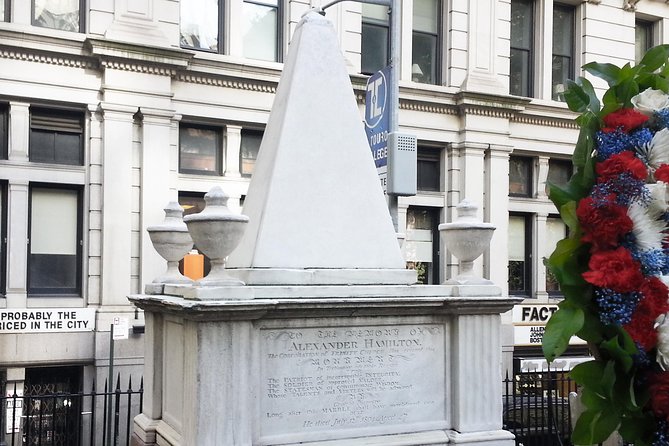
At Wall Street, the tour continues with Hamilton’s Bank of New York and Aaron Burr’s political ambitions. This is where the personal rivalry and public policy stories begin to overlap.
Hamilton and Burr were not simply two characters in a famous feud. Their different aims, methods, and political ambitions affected the early national party system and New York politics. The guide uses the street to connect those tensions to institutions that still shape the city’s identity.
The stop takes about 20 minutes and is free. It is a useful length for a complicated subject. You get enough time for context without turning the walk into a lecture that never moves.
This part will appeal to anyone who likes the political side of Hamilton, but you should expect more than a retelling of the musical’s plot. The guide places Burr and Hamilton in the real setting of banks, elections, and competing visions of government.
Federal Hall and Washington’s inauguration
Federal Hall carries some of the clearest constitutional meaning on the route. The site served as the first Capitol of the United States under the Constitution. It was also the location of the first meeting of Congress and Washington’s inauguration.
The stop lasts about 20 minutes. Admission is not included, and the building is closed on weekends, so the day you choose matters. If your tour runs when it is closed, expect the guide to explain the site from outside rather than lead you through the building.
This is one of the places where a guide adds real value. A quick photograph of Federal Hall cannot tell you what it meant to hold the first Congress there or to watch Washington take office in the new constitutional government. The stop brings together the political and personal threads introduced earlier.
You can also see why the route works geographically. The custom house, Wall Street, Federal Hall, and Trinity Church are close enough to connect on foot, yet each points to a different part of the early national story: finance, government, war, religion, and public memory.
Trinity Church and the Hamilton family graves
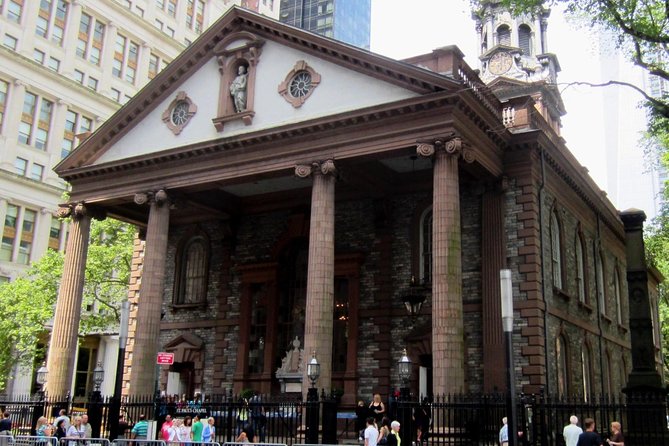
The walk ends at Trinity Church, at 89 Broadway. Its churchyard contains the graves of Alexander and Eliza Hamilton, along with other figures connected to the Revolutionary period, including Hercules Mulligan.
Allow about 20 minutes, with free admission. Entry depends on the church being open, so access is not guaranteed at every time. That condition is worth noting if seeing Hamilton’s grave is your main reason for booking.
The churchyard provides a quiet final stop after the traffic and office towers of the financial district. It also gives the tour a personal ending. Hamilton’s public work has filled the previous stops, but here you encounter his family and his memory in a much more direct way.
This is likely to be the most meaningful stop for fans of the musical, but it works just as well for anyone interested in early American history. The graveyard gives names and dates a human scale.
What three hours and 16 people really mean
The advertised length is about three hours. That is long enough to cover eight stops without rushing through the main subjects, but short enough to fit into a day of sightseeing in Lower Manhattan.
You will walk and stand repeatedly. One account specifically describes a lot of walking and standing, while another says the area is small and the total walking is not extreme. Both points can be true. The route is compact, but you spend time outdoors at each stop, and city sidewalks rarely provide comfortable seating.
The group maximum of 16 is a real advantage. A smaller group helps you hear the guide near traffic, ask about a particular person, and stay together at crossings. It also gives the guide more room to respond to children and adults at different levels of interest.
The tour is offered in English and includes a mobile ticket. It runs near public transportation, service animals are allowed, and most people can take part. Children must be with an adult.
Wear comfortable shoes and check the weather before leaving. The experience goes out in rain, snow, and sunshine, though poor weather can lead to cancellation or a new date. The provider’s policy also says you cannot cancel or make changes within 24 hours of the start time.
Is the $52.95 price fair?
At $52.95 per person, this is not the cheapest way to walk around Lower Manhattan. You are paying for a licensed guide, a small group, and three hours of interpretation rather than simply visiting public streets on your own.
The price makes the most sense if you want the connections explained. You could walk past Bowling Green, Wall Street, Federal Hall, and Trinity Church alone, but you would miss much of the meaning unless you had already done substantial reading.
Admission to the Custom House, Fraunces Tavern Museum, the New York Stock Exchange area, Federal Hall, and the church is not broadly included. That keeps the base price clear, but you should not assume every interior is part of the ticket. The tour’s value lies mainly in the guided route and storytelling.
Gratuity is also not included. If the guide gives you the clear, lively presentation described in the tour information, plan for a tip as an added cost.
Who should book this walk?
I would choose this tour if you want American history tied to real city streets, especially if Hamilton and Washington are your main interests. It also suits families with older children, solo visitors who want context without a large bus group, and anyone staying near Lower Manhattan.
You may want a different plan if you dislike outdoor walking, need frequent seating, or want long indoor visits at each landmark. This is not a museum tour with exhibits at every stop. It relies on the guide’s words, your attention, and your willingness to picture places that have changed.
The strongest reason to book is the guide. Bruce is repeatedly identified by name and praised for humor, clear teaching, personal attention, and a broad command of the subject. George is also named in one account, with a description of strong work with a multigenerational group. Since guide assignments can vary, book for the format and subject, not a guaranteed individual guide.
Should you book the Hamilton and Washington Revolutionary Walking Tour?
Book it if you want the story behind the streets, not just a list of old buildings. The route gives you Hamilton’s financial world, Washington’s farewell and inauguration, Burr’s ambitions, and the graves at Trinity Church in one compact outing.
At $52.95, the walk is worthwhile for people who value a strong guide and a small group. Just plan for outdoor conditions, regular standing, possible building closures, and extra gratuity. If those limits suit you, this is a focused way to see why Lower Manhattan mattered so much to the birth of the United States.
FAQ
How long is the Hamilton and Washington Revolutionary Walking Tour?
The tour lasts approximately three hours.
Where does the tour begin?
It begins at 1 Bowling Green, New York, NY 10004.
Where does the tour finish?
The tour finishes at Trinity Church, 89 Broadway, New York, NY 10006.
Is the tour offered in English?
Yes. The tour is offered in English.
How large is the tour group?
The group is limited to a maximum of 16 people.
Is admission to the historic buildings included?
Admission is not included at the Alexander Hamilton U.S. Custom House, Fraunces Tavern Museum, the New York Stock Exchange, or Federal Hall. Trinity Church and Bowling Green are listed as free, though entry to Trinity Church depends on opening times.
Can I cancel for a full refund?
Yes. You can cancel at least 24 hours before the start time for a full refund. Cancellations or changes made less than 24 hours before the tour are not accepted for a refund.
Latest history tours reviewed in the USA
- Franklin: Ghost Tour in Historic Franklin★ 4.8 · 65 reviews
- Fort Worth: Stockyards History Tour Pub Crawl★ 4.8 · 39 reviews
- Downtown Flagstaff Haunted History Walking Tour★ 4.7 · 46 reviews
- New York City: Flatiron Food, History, and Architecture Tour★ 4.8 · 43 reviews
- Fairbanks: Gold Dredge 8 Historic Train Tour★ 4.7 · 219 reviews
- Fairbanks: Private Mush on the Historic Yukon Quest Trail★ 5.0 · 30 reviews
- Charleston:Evening Haunted History Horse-Drawn Carriage Tour★ 4.7 · 38 reviews
- Philadelphia: Valley Forge National Historical Park Tour★ 4.9 · 39 reviews
New York City History Tours, compared.

New York City: American Museum of Natural History Ticket
Read our review →
American Museum of Natural History Admission Ticket
Read our review →
#1 Rated NYC Chinatown Food and History Walking Tour with FNYT
Read our review →

Lower Manhattan Secrets And History Walking Tour
Read our review →
NYC: Central Park Pedicab Tour and Natural History Access
Read our review →
New York City: Flatiron Food, History, and Architecture Tour
Read our review →
NYC: New York City History of Stand-Up Comedy Tour
Read our review →Browse the lists this tour appears in