Review · INDIA
Agra Fort: Guided UNESCO Heritage Walking Tour
Agra Fort tells its most moving story at Musamman Burj, where Shah Jahan spent his last years under guard, looking across the Yamuna toward the Taj Mahal. I like that this tour connects grand architecture with a very human story, and I like that a private guide can point out small details you would likely miss on your own. The one concern is time: one hour is short for such a large fort.
I also appreciate the practical help at the entrance. Guides such as Gagan and Shahid Khan have helped visitors meet up clearly, take good photos, and handle busy periods near the gate. You will need comfortable shoes, travel light for the bag check, and remember that transportation is not included.
Key points to know before you go
- Enter through Amar Singh Gate: This is the visitor entrance, with security checks and a walk over uneven ground.
- See the royal court rooms: The Diwan-i-Am and Diwan-i-Khas show how Mughal rulers handled public business and private audiences.
- Pause at Musamman Burj: This is the fort’s most poignant viewpoint, linked to Shah Jahan’s confinement and his view of the Taj Mahal.
- Look for mixed design styles: Mughal arches, Rajput jharokhas, Persian touches, and marble carving share the same complex.
- Ask about restricted areas: The mirrored palace may not be accessible on the day of your visit.
- Keep the pace in mind: A private one-hour tour is useful for orientation, but not long enough for every corner of Agra Fort.
Why Agra Fort deserves time beyond the Taj Mahal
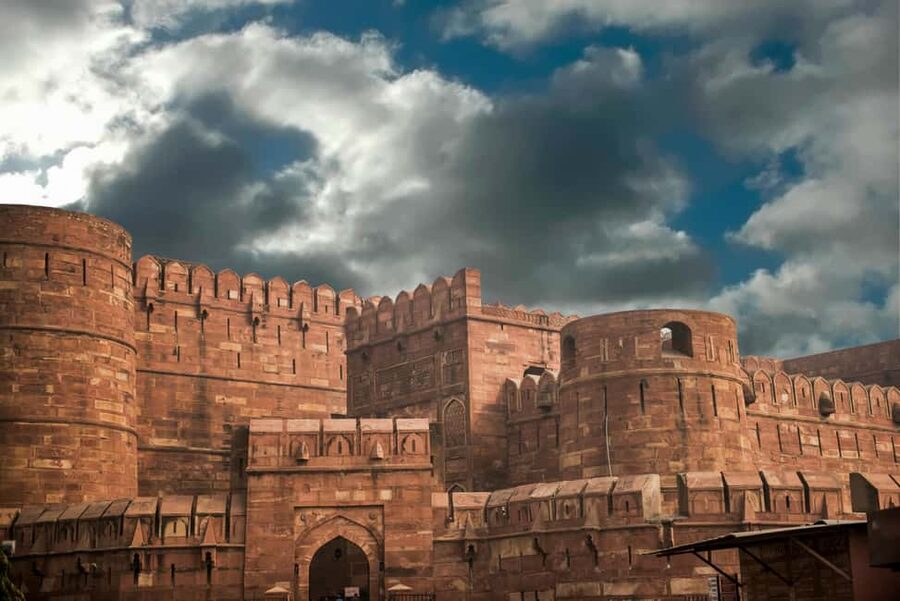
The Taj Mahal gets the photographs, but Agra Fort gives you the setting for Mughal power. This was not simply a defensive wall. It was a military base, royal home, administrative center, and ceremonial stage, all packed into one enormous red sandstone complex.
The fort changed under several emperors. Akbar began major construction, Jahangir used the complex as a royal residence, and Shah Jahan added refined marble spaces that reflect his taste. You can see this change as you move from heavy defensive architecture to delicate screens, carved stone, polished surfaces, and open courts.
I recommend pairing this tour with a visit to the Taj Mahal on the same day. The two sites are only about 2.5 kilometers apart, and the contrast is useful. The Taj is a focused memorial built around symmetry and marble. Agra Fort is layered, practical, royal, and full of rooms that once served different purposes.
More Castle and Palace History Tours in India
- Private Heritage Walking Tour in Jaisalmer Fort and Old Bazaar
★ 5.0 · 306 reviews - Private Jaisalmer Fort & old city tour
★ 5.0 · 168 reviews - Mehrangarh Fort and Blue City Historic Tour with Local Guide
★ 5.0 · 134 reviews
Amar Singh Gate and the first look inside
Your visit begins at Amar Singh Gate, the sole entrance used by visitors. This matters because the approach can be busy, and you should expect a security check before entering.
Bring only what you need. Large bags and prohibited items are not allowed, and drones and tripods are usually prohibited without special permission. Photography is allowed, so a phone or small camera is the sensible choice.
Once inside, your guide can help you understand the fort’s basic plan. Without that orientation, the wide courtyards and heavy walls can feel like a long succession of similar spaces. With a guide, you can better see how the layout balanced security, ceremony, privacy, and daily royal life.
The ground is uneven, and there is plenty of walking. Good shoes are not a minor comfort here. They make it easier to pay attention to the carvings and stories instead of watching every step.
Diwan-i-Am and the public face of Mughal rule
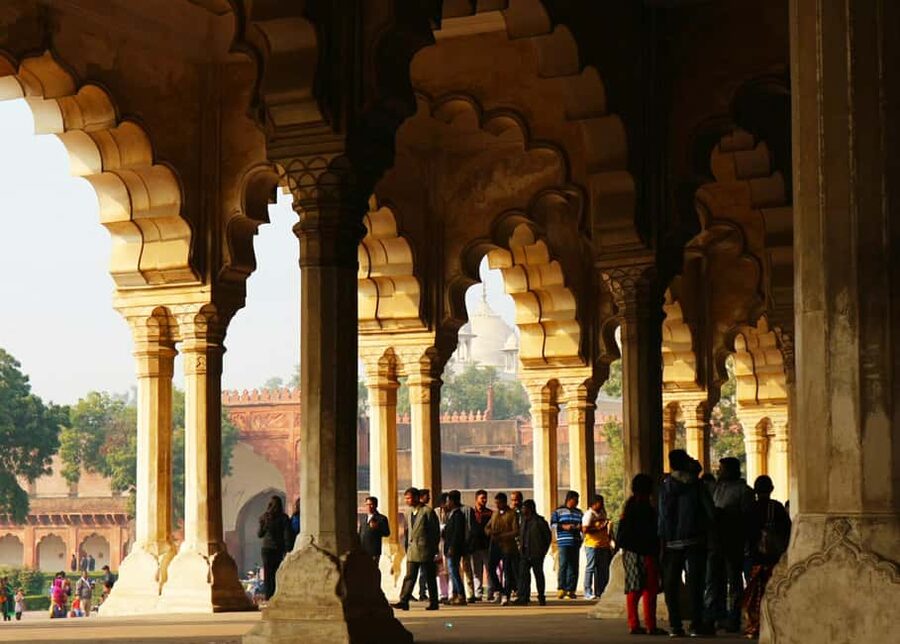
The Diwan-i-Am, or Hall of Public Audience, is one of the clearest places to picture the emperor at work. This was where formal audiences took place and where subjects could present petitions or requests.
Your guide will explain how the pillared hall functioned as a space of authority. The open design allowed people to gather while keeping the ruler visually separate and elevated within the setting.
The value of a guide is especially clear here. A bare room can seem impressive but vague. A good explanation gives the arches, columns, and raised areas a purpose. You begin to see the fort not just as a monument, but as a working court where public business was staged with care.
The hall also helps you understand the difference between the fort’s public and private zones. From here, the route leads toward more controlled spaces, where access was limited and decoration became more refined.
Diwan-i-Khas and the place of imperial display
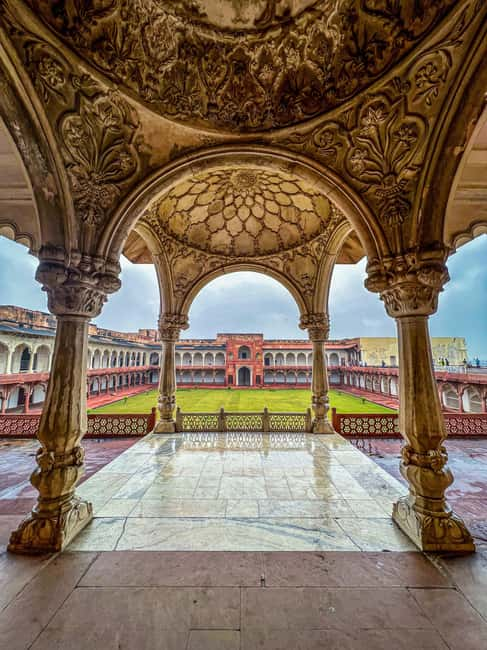
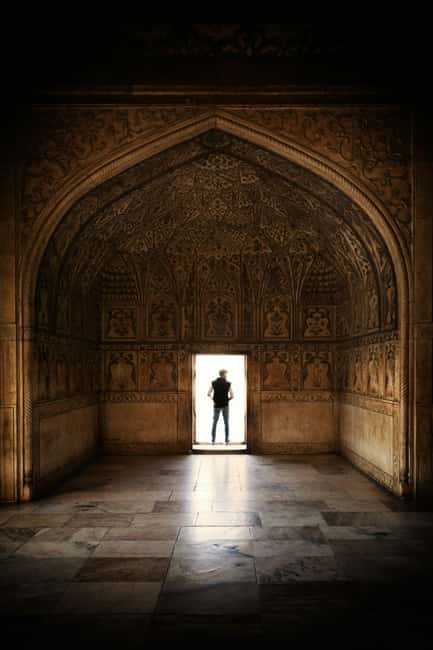
The Diwan-i-Khas was used for private audiences and important visitors. This is where the Mughal court could display wealth and power in a more intimate setting.
Look closely at the stonework rather than rushing through for a wide photograph. Arches, carved marble, decorative details, and carefully framed openings show how the court used architecture to impress. The style combines Islamic and Persian influences with Indian forms, including the projecting jharokha-style windows associated with Rajput design.
The tour also points out the spot connected with the Peacock Throne. The original throne is long gone, but the location helps you picture the scale of imperial ceremony. It is a good reminder that Agra Fort was once filled with objects and rituals designed to make authority visible.
This is one place where a private guide can adjust the explanation to your interests. If you care about architecture, you can focus on materials and design. If you prefer political history, the same room becomes a setting for courtly negotiations and royal audiences.
More History Walking Tours in India
- Fontainhas Heritage Walk by Make It Happen
★ 5.0 · 2,834 reviews - The Great Indian Food Tour: Old Delhi Food and Heritage Walk
★ 5.0 · 1,698 reviews - Old Goa Heritage Walk by Make It Happen
★ 5.0 · 797 reviews - Old Delhi Food, Heritage&Cultural Walk with Rickshaw ride to Masterji Kee Haveli
★ 5.0 · 742 reviews
Jahangiri Mahal and the fort’s mixed architectural language
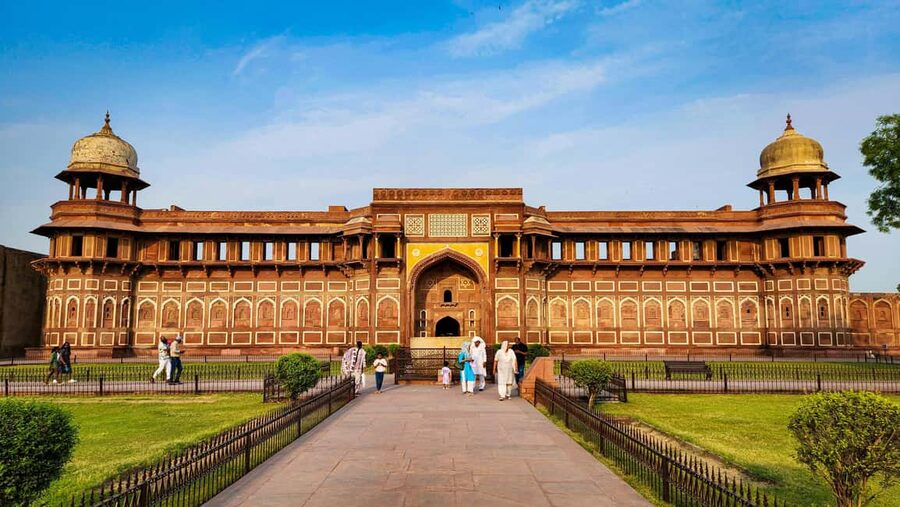
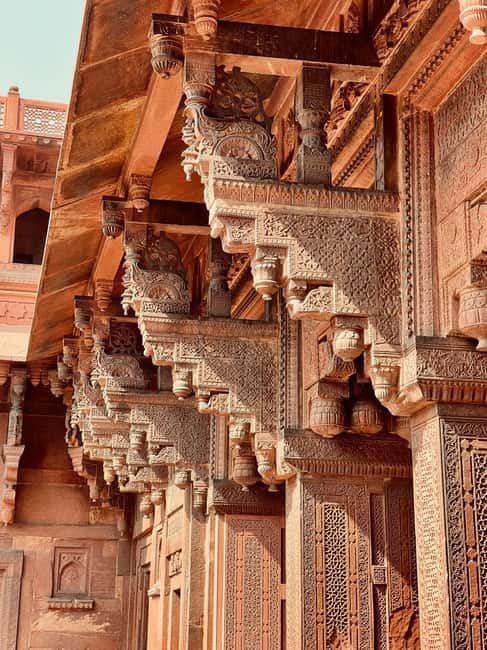
Jahangiri Mahal is one of the most important palace buildings in the visitor route. It reflects the earlier phase of the fort, with strong red sandstone forms and a blend of Rajput, Persian, and Islamic ideas.
The building is useful for reading the fort’s architecture. Notice the contrast between solid walls and open galleries, defensive mass and decorative detail. Jharokhas, arches, and carved surfaces give the palace a sense of ceremony, but the structure still feels connected to the fort’s military purpose.
The name links the palace to Jahangir, though the wider complex developed over time. Your guide can help separate the buildings and rulers instead of allowing every palace to blur into one general Mughal story.
For photography, Jahangiri Mahal offers plenty of strong angles. Still, the one-hour format means you should avoid spending the whole visit hunting for perfect shots. Take a few photographs, then keep moving while the guide’s explanation is fresh.
Musamman Burj and Shah Jahan’s final view
Musamman Burj is the emotional center of this tour. Shah Jahan was confined by his son Aurangzeb, and this was the place associated with his final years. From here, he could look toward the Taj Mahal.
The story is powerful because the view is beautiful and sad at the same time. Shah Jahan is closely linked to the Taj Mahal, yet his last years were spent in confinement rather than in the palace life he had known.
Your guide should give this moment some space. It is easy to rush from one decorated room to another, but Musamman Burj rewards a pause. Look toward the Taj Mahal if the view is clear, and consider how the two monuments are connected by family, power, grief, and memory.
This is also one of the best places to ask for a photograph. Shahid Khan has been especially helpful with finding strong viewpoints and taking pictures for visitors. Gagan has also been praised for taking photos while explaining the site and helping people avoid unwanted attention near the entrance.
The view is not guaranteed to be perfect on every day. Haze, weather, and access can affect what you see. Still, the connection between the fort and the Taj gives the visit much more meaning than a simple checklist of palace rooms.
The mirrored palace and Anguri Bagh
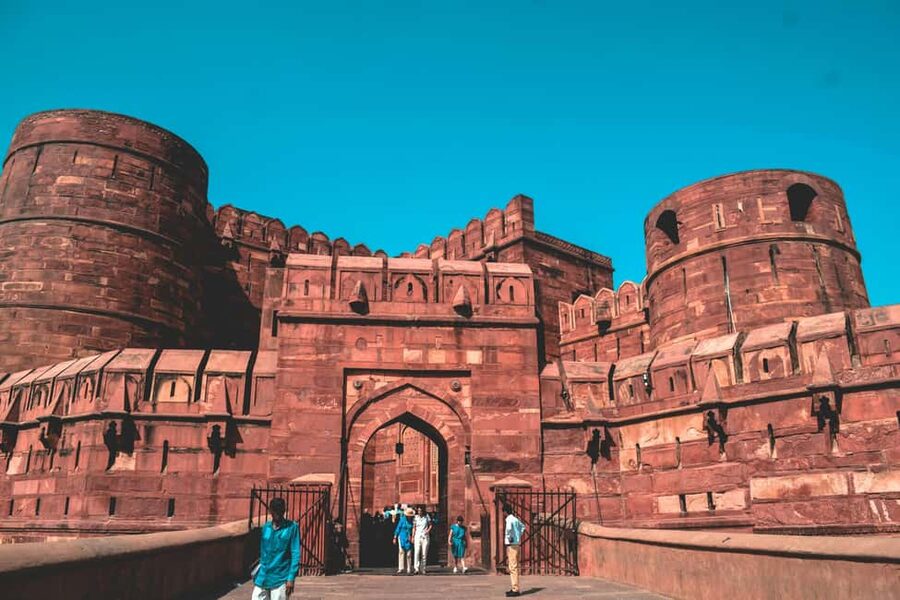
If access is available, the mirrored palace adds a different mood to the tour. Its reflective decoration catches light and creates a more intimate, theatrical interior than the broad public halls.
Access can vary, so treat this as a possible part of the visit rather than a fixed promise. If the area is open, listen to the guide’s explanation before reaching for your camera. The details are easier to appreciate when you know how the room was designed to use reflection and light.
Anguri Bagh offers another change of pace. This geometric garden was once enjoyed by Mughal queens and reflects the court’s interest in ordered spaces. Its layout brings a sense of pattern and calm after the heavier walls and formal halls.
The garden also gives you useful photo opportunities. Symmetry works well here, especially when you frame the paths and planted sections against the fort’s stone architecture. Keep in mind that gardens can look different depending on maintenance and season, so focus on the design rather than expecting a particular level of greenery.
What the one-hour private format does well
A private group is the main advantage of this experience. You can ask questions, slow down for a few key rooms, or move more quickly through areas that interest you less. You are not tied to a large group’s pace.
The short duration also makes the tour easy to fit around the Taj Mahal. If you have limited time in Agra, one focused hour can give you the fort’s essential story without taking over the entire day.
There is a trade-off. Agra Fort is huge, and one hour cannot cover every building, courtyard, and wall. You should think of this as a guided introduction with strong highlights, not a complete architectural survey.
That is not a serious problem if you want the main story. The guide can direct your attention to the Diwan-i-Am, Diwan-i-Khas, Jahangiri Mahal, Musamman Burj, Anguri Bagh, and the mirrored palace if open. You leave with a clear sense of the place instead of wandering without context.
Guides, communication, and help at the entrance
The guide speaks English or Hindi, and you receive contact details from the local provider through WhatsApp, or by email if you do not use WhatsApp, one day before the visit. The booking voucher also lists the WhatsApp number.
That communication matters because the meeting point is handled through the local provider rather than through included hotel transportation. Pay attention to the meeting instructions and contact the guide if your plans change.
Gagan has led tours for 17 years and has been praised for arriving on time, giving clear meeting instructions, explaining the fort, taking photographs, and helping visitors avoid scam photographers and vendors near the entrance.
Shahid Khan is described as active and enthusiastic, with a strong eye for the best Taj Mahal viewpoints and photographs. He has also helped people handle a weekend rush and move through queues where needed. This is helpful practical support, but you should not assume that any tour can remove every wait or bypass every line.
The most important quality to look for is clear communication. A guide who can explain where to meet, keep the pace comfortable, and help you handle the entrance is worth far more than a guide who simply recites dates.
Is $6 good value for Agra Fort?
At $6 per person, this is inexpensive for a private guided visit. The price is especially reasonable if you are visiting Agra Fort for the first time and want the main buildings explained in a compact format.
The value comes from interpretation, not from extras. Transfers are not included, and the experience does not promise a meal, a longer vehicle tour, or a full-day Agra itinerary. You are paying for the guided fort visit itself.
That narrow focus is useful. You can arrange your own transport, combine the fort with the Taj Mahal, and avoid paying for services you do not need. If you want a guide for your entire Agra day, this one-hour experience is too limited, and one visitor specifically wished the guide had continued for the rest of the city tour.
Free cancellation up to 24 hours ahead and reserve-now, pay-later booking add flexibility. Those terms are useful when your Agra schedule depends on trains, traffic, or weather, but the main question remains simple: do you want a short guided explanation of the fort, or a longer private day with transportation?
Who should book this tour?
I would choose this tour if you want a clear introduction to Agra Fort, prefer a private group, and plan to see the Taj Mahal as well. It suits first-time visitors who want the major rooms and stories without spending several hours trying to work out the route alone.
It is also a good fit for photographers. The guide can point out views toward the Taj Mahal and help with pictures, while still giving the buildings historical context.
Families and older visitors should note the uneven surfaces and amount of walking. The private format may help with pacing, but the fort itself remains large and cannot be made entirely effortless.
I would look for a longer option if your main interest is detailed architecture or if you want to inspect every palace and garden. One hour is best used as a focused visit, not a slow, exhaustive exploration.
Should you book the Agra Fort walking tour?
Book it if you want a low-cost private guide who can turn a large, confusing fort into a readable story. The strongest moments are the public and private audience halls, the mixed Mughal and Rajput design, and Musamman Burj with its link to Shah Jahan and the Taj Mahal.
Go in with sensible expectations. You arrange your own transport, pass through security, walk over uneven ground, and may not access every interior, including the mirrored palace. The one-hour schedule is brisk, but it covers the essential highlights at a price that makes sense for many Agra itineraries.
FAQ
How long does the Agra Fort tour last?
The tour lasts one hour.
What languages does the guide speak?
The live guide speaks English or Hindi.
Is this a private tour?
Yes. The activity is offered for a private group.
What parts of Agra Fort are included?
The tour includes the Diwan-i-Am, Diwan-i-Khas, Jahangiri Mahal, Musamman Burj, Anguri Bagh, and the mirrored palace if it is accessible.
Is transportation included?
No. Transfers are not included, so you must arrange your own way to the fort.
Where do I receive the meeting details?
The local provider sends the guide’s contact details through WhatsApp one day before the tour. If you do not use WhatsApp, the details can be sent by email. The WhatsApp number is also listed on the booking voucher.
Can I take photographs inside Agra Fort?
Photography is allowed. Drones and tripods are usually prohibited unless you have special permission.
What should I bring?
Bring comfortable shoes and a camera. The fort is large, has uneven surfaces, and requires plenty of walking. Expect a bag check and do not bring large bags or prohibited items.
More UNESCO World Heritage Tours in India
- World heritage Somnathpur sculptures and Talakadu temple mystery
★ 5.0 · 79 reviews - 2 days Private tour of Hampi world heritage site from Bangalore by car
★ 5.0 · 75 reviews - World heritage Ahmedabad city tour in private car with guide and lunch
★ 5.0 · 44 reviews - Private Elephanta Caves UNESCO World Heritage Site Tour
★ 5.0 · 34 reviews
Latest history tours reviewed in India
- Fort Kochi Heritage Day Cycling Tour★ 4.2 · 26 reviews
- Candolim: Heritage Walk of Fort Aguada Port and Jail Complex★ 4.9 · 25 reviews
- Private Elephanta Caves UNESCO World Heritage Site Tour★ 5.0 · 34 reviews
- World heritage Ahmedabad city tour in private car with guide and lunch★ 5.0 · 44 reviews
- Best South Mumbai Heritage Walk★ 5.0 · 122 reviews
- Heritage Walk: Recommended by Gigi Hadid as a must-do in Mumbai★ 5.0 · 122 reviews
- Mumbai: South Mumbai Heritage Walking Guided Tour★ 4.5 · 69 reviews
- Hill-station & Heritage: Lonavala & Karla Caves Tour from Mumbai★ 5.0 · 60 reviews
India History Tours, compared.


The Great Indian Food Tour: Old Delhi Food and Heritage Walk
Read our review →
Old Delhi Food, Heritage&Cultural Walk with Rickshaw ride to Masterji Kee Haveli
Read our review →
Blue City Heritage Private Walking Tour With Pickup and Drop-Off
Read our review →
Private Heritage Walking Tour in Jaisalmer Fort and Old Bazaar
Read our review →
Old Delhi Food-Spice Market-Temples Tour Soon Featured on NETFLIX
Read our review →