Review · AMSTERDAM
Amsterdam Walking Tour:Anne Frank, History & Liberal Culture
Amsterdam’s story is much bigger than canals, bicycles, and the Red Light District. This three-hour walk with Antonis links the city’s water problems, leaning houses, WWII resistance, Jewish history, education system, and open-minded culture in one steady route. It finishes with coffee and an optional Anne Frank Secret Annex VR experience.
I like the way the tour uses more than dates and monument names. Antonis brings out books, pictures, stories, and even chalk drawings, while the small group leaves room for questions and conversation. I also like the personal touches: a Polaroid photo, a postcard with a handwritten message, and a Dutch sweet.
The main drawback is that this is not a substitute for visiting the Anne Frank House itself. The VR session is optional and takes place over coffee, and the walking route is not suitable for wheelchair users. Still, at $40, the mix of guiding, refreshments, souvenirs, and a less polished but more personal view of Amsterdam is appealing.
Key points to know before you book
- Antonis leads the tour: Expect humor, local stories, and a conversational style rather than a formal lecture.
- The route covers serious ground: WWII, Jewish Amsterdam, the Holocaust Memorial, and Anne Frank’s story receive real attention.
- You see Amsterdam through its water: Canal bridges, houseboats, leaning houses, and the city’s fight against flooding all fit into the story.
- Coffee and VR close the walk: The Secret Annex experience is optional, and there is only one VR headset.
- Small groups matter: The experience is described as intimate, with a maximum of eight in one section and up to ten participants in the booking details.
- Bring good shoes: The tour takes about two hours on foot before a 45-minute coffee and VR stop.
Amsterdam beyond the postcard
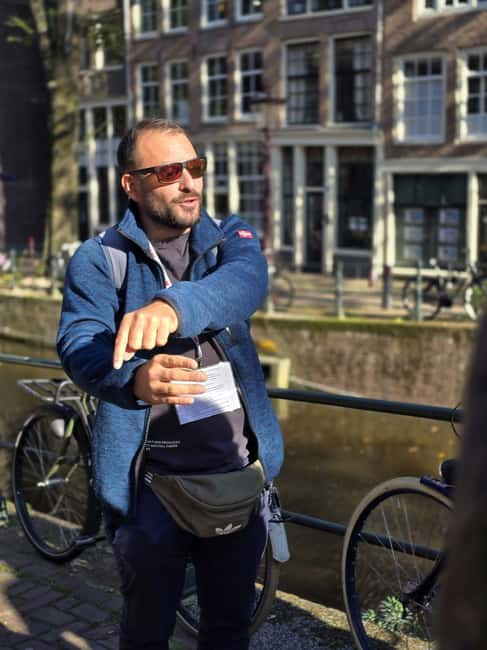
This tour works best if you want context, not just photographs. You move through central Amsterdam, but the guide keeps asking why the city looks and behaves as it does.
Water is the starting point for much of that explanation. Amsterdam’s canals are not simply pretty channels placed for decoration. They reflect the city’s long effort to control water, create usable land, and keep a low-lying settlement functioning. That background helps explain the narrow houses, canal bridges, houseboats, and the slightly tilted buildings you see along the way.
The famous leaning houses receive more than a quick photo stop. Antonis explains why some buildings tilt and how Amsterdam’s old structures relate to the damp ground below them. You also hear about the practical side of city life, including what it means to live on a houseboat rather than simply admire one from a bridge.
The tour also takes a broader look at Dutch society. Education, social policy, and the country’s liberal culture are part of the conversation. This is useful because the tour does not treat liberal Amsterdam as a collection of tourist clichés. It looks at how the city developed its modern identity, while still making room for the uncomfortable parts of its past.
More History Walking Tours in Amsterdam
- Amsterdam: Haunted History and Ghost Walking Tour
★ 4.5 · 488 reviews - Amsterdam History Walking Tour
★ 5.0 · 281 reviews - Amsterdam: Highlights & History Walking Tour
★ 4.8 · 266 reviews
From Kattengat to Centraal Station
The meeting point is in front of De Silveren Spiegel at Kattengat 4 to 6. This is a central starting place, close to Amsterdam Centraal and easy to connect with if you are already exploring the old center.
The first part of the walk helps you settle into the group and the guide’s style. Antonis uses humor and conversation, but the subject matter quickly becomes more serious. You should expect a relaxed pace with regular stops for explanations and photographs rather than a fast march through the center.
Amsterdam Centraal is one of the first important stops. It gives the group a useful orientation point and a chance to consider how the station connects the city with the rest of the Netherlands. A photo stop here is brief, but the station also marks the shift from the meeting point into the main story of central Amsterdam.
The nearby Tony’s Chocolonely Superstore adds a lighter moment. It fits the tour’s interest in Dutch culture and local products, though the stop is only about five minutes. You will have time to look and hear the guide’s explanation, but not enough for a long shopping break.
Bridges, leaning houses, and Amsterdam’s water
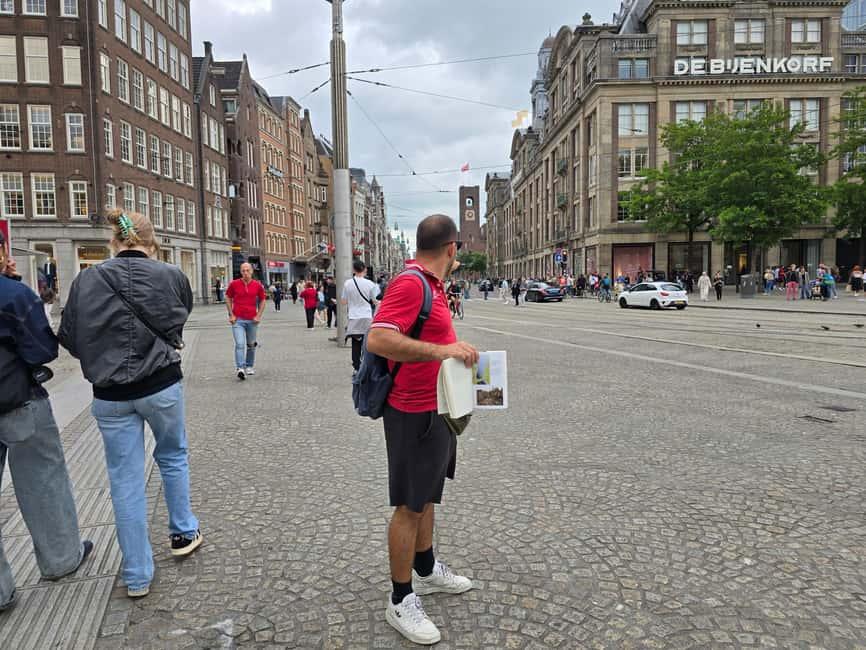
The Aluminium Bridge and Staalmeestersbrug offer two of the tour’s more visual sections. Each stop lasts long enough for photographs and a short explanation, so you get time to look at the structures instead of hearing a fact while being hurried along.
Bridges are a useful way to understand Amsterdam. They shape how you move through the city, frame the canals, and connect neighborhoods divided by water. The tour uses these crossings to explain the practical systems beneath the postcard view.
This is also where the discussion of leaning houses and houseboat life becomes more concrete. Amsterdam’s old buildings can look as if they are about to slide into the canal, but their angles are part of a longer story involving foundations, age, and construction methods. The tour does not present the buildings as curiosities alone. It connects them to the way people have adapted to a difficult physical setting.
The route is relaxed, but you should still wear comfortable shoes. Amsterdam’s central streets and bridges are manageable for most walkers, yet you will be on your feet for roughly two hours, with frequent pauses. Bring water and clothing suited to the weather. The experience operates in English.
The Jewish Quarter and Amsterdam during WWII
The stop in the Jewish Quarter changes the mood. Here the tour moves from city design and daily life toward persecution, resistance, and the choices people faced during WWII.
Antonis focuses on ordinary people and the ways their actions shaped the city’s story. That approach makes the history easier to connect with than a list of military dates. You hear about resistance secrets, hidden prisons beneath bridges, and the pressures placed on Amsterdam’s Jewish community.
This section deserves attention and quiet. The tour is not designed as a museum lecture, and some details are presented through conversation, books, and visual aids. If you want a very formal academic treatment, you may prefer a specialist museum tour. If you want a human-scale account woven into the streets around you, this format is likely a better fit.
The route then reaches the Magere Brug, one of Amsterdam’s best-known bridges. It is a natural photo stop, but it also brings the group back to the city’s relationship with water and movement. The bridge is attractive, yet the value here comes from hearing how a familiar landmark fits into the larger story.
More History Walking Tours in the Netherlands
- Anne Frank and Amsterdam Jewish History Walking Tour
★ 5.0 · 259 reviews - Amsterdam: Ghost Walking Tour and Dark History
★ 4.8 · 118 reviews - Amsterdam: Iconic Canals & Historic Sights Walking Tour
★ 4.5 · 90 reviews - Amsterdam: Anna Frank and World War II History Walking Tour
★ 4.8 · 86 reviews
A quiet pause at the National Holocaust Names Monument
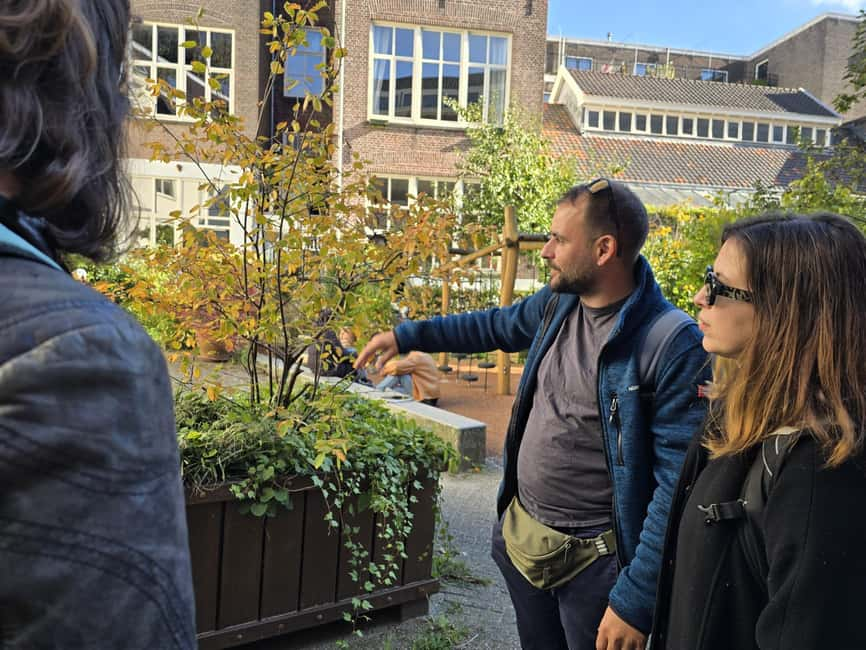
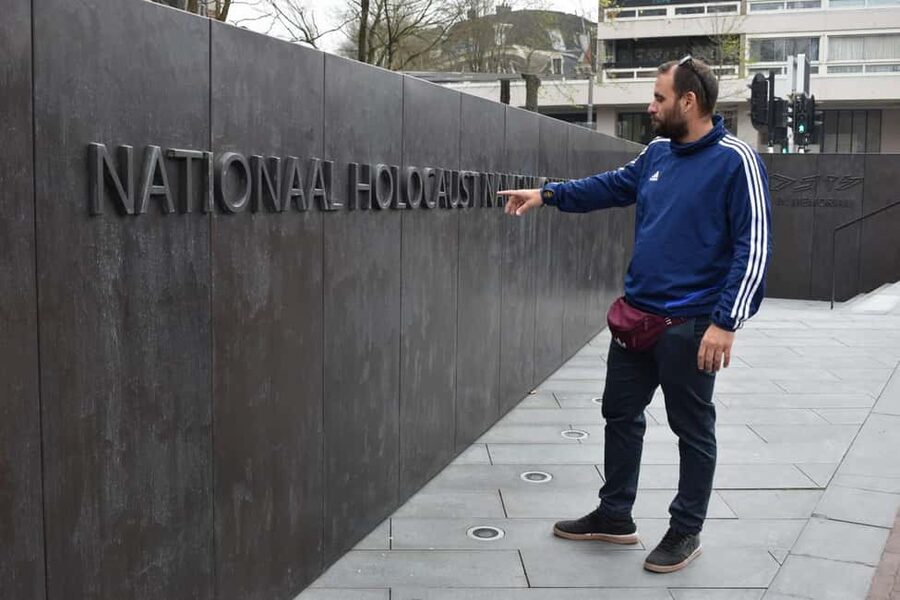
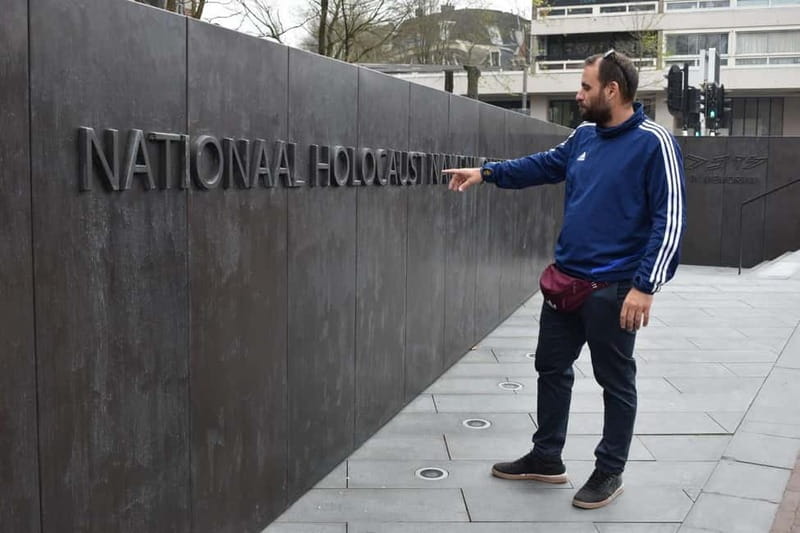
The National Holocaust Names Monument is the emotional center of the walking route. The stop lasts about 15 minutes, giving you time to reflect as well as listen.
This is not a place for rushed sightseeing. The names make the scale of the Holocaust personal, and the guide’s role is to provide context without turning the memorial into a backdrop for quick photographs. You should be prepared for a serious pause after the more playful discussion of canals, chocolate, and leaning houses.
The nearby Blauwbrug provides another short photo and storytelling stop. Together, these locations show the range of the experience. Amsterdam’s beauty is present, but it is placed beside the city’s painful memory rather than separated from it.
For many people, this section will be the most valuable part of the tour. You are not only looking at old buildings. You are being asked to consider how a modern city remembers, explains, and carries its past.
Zuiderkerk and Nieuwmarkt’s everyday Amsterdam
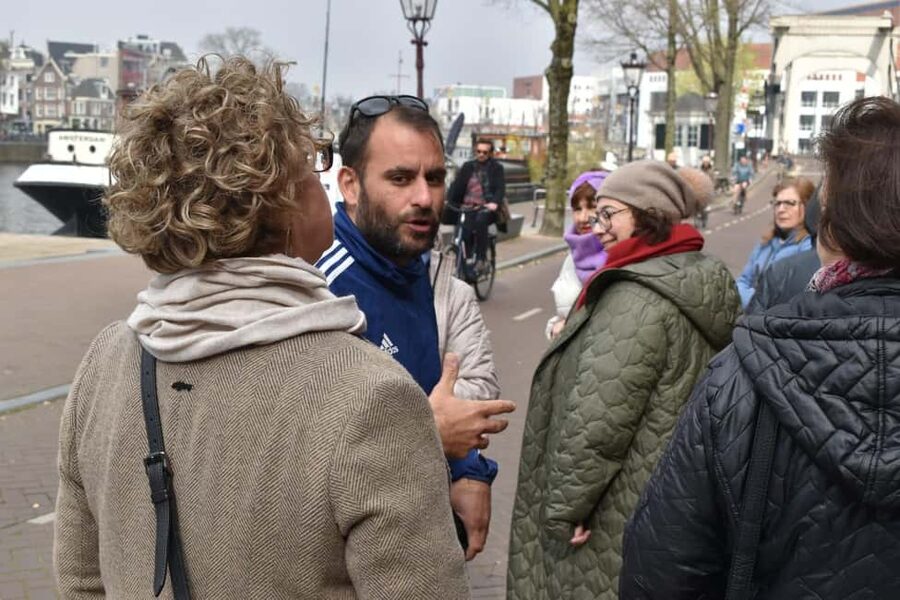
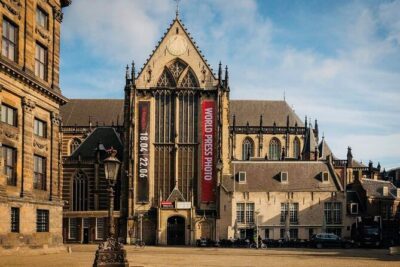
The walk continues to Zuiderkerk, where the guide brings attention back to Amsterdam’s built character and local life. The church is a useful visual marker in the old center and gives you another chance to connect the city’s religious and civic past with its current streets.
Nieuwmarkt Square brings a livelier finish to the walking portion. The stop lasts about 15 minutes, enough for sightseeing and a final round of stories before the group reaches the Waag.
The route does not depend on grand entrances or reserved museum access. That is both its strength and its limitation. You see places from the street, where you can notice people, buildings, bridges, and shops as part of a working city. But you will not spend a long time inside major attractions.
That makes the tour a good first look at Amsterdam. It gives you a map in your head and a list of places to return to. Antonis also offers suggestions for nearby bars and restaurants, which can be useful if you want to continue exploring after the tour.
Anne Frank through a VR headset
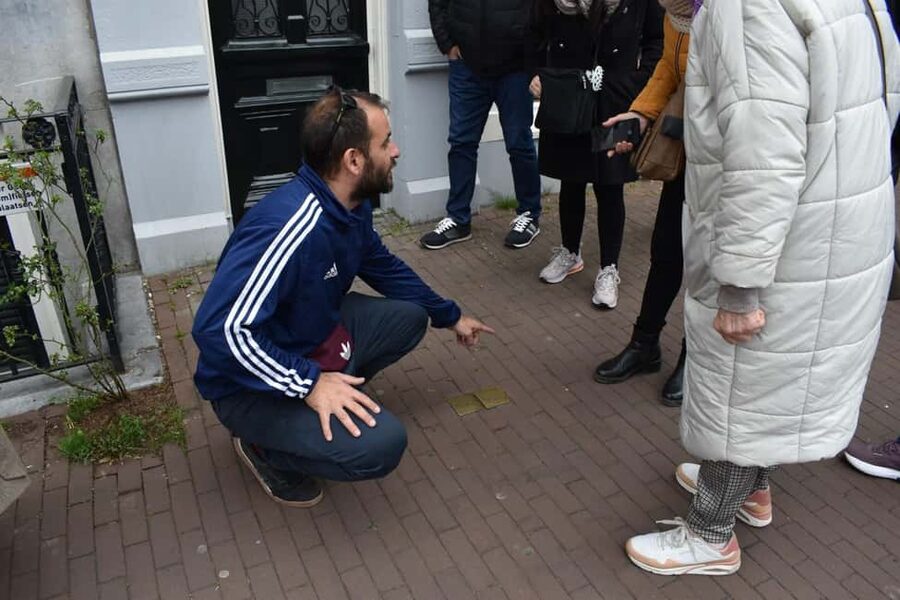
The final part takes place over coffee and lasts about 45 minutes. Coffee is included, along with a chocolate or stroopwafel, and the atmosphere is intended to be more relaxed than the walking portion.
The optional VR experience lets you enter a digital version of the Secret Annex connected with Anne Frank’s WWII story. This is particularly useful if you could not secure a ticket to the Anne Frank House, but it is important to understand what you are booking. The VR session is not an entry ticket to the real house and does not replace the physical museum.
There is only one VR headset, so the format is casual and shared rather than a private, extended virtual visit for every participant. You can choose to take part or simply use the coffee stop to ask questions and talk through what you have seen.
I like this ending because it gives the difficult history a little space. You are not pushed straight from a memorial into the next sightseeing stop. The group can pause, discuss Anne Frank’s story, and ask Antonis about Amsterdam’s past and present.
The souvenirs are small, but useful
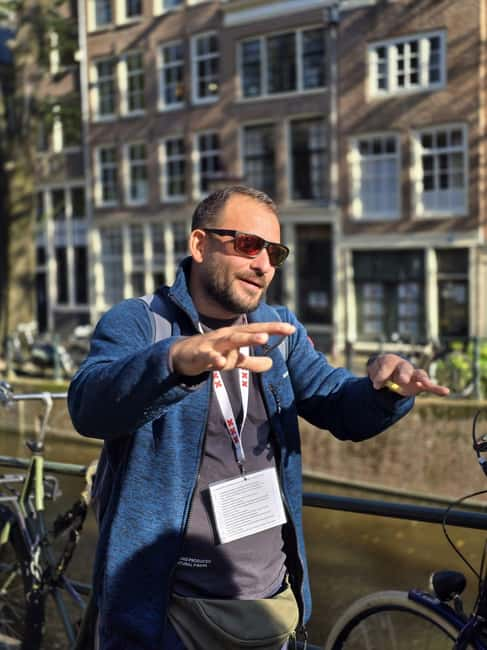
The Polaroid is more than a standard digital download. It gives you a physical reminder of the walk, and the guide’s use of the camera adds a friendly, personal note to the end of the experience.
You also receive an Amsterdam postcard with a handwritten message and official stamp. A chocolate or biscuit is included, along with coffee. These are modest extras, but they help explain the $40 price.
At this cost, you are paying mainly for three hours of guiding and access to a small group. The coffee, VR headset, sweet, Polaroid, postcard, and recommendation list add value, especially if you appreciate a tour that feels personal rather than mass-produced.
Still, price the experience against your interests. If you only want a quick overview of the canals, a free walk may cover the basics. If you want Anne Frank’s actual museum, buy a separate museum ticket when possible. This tour makes more sense if you want one guide to connect history, social culture, landmarks, and local advice.
Who will enjoy Antonis’s style
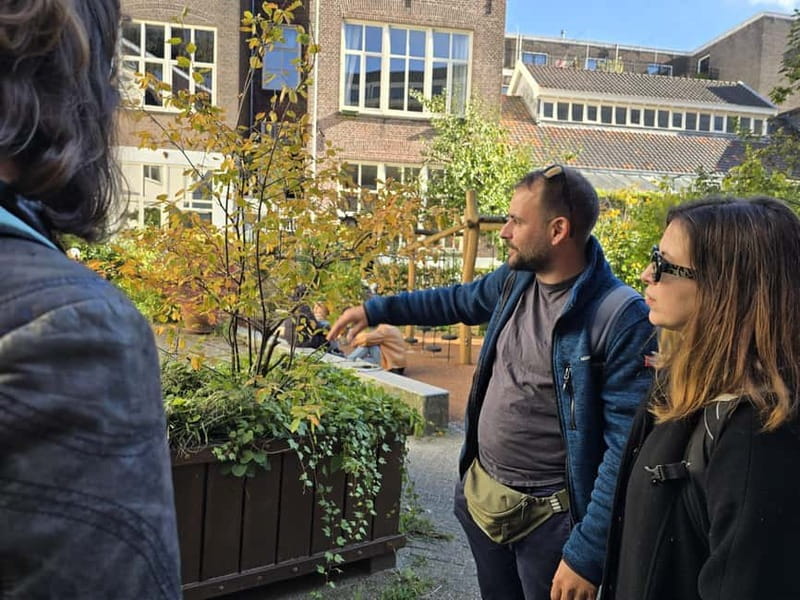
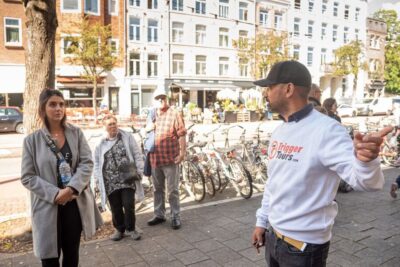
Antonis appears to be the main reason this experience works. His approach is warm, humorous, and active. He does not rely only on memorized dates. He uses stories, pictures, books, and chalk drawings to keep the group involved.
You should book this if you enjoy asking questions and hearing a guide explain how a city works. Solo visitors and couples should find the small group easy to join, while first-time visitors can use the route to get their bearings and plan the rest of their stay.
It also suits repeat visitors. The route is central, but the focus on less noticed streets, social history, and local advice can show you parts of Amsterdam you may have passed without understanding. One person who had already visited the city found that a guided walk made it feel fresh again, which is a fair description of the tour’s purpose.
You may want something else if you dislike group conversation, need wheelchair access, or want a long indoor museum visit. The tour is not suitable for wheelchair users, and much of the experience takes place outdoors.
Book with weather in mind. Comfortable shoes, water, a camera, and weather-appropriate clothing are specifically recommended. The activity offers free cancellation up to 24 hours before the start, and you can reserve now and pay later, which helps if your schedule is still changing.
Should you book this Amsterdam walking tour?
Book it if you want Amsterdam explained through people, places, and choices rather than a stack of dates. Antonis brings together water management, leaning houses, houseboats, education, WWII, Jewish history, liberal culture, and Anne Frank in a route that keeps moving without feeling hurried.
The strongest reasons to choose it are the small group, the personal guide, the Holocaust memorial stop, and the relaxed coffee ending with optional VR. The main cautions are the outdoor walking, the lack of wheelchair access, and the fact that VR is not the same as visiting the Anne Frank House.
For $40, I see good value for a first or second day in Amsterdam, especially if you want restaurant tips and a clearer sense of the city’s character. If you prefer grand interiors, audio guides, or a strictly chronological history lesson, choose a museum-focused experience instead. If you want a friendly guide and a thoughtful walk through Amsterdam’s past and present, this is a sensible pick.
FAQ
How long does the Amsterdam walking tour last?
The experience lasts three hours. About two hours are spent walking between Amsterdam landmarks, followed by roughly 45 minutes for coffee and the optional VR experience.
Where does the tour begin?
The meeting point is in front of De Silveren Spiegel at Kattengat 4 to 6 in Amsterdam.
Where does the tour finish?
The walking route finishes at the Waag.
Is the Anne Frank VR experience required?
No. The VR experience is optional and takes place during the coffee portion of the activity. There is one VR headset.
Is coffee included?
Yes. Coffee is included, along with a chocolate or biscuit, such as a stroopwafel.
What language is the tour conducted in?
The live tour is conducted in English.
Is the tour suitable for wheelchair users?
No. The experience is listed as not suitable for wheelchair users.
More WWII and D-Day Tours in Amsterdam
- Vienna: World War II Historical Walking Tour
★ 4.8 · 1,772 reviews - Zagreb: City & History Walking Tour & WW2 Tunnels
★ 4.9 · 1,202 reviews - Pearl Harbor History Remembered Tour from Ko Olina
★ 5.0 · 1,009 reviews - Hiroshima Peace (Heiwa) Walking Tour at World Heritage Sites
★ 5.0 · 872 reviews
More WWII and D-Day Tours in the Netherlands
- Anne Frank and the Jewish History of Amsterdam Private Tour
★ 5.0 · 307 reviews - Amsterdam: Private Anne Frank and Jewish History Tour
★ 5.0 · 26 reviews
Latest history tours reviewed in Amsterdam
- Skipping Lines & Sipping Beers: A History Tour of Amsterdam★ 5.0 · 22 reviews
- Amsterdam: Private Pedicab Historical Sightseeing Tour★ 5.0 · 41 reviews
- Amsterdam: Jewish Quarter and History Guided Tour★ 4.7 · 210 reviews
- Amsterdam: Iconic Canals & Historic Sights Walking Tour★ 4.5 · 90 reviews
- Amsterdam: Luxury Canal Cruise with Historic VR Experience★ 4.7 · 31 reviews
- Amsterdam: Historic Boat Cruise with open bar and nibbles★ 4.9 · 31 reviews
- Amsterdam: Walking Tour of Historic Center★ 4.6 · 24 reviews
- Amsterdam: Ghost Walking Tour and Dark History★ 4.8 · 118 reviews
Amsterdam History Tours, compared.

Amsterdam Food and Cultural Tour with Tastings
Read our review →

Amsterdam: Haunted History and Ghost Walking Tour
Read our review →
Amsterdam High-End Dutch Food & History Tour – Up to 8 guests
Read our review →
Anne Frank and the Jewish History of Amsterdam Private Tour
Read our review →
Amsterdam: 3-Course Meal in Historic 1st Class Waiting Rooms
Read our review →