
Review · FRANCE
Strasbourg on Foot: Historic Center and Petite France with a Local Guide
Strasbourg’s best introduction is on foot, and this tour connects the city’s grandest sights with its most atmospheric streets. You’ll move from Place Kléber and the soaring Notre Dame Cathedral to the canals and half-timbered houses of Petite France, with the story of Strasbourg unfolding along the way. I especially like the logical route and the way the walk joins famous sights to less formal places such as Place des Tripiers and the Tanners’ Quarter.
I also like the practical local advice. Guides such as Stefania, Leila, Stef, Maya, and Javier are praised for clear storytelling, restaurant suggestions, and answers to questions. The main consideration is time: two hours gives you a fine overview, but cathedral interiors, museum rooms, and Petite France all deserve longer if you want to explore them properly.
Key points at a glance
- A well-shaped two-hour route: Start at Place Kléber and finish in Petite France, passing the cathedral, Rohan Palace, Gutenberg Square, Saint-Thomas, and the Covered Bridges.
- The cathedral is explained, not just photographed: Hear about its 142-meter tower, medieval stained glass, and Renaissance astronomical clock.
- Petite France supplies the atmosphere: Canals, cobbled lanes, half-timbered houses, and the old working quarters provide the tour’s most memorable setting.
- Guides add useful advice: English and Spanish guides offer restaurant and sightseeing recommendations, along with historical context.
- Small extras improve the value: You receive a city map, local suggestions, and a tasting of a typical Alsatian sweet.
- Good first-day choice: The route helps you understand Strasbourg’s layout before choosing which museums, churches, and restaurants to visit in depth.
Why this Strasbourg walking route works
At $34 per person, this is priced as an affordable introduction rather than a specialist architectural tour. For two hours of live guiding, a map, local recommendations, and a small food tasting, I consider it good value if you are new to Strasbourg and want the city to make sense quickly.
The strongest feature is the order of the walk. You begin in the modern commercial center at Place Kléber, move into the cathedral quarter, cross the older central squares, and then finish among the canals of Petite France. That sequence gives you a clear sense of how Strasbourg changes from civic center to medieval town.
The route also makes practical sense for a first day. You can note the places you want to revisit, ask about restaurants, and use the guide’s advice to plan the rest of your stay. Several guides have supplied restaurant suggestions and tips about what to see next, which can be more useful than another round of general dates and names.
The experience is conducted in English or Spanish. The available guides include Stefania, Leila, Stef, Maya, and Javier, depending on the departure. Some explanations may be presented in their original language, so confirm your preferred language when choosing a time.
More History Walking Tours in France
- Paris: Dark History and Ghostly Guided Walking Tour
★ 4.7 · 1,000 reviews - Vieux Lyon Cultural & Historical Walking Guided Tour (English)
★ 5.0 · 942 reviews - Strasbourg: Guided Historical Neighborhoods Walking Tour
★ 4.9 · 275 reviews
Place Kléber starts with Strasbourg’s public face
The walk begins at Place Kléber, the city’s central square and a useful meeting point. It is a broad urban space rather than a medieval lane, so it gives you a quick contrast with the older quarters ahead.
During the Christmas season, the square is dominated by Strasbourg’s large Christmas tree. The lighting and seasonal displays can make this a particularly attractive start, though the area may feel busier during the Christmas market period. If you are visiting at that time, arrive with a little patience and allow enough time to find the meeting point.
The guide uses this opening to place Strasbourg in context. You are not simply heading from one postcard view to another. You begin with the city’s public heart, then move toward its religious, political, commercial, and working neighborhoods.
Notre Dame Cathedral deserves more than a quick photo
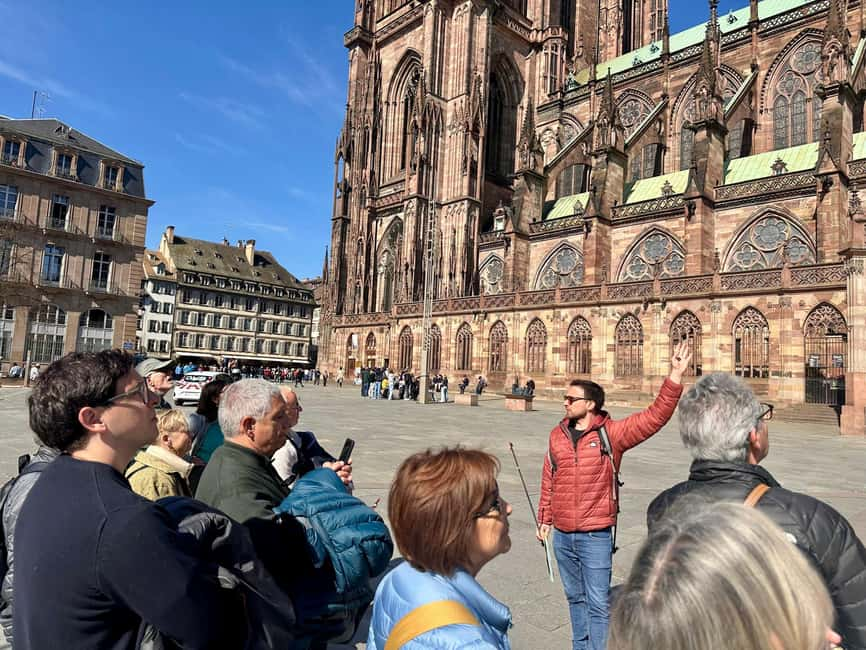
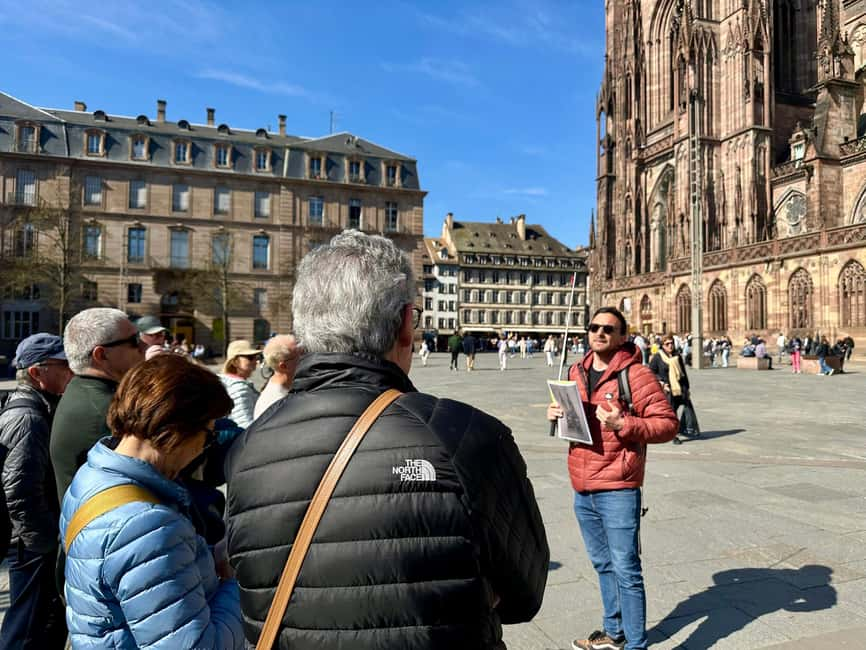
The cathedral is the tour’s grand visual moment. Its 142-meter tower dominates the center, and the red sandstone facade gives it a distinctive look unlike the pale stone churches found in many other French cities.
The guided portion here lasts about 15 minutes. That is enough to point out the main features and explain why the building matters, but not enough for a full architectural study. The activity includes an outside visit, so you should not assume that a complete interior tour or extended visit to the astronomical clock is included.
If the cathedral is open and you want to go inside afterward, the interior offers medieval stained glass and the famous astronomical clock. The colored light through the windows is best appreciated slowly, while the clock is a Renaissance engineering work with a timed display at certain hours. The guide can prepare you to notice these details, then you can return on your own for a longer look.
This stop is also where a good guide earns the $34 price. The building is easy to admire but harder to understand at a glance. Clear commentary helps you read the facade, connect the cathedral to Strasbourg’s past, and avoid treating it as just a backdrop for photographs.
Rohan Palace links princes, cardinals, and museums
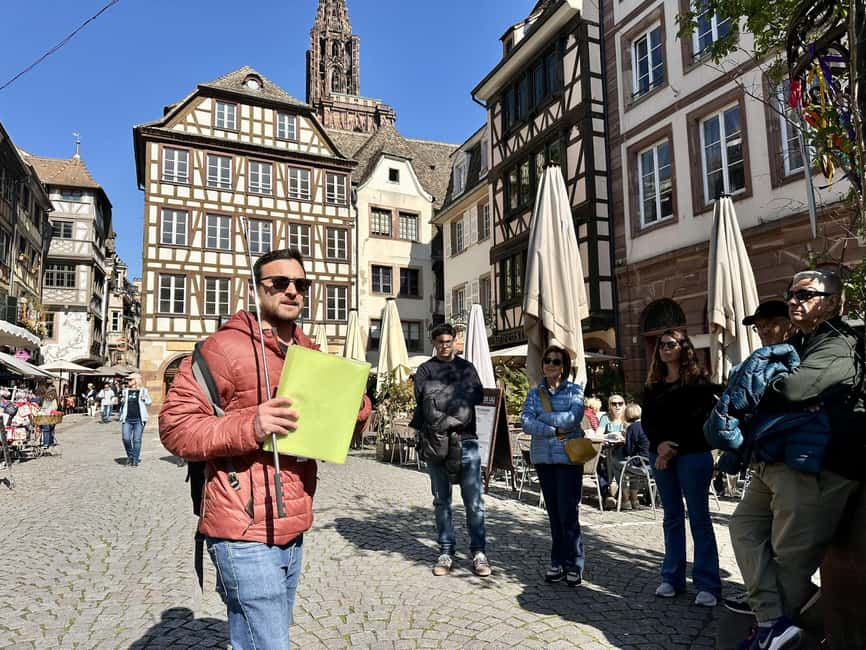
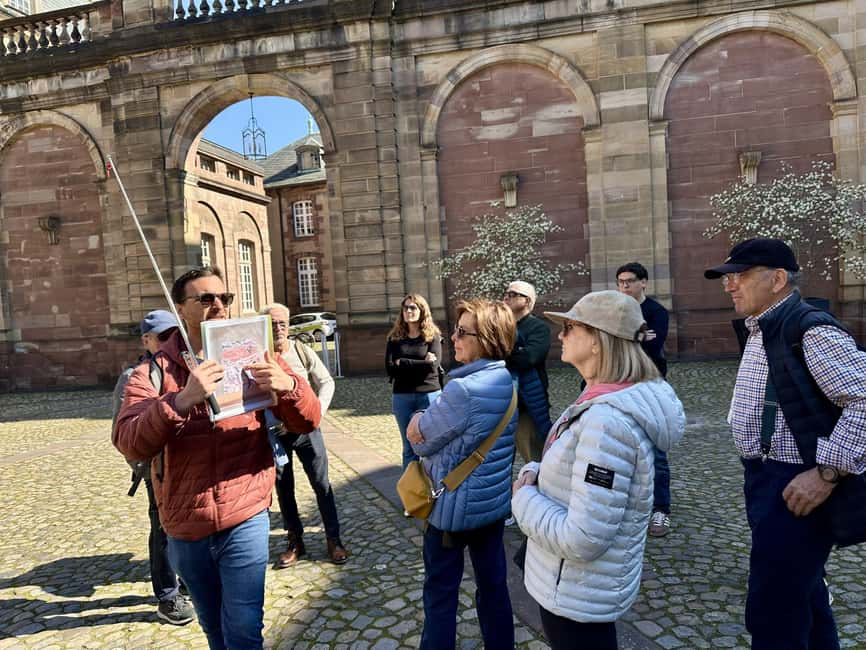
From the cathedral, the route continues to Rohan Palace, an elegant 18th-century residence associated with princes and cardinals. Its scale and formal design offer a sharp contrast with the narrow streets and older houses surrounding it.
The guide introduces the palace through its occupants and later uses. Marie Antoinette and Napoleon are among the historical figures connected with the building, and those stories give the palace a human angle. You hear how power operated in Strasbourg, rather than only receiving a list of construction dates.
Today the palace houses museums including Fine Arts and Decorative Arts. The walking tour gives you an orientation from outside and explains why the palace matters, but the museum collections require extra time and are not the focus of this two-hour route. If you enjoy painting, furniture, or decorative objects, mark the palace for a separate visit.
More Old Town and Historic Centre Walks in France
- Bordeaux: Historic Center & Chartrons District Bike Tour
★ 4.8 · 709 reviews - Rouen: Guided Tour of the Historic Center
★ 4.8 · 145 reviews - Strasbourg: Private Walking Tour of the Historical Center
★ 4.2 · 107 reviews - Avignon: Historic District Guided Food & Wine Walking Tour
★ 4.8 · 84 reviews
L’Ancienne Douane and Place des Tripiers show the working city
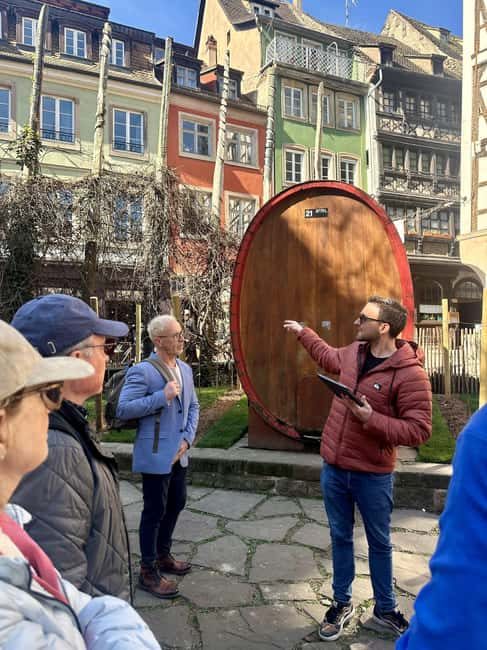
The route then moves through L’Ancienne Douane and Place des Tripiers. These stops add useful texture because Strasbourg was not only a city of bishops, palaces, and grand churches. It was also a place of trade, food production, craft, and river commerce.
L’Ancienne Douane recalls the practical business of moving goods through the city. Place des Tripiers points toward the old trades that shaped everyday life. The guide’s explanation helps connect these places to the artisans and merchants who made the center function.
This section may feel less immediately dramatic than the cathedral or Petite France, but I like its role in the walk. It keeps the experience from becoming a procession of famous facades. You get a sense of ordinary work and the city’s economic life, which makes the later visit to the Tanners’ Quarter easier to understand.
Gutenberg Square is a useful pause in the story
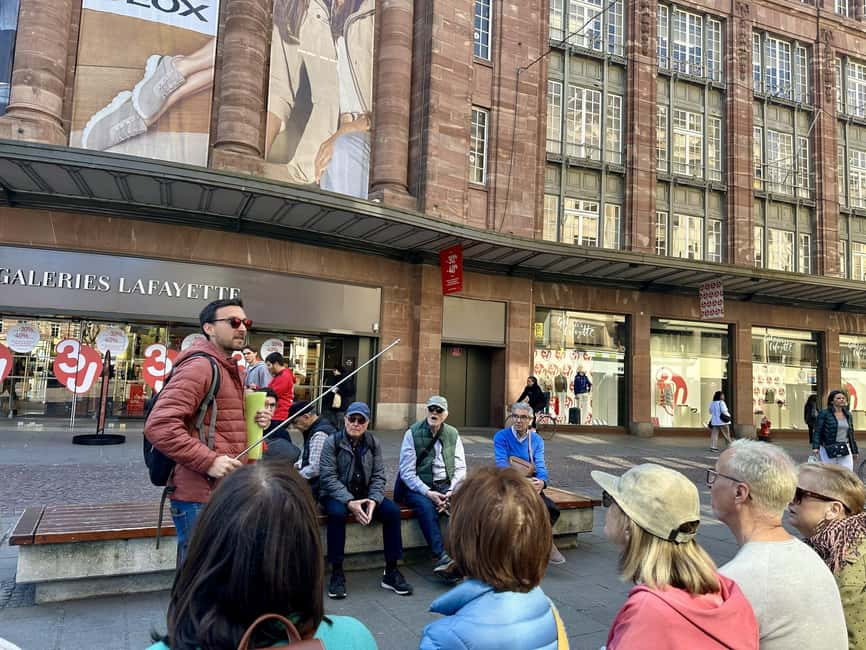
Place Gutenberg is one of the tour’s central historical stops. It sits close to the cathedral but has its own identity as a cultural and civic space.
The guide uses the square to discuss Strasbourg’s wider importance and its connection to printing and public life. The stop lasts around 10 minutes, enough for an explanation and a chance to look around without slowing the whole walk.
This is also a good place to notice how compact central Strasbourg is. Major sights sit close together, yet the mood changes from square to square. A guide helps you spot those changes and gives you a framework for exploring them later without getting lost in a maze of similar-looking streets.
Saint-Thomas adds another side of Strasbourg
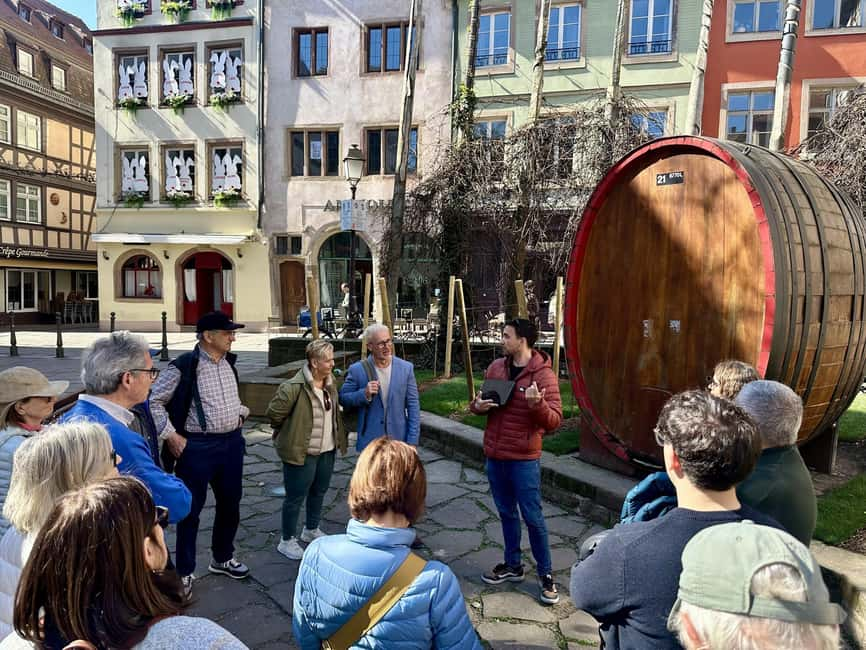
The walk includes Église Saint-Thomas, one of the city’s significant historic churches. It broadens the religious story beyond Notre Dame Cathedral and shows that Strasbourg’s identity is not contained in a single landmark.
The stop is relatively short, around 10 minutes. Expect an introduction and historical explanation rather than a long interior visit. If church architecture is a major interest, you may want to return later and spend more time there.
I find this kind of stop useful because it prevents the cathedral from taking over the whole tour. Strasbourg’s religious past had several important centers, and Saint-Thomas helps you see the old city as a group of connected quarters rather than one monument surrounded by streets.
Covered Bridges reveal the city’s defensive past
At the Covered Bridges, Strasbourg’s canals and defensive towers become the main subject. The medieval structures once had wooden roofs, and the towers helped protect the approaches to the old city.
The setting is especially effective because water, stone, and defensive architecture come together in one view. The guide explains how the bridges fitted into Strasbourg’s defenses and how the area changed as the city grew.
This is one of the places where comfortable shoes matter. The route is a walking tour through historic streets and canal-side areas, and the surfaces may be uneven. You will want to keep moving with the group, but pause when the guide gives you time to take in the towers and reflections.
The Covered Bridges also prepare you for Petite France. You have just seen Strasbourg as a defended medieval city. A few minutes later, you enter the neighborhood shaped by craftsmen, waterways, and trade.
Petite France is the visual finish
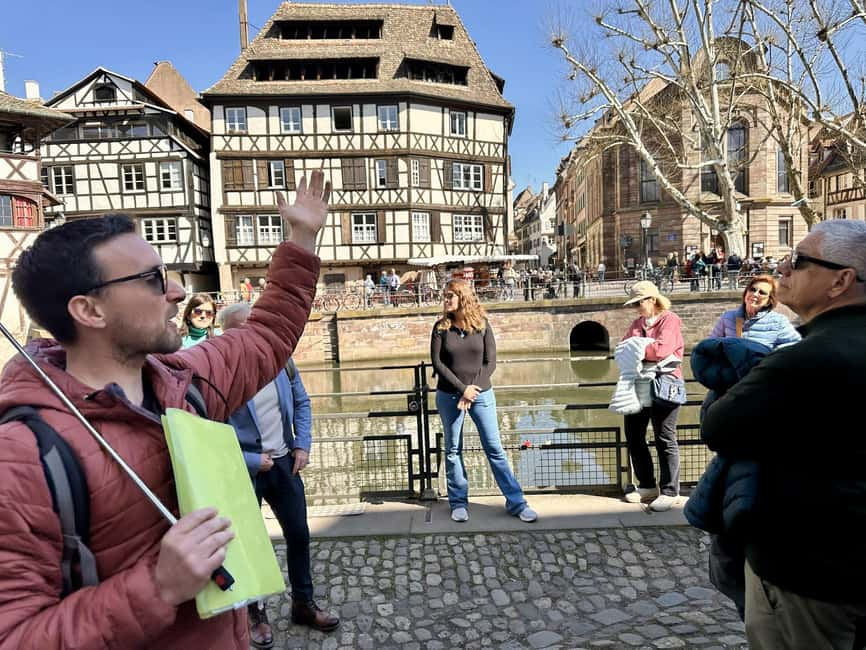
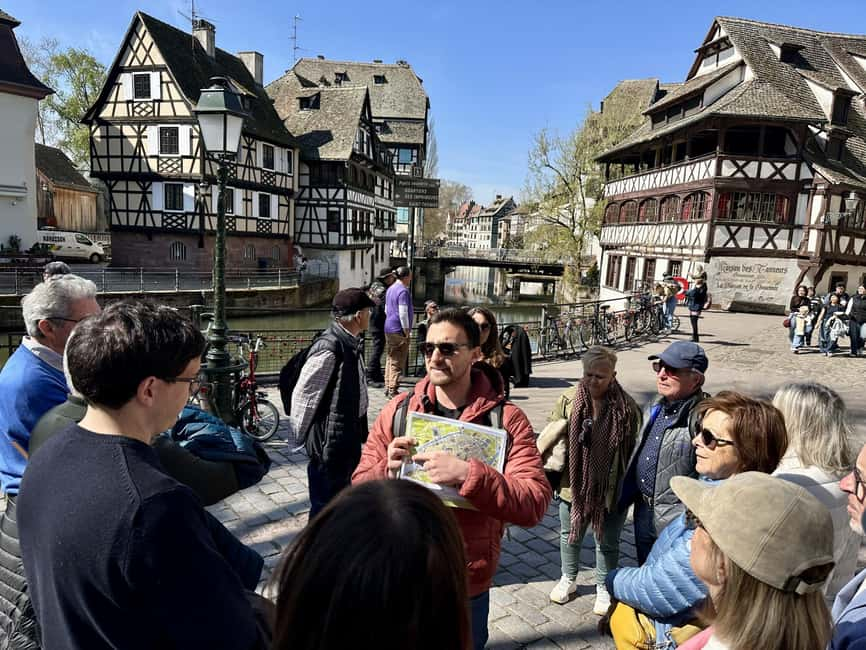
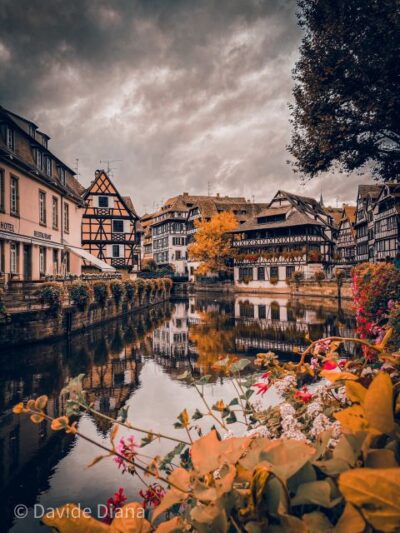
The tour ends in Petite France, the part of Strasbourg most likely to stay in your memory. Half-timbered houses line narrow streets, canals pass under small bridges, and the old neighborhood retains the character of a place built around water and work.
This was historically a quarter of fishermen, tanners, and millers. The Tanners’ Quarter, in particular, points to the artisanal roots of the old city. The houses are picturesque today, but the guide helps you remember that these were working buildings, not decorative stage sets.
The canals explain much of Petite France’s shape. Water powered mills, supported trade, and helped define the routes through the neighborhood. That practical background makes the area more interesting than a simple photo stop.
The end of the tour is intentionally relaxed. You finish in the heart of Petite France, where you can look across the water, study the traditional architecture, and decide where to eat or return later. Because the route ends here, you are well placed to continue exploring on your own, though the tour does not include a meal or a longer neighborhood visit.
How the guides shape the experience
The guide is the deciding factor in any short city walk, and the names associated with this experience receive especially warm praise for their energy, clarity, and personal approach. Stefania is noted for learning names and answering questions. Leila is praised for building a connected story from Strasbourg’s major historical periods. Stef is described as engaging and easy to follow, with useful local advice.
Maya is also associated with restaurant tips and practical suggestions for the rest of your visit. Javier leads in a friendly, well-informed way. The exact guide depends on the departure, so do not book expecting one specific person unless the booking information confirms it.
One useful detail is the audio equipment. Clear, comfortable headphones have been used on some departures, which helps when the guide is speaking near a busy square. This matters because the route includes open public spaces where voices can carry poorly.
The pace appears designed for sightseeing rather than speed. You stop regularly, and the walk lasts two hours. Still, it is not a seated activity, so wear shoes suitable for cobbles and expect to be outdoors for the full route.
What is included, and what is not
The price includes the two-hour guided walk, historical and cultural explanations, the Petite France visit, the cathedral exterior, Rohan Palace orientation, a city map, and recommendations for places to visit. A tasting of a typical Alsatian sweet is included as well. Some departures have also included gingerbread or cheese tastings, but the listed inclusion specifically promises a typical Alsatian sweet, so treat any extra food sample as dependent on the guide or departure.
Tips are not included. You can tip the guide based on your satisfaction, but it is not presented as a required charge.
The cathedral interior, museum admission, meals, and any extended time inside the monuments are not included. That is not a problem if you view the tour as an introduction. It would be a limitation if you want a detailed visit to the cathedral clock, Rohan Palace museums, or Saint-Thomas during the same two hours.
Who should book this walk
I would choose this tour for a first visit to Strasbourg, especially if you want the city’s main areas explained in a sensible order. It suits couples, families, solo visitors, and mixed-age groups who can manage two hours of walking and want a social introduction without committing to a full-day excursion.
It is also a good fit if you want advice for the rest of your stay. The city map, restaurant suggestions, and guide’s recommendations can save time later, particularly when you have only a short visit.
I would choose something longer or more specialized if you already know central Strasbourg well. The tour gives you a broad orientation rather than detailed access to every interior. Photography fans, architecture students, and museum lovers may want to use this walk as a first pass, then return independently.
With free cancellation up to 24 hours before the start and a reserve-now, pay-later option, the booking terms allow some flexibility. Check the exact meeting point, since it can vary by the option selected. One listed starting location is 14 Rue Mercière, and the route itself begins at Place Kléber.
Should you book Strasbourg on Foot?
Book it if you want a clear, lively introduction to Strasbourg before exploring on your own. The route covers the landmarks most people hope to see, but it also explains the working quarters, canals, trades, and city layout that give those landmarks meaning.
At $34, the value is strongest when you use the guide’s advice afterward. Visit the cathedral interior later, choose a Petite France restaurant with a better sense of the neighborhood, or return to Rohan Palace for its museums.
Skip it only if you prefer to wander without a schedule or if you want lengthy monument interiors. For most first-time visitors, the combination of cathedral views, medieval defenses, Petite France scenery, local food advice, and a small Alsatian tasting makes this a practical opening move.
FAQ
How long does the Strasbourg walking tour last?
The tour lasts two hours.
What is the price?
The listed price is $34 per person.
Where does the tour start?
The meeting point can vary according to the option booked. One listed starting location is 14 Rue Mercière, while the route begins with Place Kléber.
Where does the tour finish?
The tour finishes in Petite France.
Which languages are available?
Live guiding is available in English and Spanish.
Is the Notre Dame Cathedral interior included?
The included activity specifies a visit outside Notre Dame Cathedral in Strasbourg. Interior access is not listed as included.
Does the tour visit Rohan Palace?
Rohan Palace is included as a guided stop. Museum entry and extended interior access are not listed as included.
Is food included?
A tasting of a typical Alsatian sweet is included. Some departures may offer additional local tastings, but these are not specifically guaranteed.
Is a city map provided?
Yes. A city map and recommendations for places to visit are included.
Can I cancel for a full refund?
Yes. You can cancel up to 24 hours in advance for a full refund.
Latest history tours reviewed in France
- Explore the Marais: History, Art & Local Culture★ 4.6 · 105 reviews
- Discover Caen like never before: Guided tours between history & secrets!★ 4.9 · 67 reviews
- Culture History & Secrets: Lyon with a local artist -english★ 4.9 · 29 reviews
- Champagne Cellar Experience: Explore our historic cellars★ 4.7 · 46 reviews
- A locals’s guide to Bordeaux’s historic market★ 4.8 · 23 reviews
- Bordeaux: Walking Tour of the City’s Best Bakeries★ 4.8 · 69 reviews
- Bordeaux: Top Landmarks & Historic Bike Tour★ 4.9 · 346 reviews
- Avignon: Historic District Guided Food & Wine Walking Tour★ 4.8 · 84 reviews
France History Tours, compared.
Paris: Louvre Museum Entry with History of Mona Lisa
Read our review →
Paris: Dark History and Ghostly Guided Walking Tour
Read our review →
Vieux Lyon Cultural & Historical Walking Guided Tour (English)
Read our review →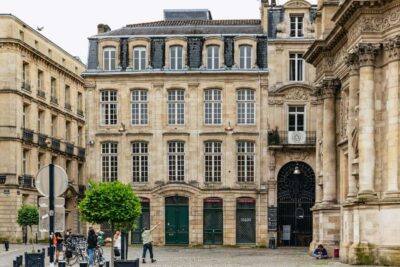
Bordeaux: Historic Center & Chartrons District Bike Tour
Read our review →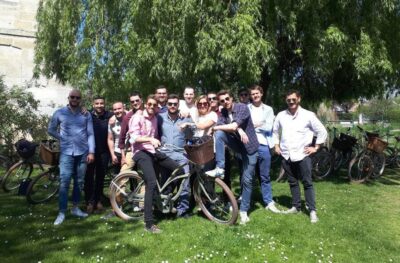
Strasbourg: Guided Historical Neighborhoods Walking Tour
Read our review →
Paris City of Fashion History Private Guided Walking Tour
Read our review →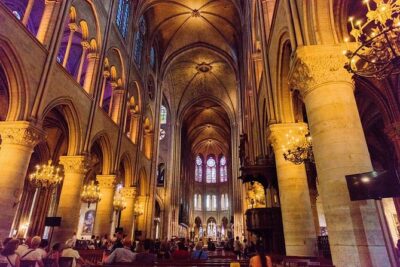
History of Paris City Center w/ Notre Dame Semi-Private 12ppl Max
Read our review →Browse the lists this tour appears in