
Review · FRANCE
Culture History & Secrets: Lyon with a local artist -english
Lyon’s old center is best understood on foot, and this tour gives you more than a parade of pretty streets. Bertrand, a Lyon-born actor and visual artist, leads you through Roman beginnings, medieval lanes, silk history, WWII stories, and the city’s famous traboules, or passageways. His use of documents and anecdotes helps turn walls and courtyards into part of a larger story.
I like the small group of up to 10 and the strong local angle. You also get useful food recommendations, not just dates and names. The main point to consider is language: the activity is advertised in English, but one recent group included French, German, and English speakers, so Bertrand gave explanations in more than one language. That can affect the pace.
Key points at a glance
- Bertrand’s personal style: A Lyon-born actor and visual artist brings storytelling and a playful French viewpoint to the walk.
- A compact history lesson: The route covers Roman Lyon, medieval Vieux Lyon, silk production, WWII, and modern food culture.
- Traboules and secret passages: You’ll see Lyon’s famous covered routes and hear why they matter.
- Small-group format: With no more than 10 participants, the walk feels more personal and avoids the feel of a large street crowd.
- Useful local advice: Bertrand provides restaurant and food suggestions, along with a small notebook of recommendations and addresses.
- Good value at $24: For two hours with a professional guide in Lyon’s UNESCO-protected center, the price is modest, though food and paid entries cost extra.
Starting at Saint-Jean Cathedral
Meet at the Vieux-Lyon metro station, then walk to Place Saint-Jean, the square in front of Cathédrale Saint-Jean-Baptiste. Bertrand identifies himself by standing near the fountain with a white T-shirt on a wire hanger. It is an unusual meeting signal, but a useful one in a busy historic square.
The cathedral visit is scheduled for about 10 minutes. That is enough for an introduction to the building and the area, but not enough for a full architectural tour. You should think of this stop as the opening chapter rather than a detailed examination of the cathedral.
Starting here makes practical sense. You are placed right in the middle of Vieux Lyon, the part of the city most visitors come to explore. The walk can then move through the surrounding streets without wasting time on transport.
Wear shoes with a firm sole. The route is a walking tour through old streets, and comfort matters more than looking polished for the first few minutes. Bring water and an umbrella, since the tour runs outdoors and the weather can change.
More Local Culture and Traditions Tours in France:
- Vieux Lyon Cultural & Historical Walking Guided Tour (English)
★ 5.0 · 942 reviews - Explore the Marais: History, Art & Local Culture
★ 4.6 · 105 reviews - Arles: Private Guide Tour – Explore History & Culture
★ 4.3 · 22 reviews
Walking through Vieux Lyon’s medieval streets
Vieux Lyon is the heart of the experience. Its lanes show a different side of Lyon from the broad riverfront avenues and modern shopping streets. You can expect the guide to connect the visible buildings with the people and trades that shaped the district.
The route covers the area in several short sections, each lasting about 10 minutes. That format keeps the walk moving, though it also means you will not spend a long time at every stop. If you enjoy a slow architectural study, you may want to return later on your own.
I like the way this structure gives you a framework for exploring the quarter after the tour. You are not simply told that a street is old. You hear about the forces that made Lyon important, including its Roman role, medieval trade, and silk production.
The tour presents Lyon as a city with more than one identity. It was an early Roman center, a major European cultural and financial center, and later a key place for silk. Those layers are easier to grasp when you move through the streets where the story took place.
Roman origins and 2,068 years of Lyon
Bertrand describes Lyon as a city with 2,068 years of history. The Roman chapter comes early in the walk and gives you a useful starting point. Instead of treating Roman Lyon as a detached archaeological subject, the tour sets it within the city’s long growth.
This is one of the better reasons to take the walk near the beginning of your stay. Lyon can feel spread across several districts, rivers, hills, and eras. A guide who explains how its story began gives you a clearer way to read the rest of the city.
The exact amount of Roman detail will depend on the group and the guide’s pacing. The route is designed as a broad historical walk, not a specialist archaeological tour. You should expect clear context and memorable facts rather than a technical lecture.
That balance suits most first-time visitors. I would choose this tour if you want the big picture and a few stories you can remember over dinner. I would choose a more focused archaeology visit if Roman sites are your main reason for coming to Lyon.
Silk, trade, and the working city
The walk also explains the roots of Lyon’s silk tradition. This is valuable because silk was not just a decorative luxury. It helped shape the city’s work, wealth, streets, and reputation.
In Vieux Lyon, the silk story gives purpose to the historic buildings. You begin to see the district as a place where people lived and worked, not merely as a photogenic quarter. That is the kind of context I find most useful on a walking tour.
The visit to a local food market adds another everyday layer. It is scheduled for about 10 minutes, so do not expect a full market tour or a tasting session. Food and drinks are not included, but Bertrand’s recommendations can help you decide where to eat after the walk.
That advice may be one of the most practical parts of the experience. Lyon is known for its food, and a short list of local addresses is more useful than a vague instruction to find a good restaurant. One review specifically noted that Bertrand carries a small notebook with recommendations and places to visit in the city.
More History Tours in France:
- Paris: Louvre Museum Entry with History of Mona Lisa
★ 3.9 · 2,823 reviews - Paris: Dark History and Ghostly Guided Walking Tour
★ 4.7 · 1,000 reviews - Bordeaux: Historic Center & Chartrons District Bike Tour
★ 4.8 · 709 reviews - Bordeaux: Top Landmarks & Historic Bike Tour
★ 4.9 · 346 reviews
Traboules and Lyon’s secret routes
The famous traboules are a central attraction. These passageways cut through buildings and courtyards, offering routes that are easy to miss if you are walking alone. The tour includes secret stops and a visit to these distinctive passages.
The value here is not only seeing a narrow entrance. Bertrand explains the role of the passageways in Lyon’s urban life, including their connection to the older parts of the city. You get a sense of how the streets worked and why these routes became part of Lyon’s identity.
Access to individual traboules can vary, and the supplied details do not promise entry to every passage. The tour does promise a visit to historical monuments and hidden places, so you should expect the guide to select suitable stops on the day.
This is also where a small group helps. Ten people can gather without filling a passageway, and the guide can answer questions without shouting over a large crowd. You should still be respectful of residents, since parts of Vieux Lyon are lived-in spaces rather than an open-air museum.
Riverside views and WWII stories
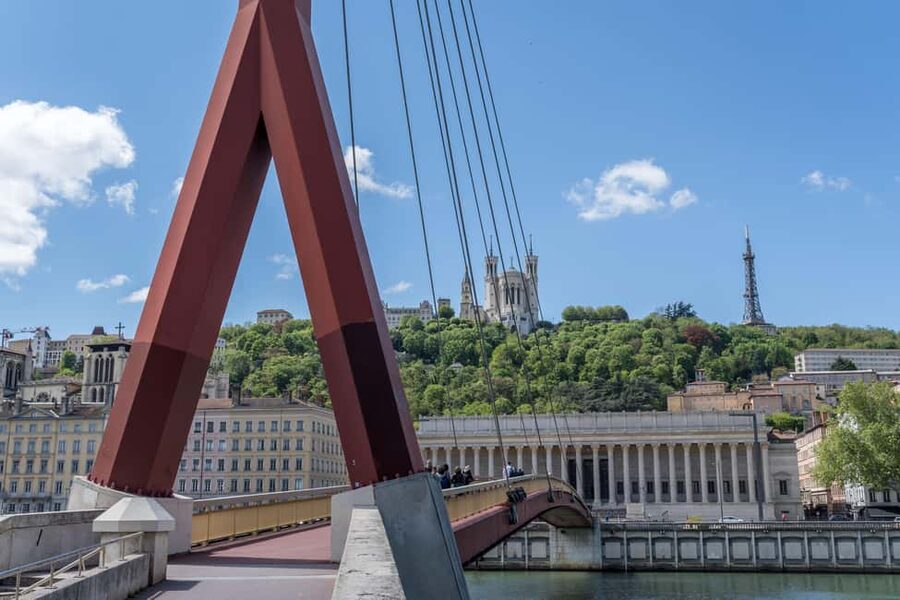
The itinerary includes a viewpoint with panoramic river views, followed by the Palais de Justice and more of Vieux Lyon. This creates a welcome change from close streets and enclosed passageways.
The view is not treated as a stand-alone photo stop. Bertrand uses it to discuss Lyon’s wartime past and WWII chronicles. That combination helps you connect the city’s geography with its modern history.
The information provided does not specify exactly which riverfront viewpoint you will visit, so do not book this expecting a named lookout or a long scenic break. The stop lasts about 10 minutes. You will have time to look, take photographs, and listen, but not to linger for a full hour.
The Palais de Justice adds another formal landmark to the route. Its presence balances the narrow lanes of the Old Town with a building tied to law and public life. Again, the visit is brief, so think of it as part of a connected story rather than a full interior tour. Entrance fees are not included, and the activity does not promise admission inside paid attractions.
Bertrand’s guiding style
Bertrand is described as a French actor, visual artist, and professional guide born and raised in Lyon. That background matters because the tour is built around presentation as much as information. You can expect a lively delivery, visual references, and stories shaped for a walking audience.
The feedback supplied about the tour repeatedly points to his enthusiasm, courtesy, and ability to explain the city through anecdotes. One French participant described the walk as a real history lesson, while another praised the documents Bertrand used to illustrate his points. An English-speaking participant highlighted his engaging delivery and the amount learned in two hours.
He also appears comfortable handling questions in several languages. One group included French, German, and English speakers, and Bertrand reportedly switched between languages to help everyone follow. That is a generous approach, though it brings a practical tradeoff: a multilingual explanation can take longer.
The advertised tour language is English. If you need a strictly English-only experience with no pauses for other languages, confirm the arrangement before booking. If you enjoy a flexible guide who can respond to a mixed group, this may work very well.
A two-hour route with a personal feel
The tour is planned for two hours, with roughly 10 minutes assigned to each stop. The route begins at Saint-Jean Cathedral and ends at Place Sathonay, so you finish in a different part of the city rather than back where you started.
That is useful for planning. Place Sathonay gives you a new point from which to continue exploring Lyon, though no onward transport plan is included. You should check your next destination before the walk ends, especially if you have a restaurant reservation or a train to catch.
The schedule is fairly compact. You will cover a lot of ground and hear several historical themes in a short time. I like that efficiency for a first afternoon in Lyon, but I would not choose it if you want long pauses for sketching, extended photography, or detailed visits inside monuments.
The maximum group size is 10. That is small enough for direct conversation and easier movement through old streets. It also supports the promise of avoiding the feel of a crowd, although popular parts of Vieux Lyon can still be busy outside the group.
What the $24 price really buys
At $24 per person, this is a reasonably priced introduction to Lyon. The fee covers a professional guide, a two-hour walk, historical monuments, and stops in the UNESCO-protected part of the city.
The strongest value is the guide’s interpretation. You can walk through Vieux Lyon for free, but it is harder to understand why the Roman, medieval, silk, wartime, and food stories fit together. Bertrand’s local advice adds value beyond the scheduled route.
Keep your expectations clear. Food and drinks are extra. Hotel pickup and drop-off are not included. Paid attraction entrances are also outside the price, though the activity is primarily an outdoor walking route.
The price is especially appealing if you are new to Lyon and want an orientation before exploring alone. It is less useful for you if you already know Vieux Lyon well or plan to spend your time inside museums and monuments rather than walking between them.
Who should take this Lyon walk
I would recommend it to first-time visitors who want a readable introduction to the Old Town. It suits you if you enjoy history told through anecdotes rather than a formal academic lecture.
It also fits solo visitors and couples who want a small group, plus families with older children who can manage two hours on foot. The playful style and famous characters may keep the subject matter moving for people who lose interest in dates and dynasties.
Food-focused visitors should pay attention to the local recommendations. You will not receive a meal, but you can leave with ideas for Lyonnais places to try later.
The tour is not suitable for wheelchair users, according to the activity information. The route also calls for comfortable walking shoes, water, a camera, and protection from rain. Photography is allowed.
Is Culture History & Secrets worth booking?
Book this tour if you want a friendly local guide, a short route, and several sides of Lyon in one sitting. Bertrand’s background as an actor and artist gives the walk a more personal feel, while the small group keeps it from becoming a street lecture.
It is a good $24 choice for your first day in Lyon, especially if you want restaurant suggestions and a clear sense of how Vieux Lyon fits into the city’s long story. The main caution is the language mix. The activity is presented in English, but explanations may be repeated in French or other languages when the group requires it.
I would skip it only if you need wheelchair access, want long indoor visits, or prefer a tour devoted to one subject such as Roman archaeology or silk manufacture. For a broad, lively introduction to Lyon’s old center, it offers plenty for two hours.
FAQ
Where does the Lyon walking tour begin?
The meeting point is at the Vieux-Lyon metro station area. Go to Place Saint-Jean, in front of Cathédrale Saint-Jean-Baptiste, where Bertrand will be by the fountain with a white T-shirt on a wire hanger.
Where does the tour finish?
The walk ends at Place Sathonay.
How long does the tour last?
The scheduled duration is two hours.
What language is the tour in?
The activity is offered in English. Bertrand may also explain points in other languages for a mixed group, including French and German.
How large is the group?
The tour is limited to 10 participants.
Are food and drinks included?
No. Food and drinks are not included, though Bertrand provides local food and restaurant recommendations.
Is the tour suitable for wheelchair users?
No. The activity is listed as not suitable for wheelchair users. Comfortable walking shoes are recommended for everyone.
Latest history tours reviewed in France
- Explore the Marais: History, Art & Local Culture★ 4.6 · 105 reviews
- Discover Caen like never before: Guided tours between history & secrets!★ 4.9 · 67 reviews
- Champagne Cellar Experience: Explore our historic cellars★ 4.7 · 46 reviews
- A locals’s guide to Bordeaux’s historic market★ 4.8 · 23 reviews
- Bordeaux: Walking Tour of the City’s Best Bakeries★ 4.8 · 69 reviews
- Bordeaux: Top Landmarks & Historic Bike Tour★ 4.9 · 346 reviews
- Avignon: Historic District Guided Food & Wine Walking Tour★ 4.8 · 84 reviews
- Avignon: History and Legend Walking Tour★ 4.8 · 122 reviews
France History Tours, compared.
Paris: Louvre Museum Entry with History of Mona Lisa
Read our review →
Paris: Dark History and Ghostly Guided Walking Tour
Read our review →
Vieux Lyon Cultural & Historical Walking Guided Tour (English)
Read our review →
Bordeaux: Historic Center & Chartrons District Bike Tour
Read our review →
Strasbourg: Guided Historical Neighborhoods Walking Tour
Read our review →
Strasbourg on Foot: Historic Center and Petite France with a Local Guide
Read our review →
Paris City of Fashion History Private Guided Walking Tour
Read our review →Browse the lists this tour appears in