
Review · UZBEKISTAN
Samarkand: Historical City Highlights Guided Walking Tour
Samarkand’s greatest sights are close enough to connect on foot, but their stories span rulers, scholars, faith, ambition, and the Silk Road. This $18 walking tour brings the main monuments into one clear half-day route, led by guides such as Sarvinoz, Charos, Ozoda, or Abdulaziz.
I especially like the chance to see Shah-i-Zinda and Registan in one outing, and the small-group format can feel almost private when bookings are light. The main consideration is the pace: you will walk for about four hours, often under strong sun, and admission tickets are not included.
Key points to know before you book
- Five major monuments in four hours: The route covers Gur-e-Amir, Registan Square, Bibi-Khanym Mosque, Hazrat Khizr Mosque, and Shah-i-Zinda.
- A guide makes the architecture easier to read: You get explanations of Amir Timur, the Timurid era, local customs, and the meaning behind the buildings.
- Small groups may become private tours: Several bookings have operated with only two people or a very small group.
- Walking is the main transport: The listed walks between stops range from about 20 to 40 minutes, so comfortable shoes matter.
- Tickets cost extra: The $18 price pays for the guide and taxes, but monument admission is separate.
- Ask for time at the sites: Guides including Sarvinoz and Charos have been praised for answering questions, waiting for photos, and keeping the tour on schedule without rushing.
Why this four-hour route works so well
Samarkand can feel like a set of enormous blue-tiled monuments scattered across a modern city. This tour gives those sights a sensible order and a human voice. You begin with Amir Timur, move into the grand public space of Registan, then continue through mosques, a hilltop religious site, and a royal necropolis.
That sequence matters. You first meet the Timurid ruler in his mausoleum, then see the educational and political world his dynasty created. By the time you reach Shah-i-Zinda, you have enough background to understand why Samarkand’s tombs and religious buildings carry such weight.
The tour is listed at four hours, with walking portions of roughly 20, 40, 20, 20, and 40 minutes at the main stops. Actual timing can vary. Guides have allowed extra time for photographs, shopping, questions, and even a local bread stop, but you should still expect a steady outing rather than a slow day with long café breaks.
More History Walking Tours in the world:
- History and Hauntings of Salem Guided Walking Tour
★ 5.0 · 14,564 reviews - Lisbon: History, Stories and Lifestyle Walking Tour
★ 4.8 · 10,902 reviews - Boston: Freedom Trail History Small Group Walking Tour
★ 5.0 · 6,450 reviews
Gur-e-Amir, where the story begins
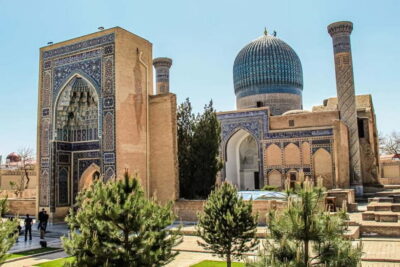
The first major stop is the Gur-e-Amir Mausoleum, also called Gur-I-Amir or Amir Temur Mausoleum. This is the burial place of Amir Timur, the conqueror known in the West as Tamerlane, and it gives the tour its historical starting point.
Look for the building’s large dome, patterned tilework, and careful geometric decoration. The exterior is impressive, but the interior details are what make a guide useful. A good explanation can help you notice the symbolism, the burial arrangement, and the way the monument reflects Timurid taste.
This stop is also a good place to ask your guide for the basic timeline of Samarkand. Guides such as Sarvinoz have been praised for explaining Amir Timur and the Timurid Empire in a way that remains clear rather than turning into a long lecture. If you are interested in Central Asian or Indian history, ask how the region’s rulers and trade routes connected with neighboring cultures.
The first walk sets the tone. You are not being driven from gate to gate. You get a closer look at the streets between monuments, and you can ask about daily life in Samarkand as you go.
Registan Square, Samarkand’s grand central stage
Registan is the visual centerpiece of the tour. Three madrasahs frame the square: Ulugh Beg, Sher-Dor, and Tilya-Kori. Their facades use layers of blue, turquoise, cream, and gold, with arches and tile patterns that reward both a wide view and a close look.
Your guide should help you separate the three buildings and explain their different roles. Registan was not simply a pretty plaza. It was a center for study, religion, public life, and political display during the Timurid and later periods.
Allow time here for photographs. The square changes character as you move around it, and a guide can point out details that are easy to miss when you are focused only on the huge facade. The tour includes a photo stop as well as guided sightseeing, so you should not have to choose between listening and taking pictures.
One useful detail from the experience is the flexible attitude of the guides. Anne’s guide even stayed for the Registan light show, while other guides have waited patiently while people shopped or took extra photographs. Do not assume every departure includes a light show, but it is worth asking about current timing if one is running during your visit.
Registan can also be the busiest-feeling part of the route. The square is open and exposed, with little shade mentioned in the tour details. Bring a hat, sunscreen, and water, especially in warmer months.
Bibi-Khanym Mosque and the weight of ambition
A short walk leads to Bibi-Khanym Mosque, one of Samarkand’s most imposing religious buildings. It was commissioned by Amir Timur in honor of his wife, and its scale tells you a great deal about the ruler’s ambition.
The mosque is partly ruined, but that is part of its appeal. The remaining arches and monumental walls show how grand the original project was, while the damaged sections make the site feel less polished and more connected to the passage of time. You can appreciate the architecture without pretending the building is untouched.
This is a place where stories can easily become legend. Ask your guide which parts are accepted history and which belong to local tradition. That conversation often adds more value than memorizing dates.
The walk from Registan is manageable, but you will already have spent time on your feet. If you want detailed photographs of tilework, tell your guide early. Guides have generally been willing to give people time to explore while keeping the group moving toward the next stop.
More Guided Tours in the world:
- Edinburgh: Edinburgh Castle Guided History Tour with Tickets
★ 4.8 · 9,933 reviews - Historic Charleston Guided Sightseeing Walking Tour
★ 5.0 · 6,216 reviews - Rome: Colosseum with Arena, Roman Forum and Palatine Guided Tour
★ 4.0 · 5,598 reviews - Venice: St. Mark’s Basilica Guided Tour & VR History Intro
★ 3.9 · 4,880 reviews
Hazrat Khizr Mosque and a quieter pause
Hazrat Khizr Mosque offers a change of mood. Compared with the monumental scale of Registan and Bibi-Khanym, this is a more peaceful and spiritually important stop. It is described as one of Samarkand’s oldest and most revered religious sites, with a position that provides wide views over the city.
The setting gives you a useful pause in the route. You can look back at the city and understand how the major monuments fit into modern Samarkand. It is also a good moment to ask your guide about religious customs and the continuing role of these places.
Wear clothing suitable for visits to religious sites, and behave quietly inside. Photography is allowed, but respect local practice. A guide can help you understand where photographs are appropriate and how to avoid treating an active sacred place like a photo set.
This stop may appeal most to people who want more than grand facades. The tour does not focus only on famous postcard views. It includes a working spiritual site and gives you a chance to consider how old buildings remain part of local life.
Shah-i-Zinda, the strongest final stop
The tour finishes at Shah-i-Zinda, a major necropolis of mausoleums associated with royal figures and religious people. Its name is often translated as Living King, while the complex is also described as the Street of the Dead. Either way, this is one of Samarkand’s most powerful places.
The complex is known for its narrow passage lined with tombs, richly patterned tile, and changing shades of blue. Unlike the broad openness of Registan, Shah-i-Zinda draws you forward through a more intimate sequence of buildings. Every turn offers another doorway, dome, inscription, or mosaic surface.
This is where a guide’s timing matters most. You need enough space to look carefully, but the complex also has a strong flow of people and religious activity. Sarvinoz, Charos, and other guides have been praised for allowing photographs and questions without losing track of the route.
The final walk is listed at about 40 minutes, and that does not mean every minute is spent walking. It includes the visit itself, so expect to stand, climb or descend where needed, and pause at several points. If you have knee problems, fatigue, or difficulty with uneven walking, ask about the route before booking. The supplied information does not give an accessibility assessment, so you should not assume every section is easy for every mobility level.
The guides make the difference
The strongest part of this experience is the guide service. Names that appear repeatedly in the supplied details include Sarvinoz, Charos, Ozoda, Obidova, Abdulaziz, and Bekhruz. Guides have been praised for clear explanations, good humor, patience, cultural insight, and the ability to answer questions without making the tour feel like a classroom.
Sarvinoz in particular has led many departures, and the descriptions of her guiding style are consistent: she explains the monuments in detail, manages the pace, leaves room for photographs, and offers practical suggestions for the rest of an Uzbekistan trip. Charos is described as friendly and attentive, while Ozoda has handled English tours with clarity and care.
Your actual guide may be different. The booking information lists English and Chinese, and it does not promise a specific person. Add your WhatsApp number when booking, since the operator asks for it and the meeting point can vary by booking option.
A small group is a real advantage here. You can ask about tile patterns, local traditions, food, or the Uzbek language without waiting for a large crowd to quiet down. Some outings have effectively become private tours because only one other person or partner booked.
What $18 really gets you
At $18 per person, this is an unusually low-cost way to organize your first look at Samarkand’s central monuments. You are paying for a professional guide and taxes, not a vehicle, meals, or admission tickets.
The value comes from the context. You could walk between these sites yourself, but you might not understand how Gur-e-Amir connects to Registan, why Bibi-Khanym matters, or how Shah-i-Zinda differs from a standard group of mausoleums. A good guide also saves you the effort of planning a route and keeps the four-hour visit focused.
You should budget separately for entrance fees. The supplied details do not state the ticket prices, so check the current cost before you go. Carry local currency for personal expenses, shopping, or food.
The tour may include a taste of local Uzbek cuisine or a bazaar stop, but this is not presented as a full food tour. Think of food as a possible part of the local experience, not the main reason to book.
Who should choose this walking tour
I would choose this tour if Samarkand is your first stop in Uzbekistan and you want a clear introduction before exploring independently. It is also a strong fit for history lovers, architecture fans, photographers, and anyone who prefers a guide who can explain what they are seeing.
It suits visitors with only an afternoon or half-day available. The route covers the main monuments without requiring a full-day commitment, and several people have found the walking distances manageable.
You may want something else if you dislike walking, need a very slow pace, or want long unstructured visits at each site. Four hours is enough to see a great deal, but not enough to linger indefinitely. Summer heat, winter cold, and changing weather can also affect comfort. One outing continued in cold conditions, with the guide completing the full route, but you should still dress for the forecast.
Wear comfortable shoes, bring a hat and sunscreen, and carry water. Dress respectfully for mosques and sacred spaces. Photography is permitted, but local customs still apply.
Should you book the Samarkand highlights walk?
Book it if you want the city’s major monuments explained in a logical order for very little money. The strongest reasons are the five-site route, the chance of a small or private group, and guides who are willing to answer questions and adjust the pace.
Before paying, confirm the meeting point, since several starting options are available, and remember that admission tickets are extra. If you are comfortable walking for four hours and want more than quick photographs, this is a smart first introduction to Samarkand. If you prefer total flexibility or cannot manage a long walking route, arrange a slower private plan instead.
FAQ
How long does the Samarkand walking tour last?
The tour lasts four hours.
How much does the tour cost?
The listed price is $18 per person.
Which sites are included?
The route includes Gur-e-Amir Mausoleum, Registan Square, Bibi-Khanym Mosque, Hazrat Khizr Mosque, and the Shah-i-Zinda Complex.
Are entrance tickets included?
No. Admission tickets are not included in the tour price.
Is the tour conducted in English?
Yes. English and Chinese-speaking live guides are available.
Is this a private tour or a group tour?
Private or small-group options are available. The group type depends on the option booked.
How much walking is involved?
The tour is a walking experience, with listed walking sections of about 20 to 40 minutes between or around the main stops. Comfortable walking shoes are recommended.
What should I bring?
Bring comfortable shoes, a hat, sunscreen, protection for changing weather, and some local currency for personal expenses.
Can I take photographs?
Photography is allowed, but you should respect local customs at religious sites.
Can I cancel the booking?
You can cancel up to 24 hours in advance for a full refund. The reserve-now, pay-later option lets you book without paying immediately.
Latest history tours reviewed in the world
- From Athens: Ancient Olympia Full-Day Private Tour★ 4.8 · 22 reviews
- From Athens: Explore Ancient Corinth & Charming Nafplion★ 4.6 · 102 reviews
- From Athens: Explore Ancient Greece 4-Day Tour★ 4.7 · 73 reviews
- From Albufeira: Wine Tasting & Historic Silves Tour★ 4.9 · 421 reviews
- From Albufeira: Historical Algarve Region Tour★ 4.7 · 585 reviews
- From Alexandria: Full-Day Guided Tour of Historical Sights★ 4.5 · 54 reviews
- Franklin: Ghost Tour in Historic Franklin★ 4.8 · 65 reviews
- Freiburg: Exciting City Tour with sightseeing and history★ 4.3 · 103 reviews
Uzbekistan History Tours, compared.
Samarkand: Historical Monuments Guided Walking Tour
Read our review →Khiva: Historical City Highlights Guided Walking Tour
Read our review →
Browse the lists this tour appears in