Review · MADRID
Madrid Historical Tour with Local Guide in Eco Tuk Tuk Private
Madrid’s long boulevards and spread-out sights make an electric tuk-tuk tour a smart first look at the city. You can roll from the Royal Palace to Atocha, the Prado, Cibeles, and the Temple of Debod without spending your first afternoon marching between monuments.
I like the private setup, since your group gets the guide’s attention and can ask questions freely. I also like the local touch: guides such as Carlos, Laura, Clara, Gloria, and Alejandro explain the city with history, neighborhood tips, food suggestions, and the occasional joke. The main drawback is the fixed route. Photo stops are planned ahead, and the tuk-tuk holds no more than four passengers.
Key points to know before booking
- A quick city orientation: The route links Madrid’s royal, artistic, political, and everyday landmarks in one ride.
- A genuinely private outing: Only your party joins the tuk-tuk, with a legal limit of four passengers per vehicle.
- A strong choice for day one: Use the guide’s food and neighborhood advice to shape the rest of your stay.
- An easy ride for limited walkers: The vehicle covers ground without asking you to cross Madrid on foot.
- A careful meeting point: The tuk-tuk leaves from an underground bus station near the Royal Palace, not from the visible tuk-tuks outside.
- Weather protection included: Blankets and protective layers help in cold, rainy, or windy conditions.
Why a Madrid tuk-tuk tour works so well on your first day
Madrid is easy to enjoy on foot, but its sights are not packed into one small square. The Royal Palace, Prado Museum, Atocha Station, Puerta de Alcalá, and Temple of Debod are separated by broad streets, busy junctions, and several neighborhoods.
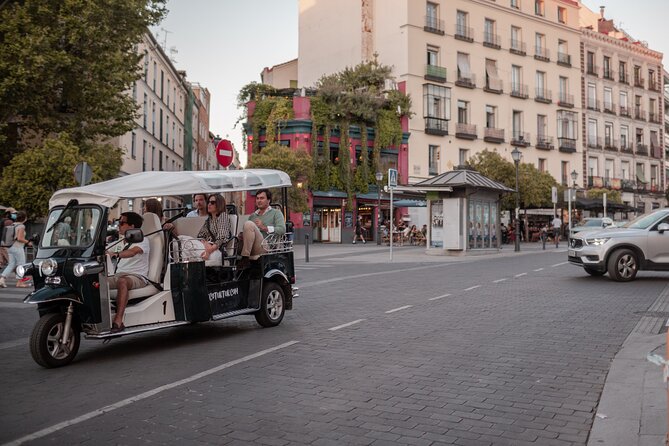
A tuk-tuk gives you a useful middle ground. You get more contact with the city than from a sealed sightseeing bus, but far less walking than on a full-day city tour. The open sides let you see the streets as you move, while the small vehicle can keep the experience personal.
The guide drives and provides commentary in English. The strongest part of the experience is likely to be the guide’s personality. Carlos is praised for combining city history with practical suggestions. Laura brings humor and local pride. Clara is described as friendly, safe, and willing to answer questions. Gloria is especially good at timing photo stops and explaining architecture and lesser-known corners.
I would book this near the start of your visit. You can mark places to return to later, ask where to eat, and get a working map of Madrid in your head before choosing museums and neighborhoods on your own.
More History Bike, Segway and Tuk-Tuk Tours in Spain
- Barcelona: 2.5-Hour Bike or E-Bike Historical Tour
★ 4.5 · 1,262 reviews - San Sebastian E-bike trour: Basque History and Cultural.
★ 5.0 · 367 reviews - Segway Your Way Through Granada’s History: The Ultimate Ride
★ 5.0 · 334 reviews
What the private electric tuk-tuk feels like
The vehicle is fully electric, which keeps the ride quieter than a standard motor vehicle and fits Madrid’s move toward cleaner urban transport. It is not a luxury car, and you should not expect a silent, glass-smooth ride. The appeal is the open-air view and the unusual way of moving through the capital.
Your group rides alone. That matters because a guide can respond to your questions rather than deliver a one-size-fits-all speech. A family can ask about child-friendly stops, an art lover can focus on the Prado, and a football fan can spend more time on Madrid’s rival clubs and their city traditions.
The legal maximum is four passengers per tuk-tuk. Larger parties need more than one vehicle, and the price is set according to the number of tuk-tuks required. At the listed rate of about $28.66 per person, the experience offers good value for a short private introduction, though the final cost for a bigger party depends on vehicle needs.
The ride suits older people, and drivers can help with boarding. Babies are not allowed, and the minimum age is two years. A minimum weight of 9 kilograms also applies. Pets are not permitted.
Finding the pickup point beside the Royal Palace
The meeting instructions deserve close attention. The listed address is C. de Bailén, 4, but there is no obvious number 4 on the street. The useful landmark is the Puerta del Príncipe, the Royal Palace’s Prince’s Gate.
You go down to the underground bus station directly opposite that gate. Look for the Eco Tuk Tuk signs once you are downstairs. One rider nearly missed the departure because they searched among the tuk-tuks outside the palace rather than in the underground station.
You can contact the operator by phone or WhatsApp if you are lost. An elevator can be arranged for anyone who has trouble using the stairs. Arrive early. A delay reduces your tour time, and a delay longer than 15 minutes can lead to cancellation without a refund.
The tour returns to the same meeting point. Hotel pickup and drop-off are not included and are not legally available for this activity.
From the food market to Madrid’s old center
One stop is a covered market dating from around 1916, with local food, delicatessen stalls, and events in an elegant setting. This gives you a useful look at Madrid beyond grand monuments. You can ask your guide what locals buy, which foods fit your schedule, and which markets deserve a return visit.
Do not expect a long food tasting session unless your chosen tour arrangement says otherwise. The market is part of a city overview, not a dedicated culinary tour. Its value is in seeing how food, social life, and old architecture share the same space.
The route also reaches the Royal Basilica of San Francisco el Grande, officially the Basilica of Our Lady of the Angels. It sits in the historic center in the Palacio neighborhood. The church adds an important religious and architectural note to a route otherwise filled with palaces, museums, and public squares.
From here, the guide can place Madrid’s central sights in a wider story. You see how royal power, the church, government, commerce, and public life grew together rather than as isolated attractions.
More Private History Tours in Madrid
- Segway Private Tour in the Historic Center of Madrid
★ 5.0 · 310 reviews - Madrid Historical in French (petit comité & private)
★ 4.8 · 228 reviews - Private: Madrid Historic Centre Food Tour with 10+ Authentic
★ 5.0 · 97 reviews
Atocha, Congress, and the working capital
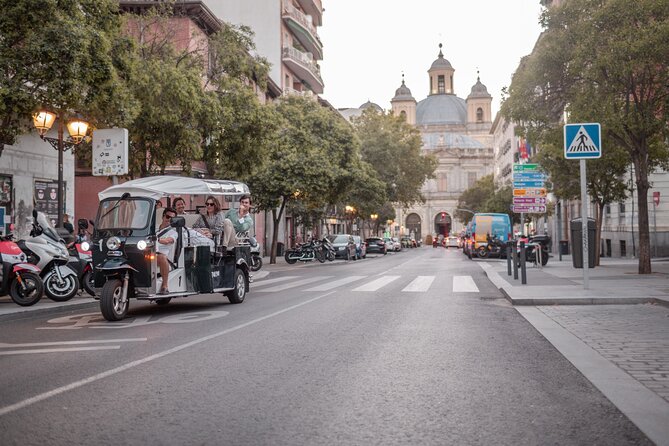
Atocha Station is more than a transport stop. It is Madrid’s busiest railway hub and one of the major stations in Europe, near Plaza del Emperador Carlos V. Its importance helps explain the city’s role as Spain’s national crossroads.
The tuk-tuk gives you the outside view and the urban setting around the station. This is not a station tour, and the itinerary does not promise entry. Still, it is a useful landmark if you are arriving by train or planning a later visit to the area.
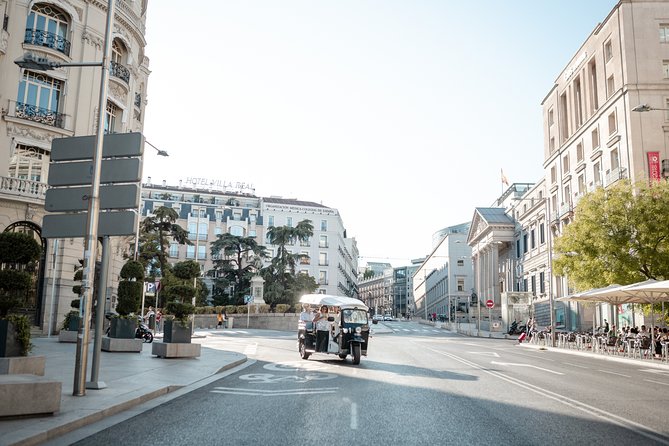
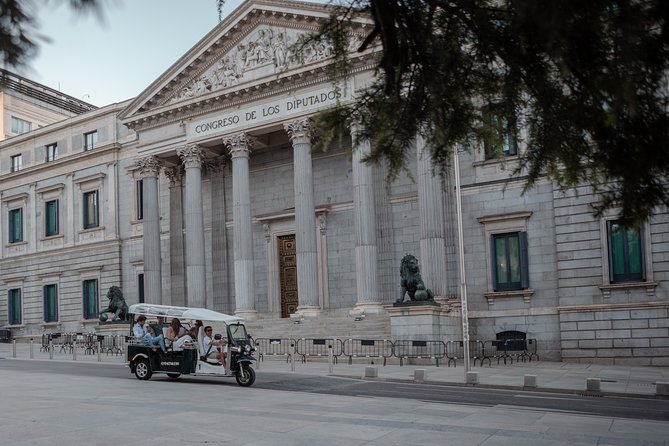
The route also passes the Palace of the Spanish Courts, home of Spain’s Congress. The neoclassical front has six fluted Corinthian columns, a triangular pediment decorated by Ponciano Ponzano, and the famous bronze lions at the entrance. Those lions were cast from iron taken from cannons captured during the war in Africa.
You may also hear about the building’s Session Room, library, and Conference Room, known as the Lost Steps Room. Since access inside is not included, treat this as an exterior explanation rather than a visit to the parliamentary rooms.
Cibeles, Neptune, and Madrid’s football loyalties
One of the more entertaining parts of the route concerns the fountains of Cibeles and Neptune. In Greek mythology, the two gods hold important places, but Madrid has given them a local sporting role.
Real Madrid supporters celebrate at Cibeles after major victories. Atlético de Madrid supporters gather at the Plaza del Dios del Mar, associated with Neptune. The guide can explain how two classical figures became symbols of modern football identity.
This is a good example of why a local guide adds value. A photo of a fountain is one thing. Knowing which club gathers there, and why, turns it into a piece of living city culture. If football matters to you, this part may be a highlight. If it does not, it is still a quick, amusing lesson in how Madrid marks public celebrations.
Around Cibeles, you also see the Buenavista Palace, Linares Palace, Communications Palace, and Bank of Spain. The former post office headquarters now houses Madrid City Hall, while Linares Palace is home to Casa de América.
The Bank of Spain building is particularly decorative. It received an award at the 1884 National Exhibition of Fine Arts and was built to give Spain’s national bank a headquarters suited to its role. The guide’s commentary helps you notice details that are easy to miss when traffic and grand avenues compete for your attention.
The Prado and San Jerónimo
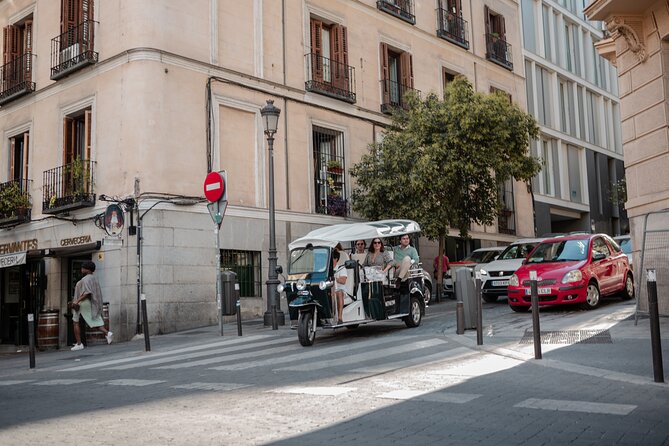
The Prado Museum is the artistic heavyweight on the route. It is famous for European painting from the 16th through the 19th centuries, with major works by Spanish and other European masters.
The tuk-tuk does not replace a museum visit. You will not have time to see the galleries during a city ride, and admission to the museum is not included. Instead, this stop helps you decide if the Prado deserves a full morning later.
Nearby is the Parish Church of San Jerónimo el Real, commonly called Los Jerónimos. The church is late Gothic with Renaissance influence and dates from the early 16th century, though repeated restoration has changed much of the original building.
I like this pairing because it shows two sides of Madrid’s cultural center: the museum’s formal collection and the church’s long architectural life. Ask the guide which entrance, square, or nearby street is worth finding again on foot. The tuk-tuk can introduce the area, but walking is the better way to study its details.
Puerta de Alcalá and the grand city avenues
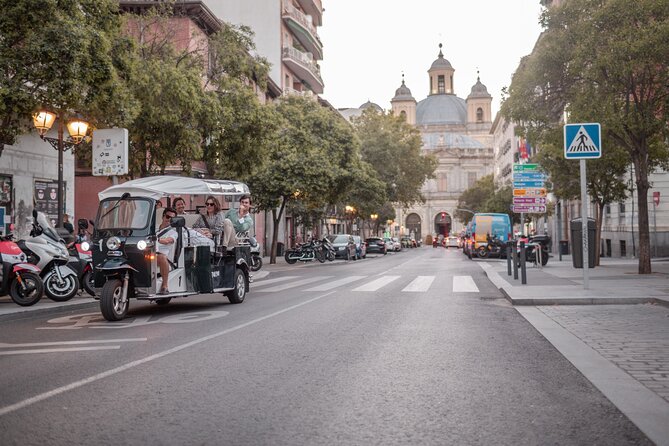
Puerta de Alcalá was commissioned by Carlos III to replace an earlier 16th-century gate and opened in 1778. It is one of Madrid’s best-known monuments, but its location on a major traffic circle means you need a safe, planned stop for photographs.
This is where the tuk-tuk format earns its keep. You can approach the monument with a guide who knows the route and pause at a prearranged place instead of trying to cross a busy avenue for a quick picture.
The tour includes selected photo stops, but you cannot change every stop on the day. That keeps the route moving, yet it also limits spontaneity. If you want ten minutes at one monument or a special family photo at a different corner, ask about the planned stops before departure.
Plaza de Santa Ana and everyday Madrid
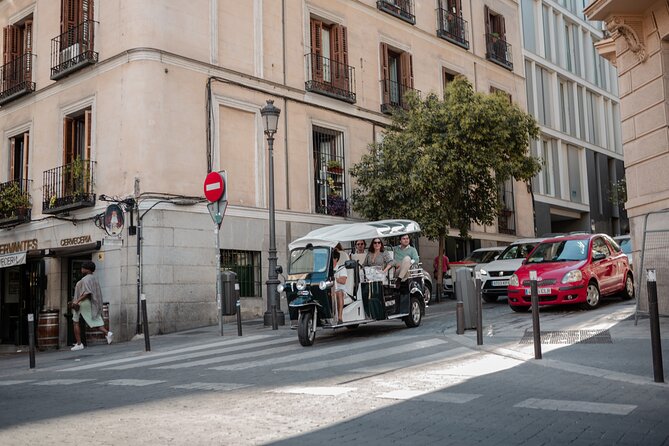
Plaza de Santa Ana lies in the Cortes neighborhood and dates from 1810. Its appearance has changed through several urban renewal projects, making it a good place to discuss how Madrid’s public spaces evolve.
The square gives the tour a break from royal buildings and national institutions. It is part of the city’s social center, where you can connect the historic core with restaurants, streets, and evening activity.
The guide can also offer suggestions for eating and for neighborhoods worth revisiting. Several guides are praised for giving practical food tips, which may be more useful than another list of dates and architectural labels.
The Royal Palace, Sabatini Gardens, and Campo del Moro
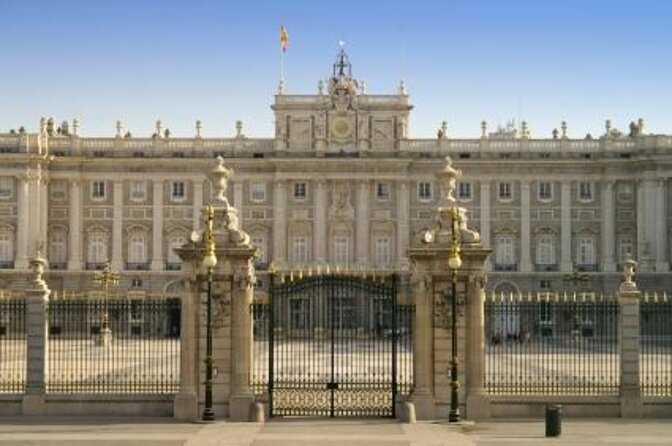
The Royal Palace of Madrid, also called the Palacio de Oriente, began construction in 1738 and took 17 years to complete. It replaced the Palace of the Austrias, destroyed by fire on Christmas Eve in 1734.
Carlos III made it his regular residence in 1764. Today, Spain’s kings live at the Palacio de la Zarzuela, so the Royal Palace is used for receptions, ceremonies, and official events. The tour provides an exterior introduction, not a palace interior visit.
The palace is framed by the Campo del Moro gardens to the west and the Sabatini Gardens to the north. Campo del Moro has medieval roots and can be visited during the day. The Sabatini Gardens cover about 2.66 hectares between Bailén Street and the San Vicente slope.
These gardens help explain the palace setting. You get more than a grand facade. You see the planned open spaces that separate royal buildings from the surrounding city. If you want to enter the palace or walk through the gardens at length, plan a separate visit.
The Temple of Debod at the end of the route
The final listed stop is the Temple of Debod, an ancient Egyptian building now located in Madrid on a hill west of Plaza de España, beside Paseo del Pintor Rosales. The site once held the Cuartel de la Montaña.
The temple is a surprising finish after so much Spanish royal and civic architecture. It shows Madrid’s habit of collecting layers from far beyond the Iberian Peninsula. The stop allows about ten minutes and has no admission charge.
Treat this as a short photo and orientation stop, not a full archaeological visit. Its position gives the guide a chance to finish with one of Madrid’s more unusual sights. If you want a slow look at the temple or its setting, return independently.
Timing, weather, and the value of the ride
Tours last about one to four hours, depending on the option you book. The shorter version works as a quick introduction. Two hours gives you a better balance of driving, commentary, and photo stops. Three hours allows more time for the city’s districts and practical advice, though the route can still feel brisk.
Madrid’s weather changes the feel of the ride. Tours operate in rain and heat and cancel only in extreme conditions. Blankets and protective layers are supplied against cold, wind, and rain. Dress for the forecast anyway, since an open-sided vehicle leaves you more exposed than a car.
At $28.66 per person, this is strongest value for a small group that wants a private overview without paying for a full private car. Solo visitors also get the benefit of a personal guide, while families avoid the strain of a long first-day walk. Larger groups need to check the vehicle count, since four passengers is the legal limit per tuk-tuk.
The guide quality matters more than the vehicle itself. The most praised qualities are clear history, humor, safe driving, patience, and useful suggestions. Names repeatedly associated with strong experiences include Carlos, Laura, Clara, Gloria, Alejandro, Fernando, Juan, Sandra, Christian, and Nerea. You cannot assume a particular guide will be assigned, but the operator has a broad team of English-speaking drivers.
Who should book this Madrid tour?
Book it if you are visiting Madrid for the first time, have only one day, prefer not to walk long distances, or want a private introduction before exploring alone. It also suits families, couples, solo visitors, and small groups who value conversation over a standard bus narration.
It is especially useful for older visitors and anyone trying to cover many districts with limited energy. Football fans, architecture fans, and people who like local food suggestions should find plenty to discuss with the guide.
Skip it if your main goal is extended time inside the Prado, Royal Palace, or Almudena Cathedral. This is a moving overview, not an interior tour. You should also think twice if you dislike open vehicles, fixed photo stops, or strict meeting instructions.
My advice is simple: book the two or three-hour option early in your Madrid stay if you want to get your bearings fast. Keep the rest of the day flexible, note the places that catch your eye, and return on foot to the ones that deserve more time.
FAQ
How much does the Madrid Historical Tour cost?
The listed price is $28.66 per person. The total price can depend on how many tuk-tuks your group needs, since each vehicle holds a legal maximum of four passengers.
How long does the tour last?
The experience lasts approximately one to four hours, depending on the option selected.
Is the tour private?
Yes. Only your group participates in the private activity.
What language is the tour offered in?
The tour is offered in English.
Where does the tour begin?
It begins near the Royal Palace at C. de Bailén, 4, in Madrid’s Centro district. The practical pickup location is the underground bus station opposite the Puerta del Príncipe.
Where does the tour end?
The tour ends back at the meeting point.
Are hotel pickup and drop-off included?
No. Hotel pickup and drop-off are not included and are not legally available for this activity.
Can children join the tour?
Children aged two and older can participate. Babies are not allowed, and a minimum weight of 9 kilograms applies.
Are blankets provided in cold weather?
Yes. Blankets and protective layers against rain and wind are available.
Can I change the route or request extra photo stops?
No. The route and photo stops are prearranged. The itinerary may also change because of closed streets or demonstrations.
What happens if I arrive late?
Your tour time may be shortened by the delay. If you are more than 15 minutes late, the activity may be cancelled without a refund.
Can I cancel for a refund?
You can cancel at least 24 hours before the start time for a full refund. Cancellations or changes made less than 24 hours before departure are not refunded.
More Private History Tours in Spain
- Private Jewish Heritage Journey by Barcelona Dreaming
★ 4.8 · 383 reviews - Barcelona 1.5h Private Old Town, Gothic & Ramblas Walking Tour
★ 5.0 · 318 reviews
Latest history tours reviewed in Spain
- Barcelona Historic Guided Tour★ 4.8 · 24 reviews
- Essential Madrid: Walking Tour of the Historic Center★ 4.7 · 58 reviews
- Discover the fascinating Alcazaba: History and unique views★ 4.8 · 30 reviews
- Cordoba: Segway Tour historic center★ 4.5 · 21 reviews
- Private Jewish Heritage Journey by Barcelona Dreaming★ 4.8 · 383 reviews
- Cartagena: Ancient Roman Walking Tour with Entry Tickets★ 4.5 · 89 reviews
- Caceres: Highlights, History and Jewish Quarter Walking Tour★ 4.7 · 20 reviews
- Bilbao Historical Tour in small group★ 4.7 · 52 reviews
Madrid History Tours, compared.
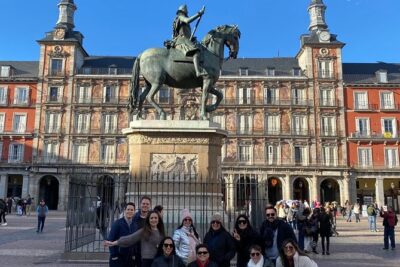
Madrid Essential: Historic Center, Plaza Mayor & Royal Palace
Read our review →
Madrid Tapas & Taverns Small Group Food & History Tour
Read our review →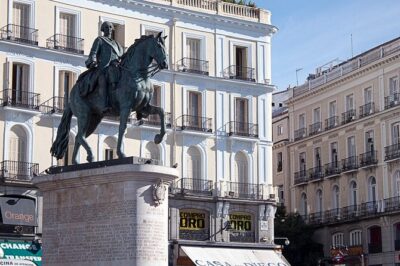
Madrid Historic Centre Food Tour with Authentic Tapas & Wines
Read our review →
Madrid in a Day Tour:Royal Palace, Historic Center & Prado Museum
Read our review →
Guided Tour of Madrid of the Austrias and the Historic Center
Read our review →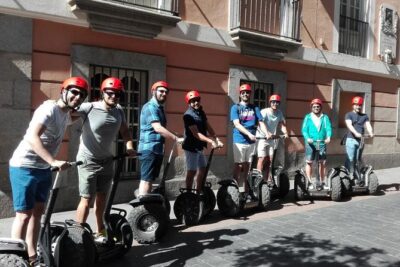
Segway Private Tour in the Historic Center of Madrid
Read our review →