
Review · BELGIUM
Historical Walking Tour: Legends of Gent
Ghent reveals its character best on foot, and this tour gets you quickly into the city’s medieval core. In two hours, you move from the panoramic view at St Michael’s Bridge through old trading quays, a castle, churches, civic squares, and a graffiti alley. The guide’s job is not just to point at grand buildings, but to explain Ghent’s stubborn, independent streak.
I like the pay-what-you-want format, which makes this an unusually low-cost introduction, and I like the broad route. You see the main center without spending your first day guessing which lane leads somewhere important. Guides including Tatiana, Kasia, Kenny, Sophia, Robin, and Liedewei have been singled out for clear explanations, humor, and practical suggestions for food and beer.
The main consideration is that you are on your feet for about two hours, often on old paving. Also clarify the payment arrangement before you go. The listed price is $3.62 per person, but the tour itself asks you to decide what it was worth at the end, and one booking account describes confusion about being asked to pay again.
Key points at a glance
- Thirteen central stops: The route links St Michael’s Bridge, the medieval quays, Gravensteen Castle, St Bavo’s Cathedral, the Belfry, and St Nicholas’ Church.
- Ghent’s independence is the theme: Stories about trade, rebellion, civic power, punishment, and local pride give the buildings a clear purpose.
- A practical first-day walk: The tour ends near the Belfry, leaving you well placed to revisit the sights that caught your eye.
- Strong guide-led storytelling: Tatiana, Kasia, Kenny, Sophia, Robin, and Liedewei are among the named guides praised for humor and clear delivery.
- Low upfront cost, voluntary final payment: The listed price is $3.62, with payment based on your experience at the end.
- Best for curious walkers: Expect a steady two-hour route, a maximum group size of 35, and no promise of interior visits at every stop.
Why this walk is a smart first look at Ghent
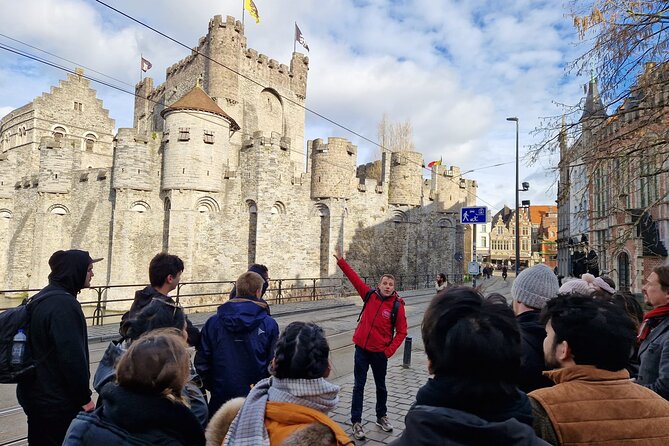
Ghent can feel confusing at first. Its center packs canals, Gothic towers, narrow streets, large squares, and a castle into a fairly compact area. A guide gives those pieces an order.
The tour begins at Hostel Uppelink on Sint-Michielsplein and finishes at the Belfry on Sint-Baafsplein. That direction works well. You start with the city’s broadest view, then walk through the old commercial center before reaching the civic and religious landmarks that define Ghent.
I especially like the way the route mixes major sights with smaller clues about local life. You hear about medieval trade at Graslei and Korenlei, but also about the city’s rebellious spirit at the Design Museum and the reason graffiti artists were given a designated street. That balance keeps the walk from becoming a procession of dates and architectural labels.
The format is simple: an English-speaking guide leads the group, the walk lasts roughly two hours, and you decide what to pay at the end. The group can reach 35 people, though one account described a group of about 18 to 20. Larger groups may feel less personal, so arrive ready to stay near the guide and listen carefully.
More History Walking Tours in Belgium
- Historical Walking Tour: Legends of Bruges
★ 5.0 · 2,541 reviews - Historical Walking Tour: Legends of Antwerp
★ 5.0 · 1,837 reviews - Brussels: Historical Walking Tour with Chocolate & Waffle Tasting
★ 5.0 · 1,165 reviews
St Michael’s Bridge gives you the essential view
The opening stop is one of Ghent’s best orientation points. From St Michael’s Bridge, you can see the three famous towers that shape the skyline: St Nicholas’ Church, the Belfry, and St Bavo’s Cathedral.
This is also where the guide introduces Ghent as a medieval trading center. That context matters. The city’s handsome quays and churches were not placed here by accident. Trade, wealth, civic power, and control of the waterways helped shape the center you see today.
The stop lasts about 15 minutes, making it the longest early pause. It is a good place to take photographs, but keep listening. The view gives you a visual map that makes the rest of the walk easier to follow.
Graslei and Korenlei explain the city’s old port
At Graslei and Korenlei, the guide points out the buildings connected with trading activity when this stretch served as Ghent’s port. You get more than a pretty canal view. The facades become evidence of how goods, merchants, and money once moved through the city.
The stop is short, about 10 minutes. That is enough for a clear introduction, but not a detailed architectural study. If these quays appeal to you, plan to return later when you can look more closely and take photographs without keeping pace with the group.
This is one of the tour’s strongest early sections because it connects beauty with function. Ghent’s old center is not simply decorative. Its canals and buildings tell you why the city became powerful.
Design Museum Gent and the city’s stubborn streak
The stop outside Design Museum Gent shifts the focus from medieval commerce to local character. The guide explains how a detail connected with the museum symbolizes the stubborn and rebellious mindset of the Gentenaars, the people of Ghent.
The museum admission is not included, and this walk does not promise an interior visit. That is worth noting if you want a design-focused museum experience. Here, the value is the story and the connection to Ghent’s civic personality.
I like this pause because it prevents the tour from presenting Ghent as a frozen medieval town. The city’s identity includes argument, resistance, and a willingness to do things its own way.
Same old streets, another chapter:
- Brussels: Historical Tour with Chocolate & Waffle Tasting
★ 4.8 · 1,206 reviews - THE Storytelling Tour of Bruges | First Day Must | History & Tips
★ 5.0 · 925 reviews - Historical Walking Tour: The Story of Bruges – by Legends
★ 4.7 · 483 reviews - Antwerp: Historical Walking Tour in the Old City
★ 4.8 · 373 reviews
Het Groot Vleeshuis brings out the darker side
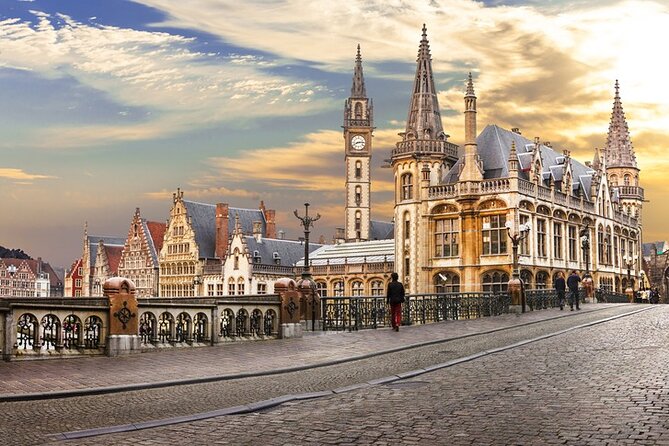
Across the water, you look toward Het Groot Vleeshuis, the medieval covered Great Butchers’ Hall. The building is majestic, but the guide uses it to tell darker facts about its past.
That change in tone is useful. A good city walk should not smooth away the less pleasant parts of history. This stop takes about 10 minutes and stays outside, with free admission listed for the stop.
You may find the view more valuable than the building’s interior here. The guide’s story gives the hall a human edge and helps you see how medieval food trade and civic life were tied together.
Gravensteen puts a castle in the middle of town
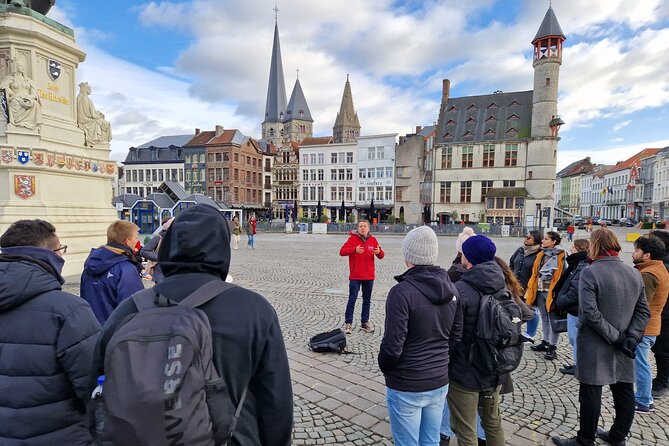
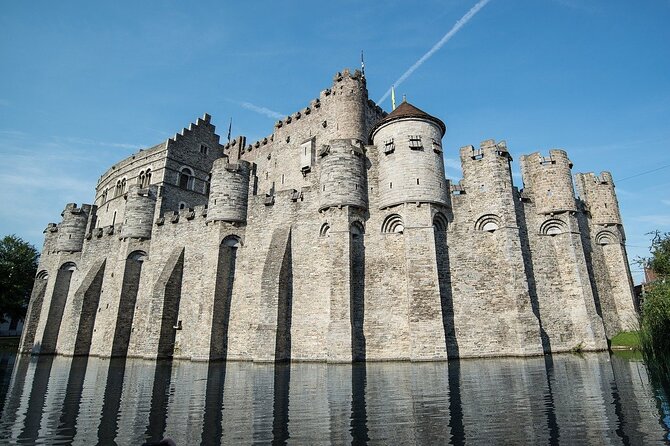
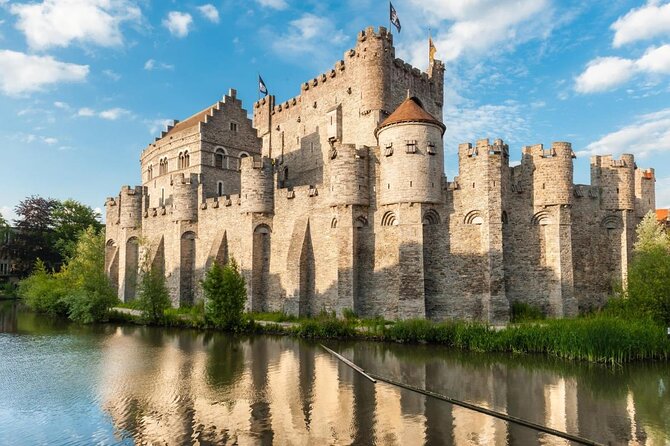
Gravensteen, the Castle of the Counts, is one of the route’s headline sights. Unlike many castles, it sits right in the city center and remains remarkably well preserved.
The guide explains its past during a 10-minute stop. Admission is not included, so treat this part of the walk as an introduction rather than a castle visit. If you want to see the interior, you will need to arrange that separately.
For many people, this is the point when Ghent feels especially distinctive. A medieval fortress beside canals, shops, and city streets is an unusual urban combination. The guide’s short explanation helps you decide if the castle deserves more of your time later.
St Veerleplein connects punishment and daily life
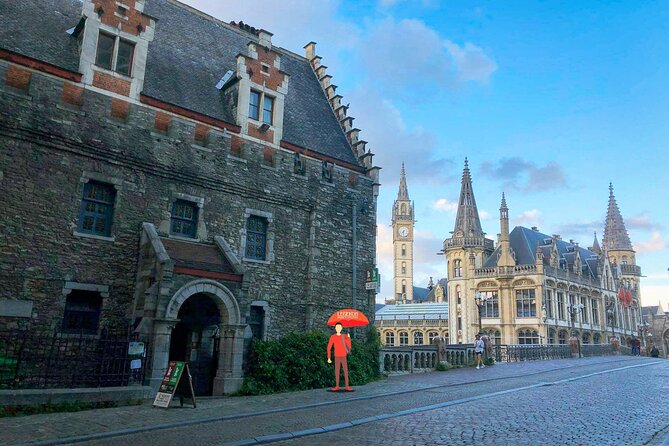
The square in front of Gravensteen is known both as the square of death and the square of life. The guide explains the contrast during another 10-minute stop.
This is a good example of how the walk uses memorable labels to make history stick. You do not just hear a name and move on. You learn why the square gained two very different associations.
Because the stop is outside and free, you can return easily after the tour. The square also helps you understand how a fortress could shape the life of the city around it.
Huis van Alijn tells a difficult hospital story
Huis van Alijn occupies a former hospital and is Ghent’s only remaining god house. The guide explains the unfortunate story behind its development as a hospital.
This stop adds social history to the tour. Churches, castles, and guild halls can make a city’s past look grand. A former hospital brings attention to illness, care, and ordinary people.
The visit here is an exterior explanation rather than a guaranteed museum entry. If the story catches your attention, note the museum for a separate visit. The tour gives you the reason to care about it, which is often more useful than a quick walk through without context.
Vrijdagmarkt places power in a public square
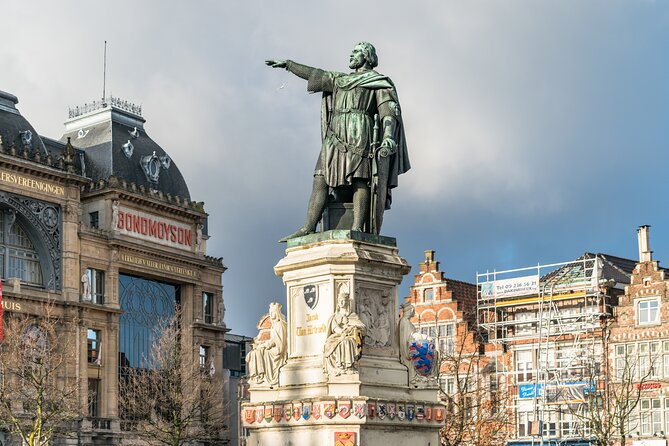
Vrijdagmarkt has played a major part in Ghent’s past, and the statue in its center gives the guide a natural starting point. The story brings together the square, the man represented by the statue, and the city’s political life.
This is one of the places where a local guide can add more than a map or guidebook label. You see a large open square, but the explanation reveals how public spaces held ceremonies, conflict, trade, and civic meaning.
The stop lasts about 10 minutes. It is long enough to understand the setting, not long enough to cover every period of the square’s past. That is a fair trade on a route designed to show you the whole center.
Werregarenstraat shows Ghent’s practical approach to graffiti
Werregarenstraat is the city’s designated street for street art. The idea is practical: give artists a place to work so monumental buildings are less likely to be sprayed.
You walk through the alley as part of the route, seeing how the city has made room for a form of expression that might otherwise create conflict. The contrast with the polished medieval center is part of the appeal.
This is a quick stop, but it gives you a modern piece of Ghent. It also shows that local identity is not limited to old churches and stone facades.
Town Hall reveals a major civic conflict
At Ghent Town Hall, the guide explains why the building looks somewhat confused. Its mixed architectural appearance reflects a major conflict in the city’s past.
This is a useful pause because the building itself becomes a visual clue. Instead of treating the town hall as one unified style, you learn to read its competing parts as evidence of political and historical change.
Admission is not included. The tour focuses on the exterior and the story behind it, which is enough to make the building more interesting when you pass it again.
St Bavo’s Cathedral and the Van Eyck connection
St Bavo’s Cathedral is one of the most important stops. The guide covers the cathedral’s past and its art treasures, especially the famous Ghent Altarpiece by Hubert and Jan van Eyck.
The cathedral stop is listed as free, but this does not mean every part of the experience is a full interior visit. The provided route sets aside about 10 minutes, so expect an introduction and historical context rather than a long examination of the artwork.
That short explanation still has real value. The altarpiece is one of Ghent’s defining works, and knowing its place in the cathedral’s story helps you plan a separate, more focused visit if art is a priority.
The Belfry explains civic independence
The Belfry of Ghent is the people’s tower. The guide links it to the city’s stubbornness, power, and independence, then adds the story of its former prison and a strange legend connected with the facade.
The Belfry is also where the tour ends, at Sint-Baafsplein. Admission is not included, so you can decide later if you want to go inside. Ending here is convenient because the tower is one of the city’s central landmarks and an easy point from which to continue exploring.
This is a satisfying final major stop. The tower is not just a beautiful object on the skyline. It represents Ghent’s civic strength and its desire to control its own affairs.
St Nicholas’ Church closes the route with a legend
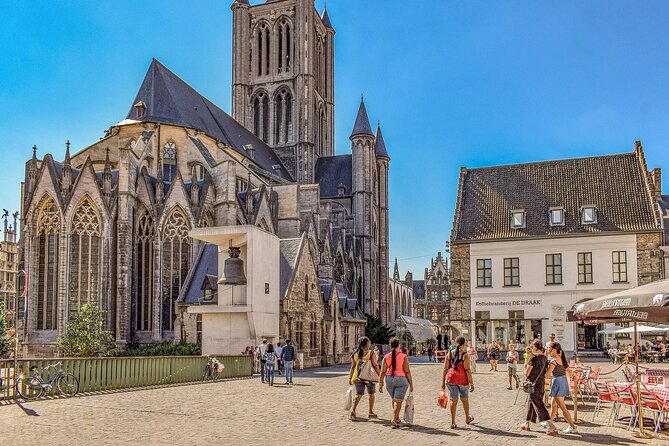
The final stop is St Nicholas’ Church, which looks over Korenmarkt. Its patron saint, Nicholas, protected merchants and sailors, so the church connects neatly with the earlier discussion of trade and the old port.
The facade itself illustrates a legend about the patron saint. It is a fitting ending because the guide returns you to the themes of commerce, protection, local stories, and recognizable buildings.
The church is listed as free at this stop. The route ends at the Belfry, so St Nicholas’ Church is part of the closing section rather than the formal finish point.
Guides, pace, and group size
The quality of this kind of walk depends heavily on the person holding the microphone. The named guides associated with strong experiences include Tatiana, Kasia, Kenny, Sophia, Robin, Liedewei, Camilla, Hans, Florian, and others.
The qualities to look for are clear speech, humor, and the ability to connect buildings with stories. Tatiana is praised for keeping a large group involved. Kasia is described as warm and considerate in hot weather. Kenny is noted for charm, and Robin for strong storytelling and humor. Florian is described as especially good at discussing architecture and history in English.
The route moves at a steady pace. One account calls it fast-paced but effective for seeing most of Ghent, while another says the two hours passed quickly. That tells you what to expect: this is an introduction, not a slow photography walk.
You will be standing and walking for about two hours. Old paving can be tiring, and one account specifically points out cobblestones as a possible concern. Wear comfortable shoes and avoid carrying more than you need.
Price, payment, and one important booking check
The listed price is $3.62 per person, and the tour operates on a pay-what-you-want basis. You pay according to your experience at the end, and guides do not receive their usual payment unless the group contributes.
That makes the tour excellent value for someone who wants orientation at low upfront cost. It also creates a responsibility: carry enough money or have a clear payment method ready, and consider the guide’s time when deciding what to give.
There is one practical warning. A booking account describes being asked for a second, much larger payment despite having a paid confirmation, with confusion about which booking platform had been used. That is not consistent with the simple arrangement described here, so check your confirmation carefully and ask the meeting staff to explain the final payment before the walk begins.
The experience is offered in English, uses a mobile ticket, and allows service animals. It is near public transportation, and most people can take part. The tour requires good weather and a minimum number of participants. If poor weather or low enrollment cancels it, you are offered another date or a full refund.
Free cancellation is available up to 24 hours before the start time. Inside that window, the payment is not refunded and changes are not accepted.
Who should book this Ghent walking tour?
I would choose this tour for a first visit, especially if you want the city to make sense before choosing which interiors deserve your time. It suits solo visitors, couples, families, and anyone who prefers stories over a list of dates.
It is also a good fit if you want practical suggestions for food, beer, chocolate, and other places to explore. Several guides are praised for giving local recommendations, though one account found the commercial suggestions too frequent and would have preferred more explanation of chocolate’s role in Ghent.
You may want a different experience if you dislike group walks, need frequent sitting breaks, or want long visits inside the castle, cathedral, Belfry, and museums. The route introduces those places, but it does not include every admission or give each one extended attention.
Should you book Legends of Gent?
Yes, if you want a lively, low-cost introduction to central Ghent with a clear route and plenty of local stories. The 4.9 rating from 1,761 ratings and 98 percent recommendation rate match the tour’s strongest qualities: engaging guides, a useful overview, good humor, and a route that covers the city’s main landmarks.
Book it early if your schedule is fixed, since it is commonly reserved about 16 days ahead. Choose a day with good weather, wear shoes suited to cobblestones, and treat the walk as your orientation, not your complete visit to Ghent.
FAQ
How long does the Historical Walking Tour: Legends of Gent last?
The tour lasts approximately two hours.
Where does the tour begin?
It begins at Hostel Uppelink, Sint-Michielsplein 21, 9000 Gent, Belgium.
Where does the tour end?
It ends at the Belfry of Ghent on Sint-Baafsplein.
What language is the tour offered in?
The tour is offered in English.
Is the tour pay what you want?
Yes. You pay at the end based on your experience. The listed price is $3.62 per person, so check your booking confirmation for how that amount applies to your reservation.
Are attraction admission fees included?
All fees and taxes are included for the experience, but admission is specifically not included at Design Museum Gent, Gravensteen, Ghent Town Hall, and the Belfry. The route gives you historical explanations at these stops.
How many people can join the tour?
The maximum group size is 35 people.
Is the walk suitable for most people?
Most people can participate, and service animals are allowed. You should expect to walk and stand for about two hours, including sections with cobblestones.
What is the cancellation policy?
You can cancel up to 24 hours before the start time for a full refund. Cancellations or changes made less than 24 hours before the start are not accepted or refunded. If poor weather or too few participants cancels the tour, you are offered another date or a full refund.
Latest history tours reviewed in Belgium
- Brussels: Museum Art & History Entry Ticket★ 4.5 · 58 reviews
- Brussels on Foot: Historic Center with a Local Guide in 2 hours★ 4.3 · 36 reviews
- Brussels: BELvue Belgium History Museum Entry Ticket★ 4.6 · 27 reviews
- Bruges: History, Chocolate and Beer Walking Tour★ 4.9 · 65 reviews
- Unforgettable Bruges: Sightseeings, History and Tasting.★ 4.3 · 27 reviews
- Bruges: Historical Walking Tour with Food Tasting★ 3.6 · 22 reviews
- Bruges: Nightly Tales and Untold History Walking Tour★ 4.9 · 154 reviews
- Antwerp: Private Historical Highlights Walking Tour★ 4.9 · 36 reviews
Belgium History Tours, compared.
Brussels: Historical Tour with Chocolate & Waffle Tasting
Read our review →
THE Storytelling Tour of Bruges | First Day Must | History & Tips
Read our review →

Private Historical Tour: The Highlights of Bruges
Read our review →
Bruges: Nightly Tales and Untold History Walking Tour
Read our review →Browse the lists this tour appears in