
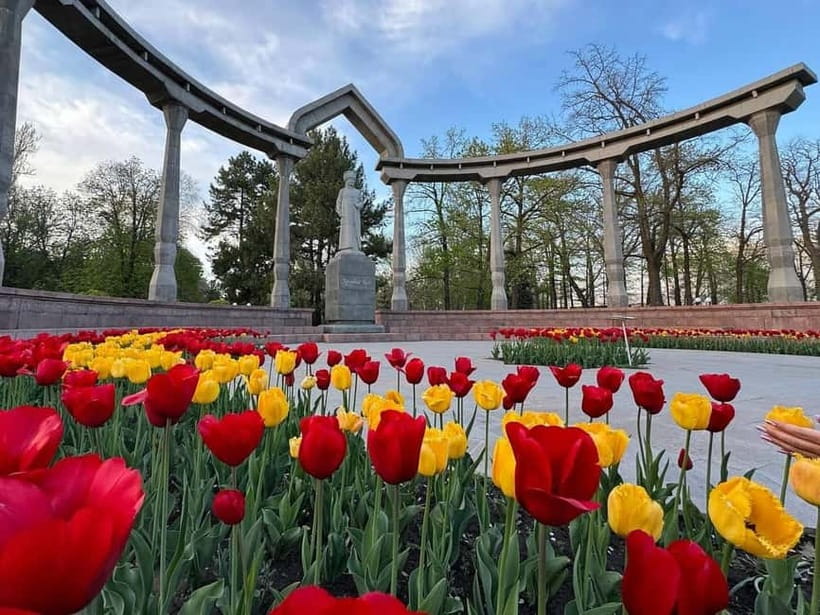
Review · HISTORY WALKING TOURS
Bishkek Street Art & Kyrgyz Nomadic History (Walks & Talks)
Bishkek’s best stories are painted on walls, set in Soviet mosaics, and tucked beside statues and parks. This walking tour connects those sights with Kyrgyz nomadic customs and the city’s changing identity, giving you more context than a quick photo stop ever could. Ala-Too Square provides the main historical anchor, while the city streets supply the visual interest.
I like the chance to ask direct questions about Kyrgyz life, economics, legends, and culture as you walk. I also like the practical stop at local souvenir shops, especially if you want felt work or another small reminder of Kyrgyzstan instead of a generic airport purchase. The main caution is that the advertised 3.5 hours may not always be met, and one recent booking lasted about 2.5 hours with less street art than expected.
Key points at a glance
- Soviet mosaics with a story: See public art tied to Bishkek’s Soviet past and the historical relationship between Kyrgyzstan and the Russian Empire.
- Ala-Too Square as your starting point: Use the city’s central square to understand Bishkek’s public spaces, monuments, and national identity.
- Guides who adapt to questions: Sofia, Alex, and Andrew have led this walk, with explanations ranging from distant history to present-day life.
- Souvenir shopping built into the walk: Browse shops connected with Kyrgyz culture rather than adding a separate shopping trip.
- Good first-day orientation: The route introduces Bishkek’s main streets, art, parks, statues, and cultural background in one outing.
- A small timing risk: Plan around 3.5 hours, but keep some flexibility because the actual walk can be shorter.
Why Bishkek’s walls tell more than a history textbook
Bishkek can look broad and orderly at first glance, with major avenues, public squares, statues, and parks laid out in a formal city plan. The details become more interesting when someone explains why a mosaic was made, what a monument represents, or how a public celebration fits into Kyrgyz history.
That is the useful idea behind this walk. You are not simply moving from one central sight to another. You are reading the city through its public art and Soviet-era mosaics, then linking those images to Kyrgyz traditions and the country’s nomadic past.
The art is also a good way to approach complicated history. Kyrgyzstan’s modern identity includes local customs, Soviet rule, Russian imperial influence, independence, and present-day cultural renewal. A guide can place those layers side by side without reducing the city to a list of dates.
The strongest part of the experience is the conversation. Sofia has been praised for making the walk welcoming while explaining history and culture. Alex has handled questions about legends, myths, economics, and recent events. Andrew has also led the tour and helped with practical arrangements, including calling a taxi for one participant. The guide you receive may vary, but the format allows for questions rather than a fixed speech.
More History Walking Tours in the world:
- History and Hauntings of Salem Guided Walking Tour
★ 5.0 · 14,564 reviews - Lisbon: History, Stories and Lifestyle Walking Tour
★ 4.8 · 10,902 reviews - Boston: Freedom Trail History Small Group Walking Tour
★ 5.0 · 6,450 reviews
Meeting at the Kyrgyz Republic Flag
The walk begins at the Paramount Kyrgyz Republic Flag. This gives you a clear meeting point in the city center and puts you close to the first major stop, Ala-Too Square.
The flag is more than a convenient landmark. National symbols matter in a capital city, and beginning here sets up the discussion about Kyrgyz identity, public ceremonies, and the way the city presents its past. Your guide can use the area to explain the larger setting before leading you into the square and nearby streets.
You should arrive ready to walk for several hours. The tour is described as wheelchair accessible, but the route is still a walking experience through city streets, public spaces, and shops. If mobility details matter to you, confirm the route conditions when booking.
Ala-Too Square and the public face of Bishkek
Ala-Too Square receives about 1.5 hours in the listed schedule, including guided commentary, walking, passing nearby sights, and a safety briefing. That is a substantial portion of the experience, so expect more than a quick photograph in front of an open plaza.
The square is a useful place to discuss how Bishkek presents national history in a public setting. Your guide may connect the square’s monuments and civic spaces with the celebrations and historical changes that shaped Kyrgyzstan. The supplied description links the city’s art to commemorations involving 100 years of Kyrgyz history under the Russian Empire, so this is one point where a guide’s explanation helps sort out the historical context.
The value here is not just the square itself. A large central space gives you a visual key to the city. You can see how monuments, official buildings, statues, and open gathering places work together. Later, when the tour moves into smaller streets and art-filled areas, you have a better sense of how official history differs from local memory and cultural expression.
You will also have time to ask about the country’s recent past. One guide has been praised for balancing older history with current questions, while another spent the walk discussing culture and economics. If you want only monument facts, you can keep the conversation focused. If you want to understand daily life in Kyrgyzstan, ask directly.
Bishkek’s street art, mosaics, parks, and statues
The central walking section lasts about 105 minutes in the stated plan. Here the focus shifts from one formal square to the city’s collection of murals, mosaics, statues, parks, and notable streets.
The Soviet mosaics are the main reason to choose this tour instead of a basic city walk. Public mosaics from the Soviet period often carry messages about work, education, community, technology, or national celebrations. Their scale and placement can make them easy to pass without a second glance. A guide’s explanation gives you a reason to stop and look closely.
The tour also presents Bishkek’s street art as part of a larger cultural conversation. Not every work will have the same age, style, or purpose. Some pieces connect to official history, while others may offer a more modern view of Kyrgyz identity. The point is the contrast between older public art and newer creative work.
Keep your expectations measured. The experience is promoted around street art, but one participant found there was not as much of it as expected. You may see more mosaics, monuments, and public art than large contemporary murals. If your main goal is a dedicated graffiti tour, this may feel too broad. If you want art placed in the context of Bishkek’s history and culture, the mix makes more sense.
The route also includes parks and statues. These stops help break up the walking and add variety. A statue can lead to a conversation about a historical figure, a park can show how residents use central public space, and a mosaic can reveal the tone of a former political period. You are not simply checking off sights. You are learning how to notice details you might otherwise miss.
More Street Art Tours in the world:
- Naples Spanish Quarters Walking Tour Street Art, Folklore & Sweet
★ 5.0 · 797 reviews - Naples: Street Art & History Tour in the Spanish Quarters
★ 4.9 · 540 reviews - 3-Hour Atlanta Beltline Food, Street Art and History Tour
★ 5.0 · 345 reviews - Atlanta: Beltline Food, Street Art, and History Walking Tour
★ 5.0 · 47 reviews
Stories about nomadic culture and Kyrgyz identity
The title promises Kyrgyz nomadic history, but the experience is not described as a museum visit or a hands-on nomadic activity. Expect the subject to come through conversation, stories, traditions, legends, and the meaning of cultural objects.
That conversational approach suits Bishkek. The capital is a modern city, yet Kyrgyz cultural identity is closely tied to nomadic traditions and memories of life beyond the urban center. A good guide can explain how these ideas continue to shape celebrations, family customs, national symbols, and the way Kyrgyz culture is presented today.
Several guides have shared stories about myths and legends, which adds texture to the historical discussion. These stories can help you understand how a culture remembers its past, not only how official history records it. Ask your guide to distinguish between legend, tradition, and documented history if that difference matters to you.
You can also steer the discussion toward current life. One participant specifically wanted more information about life in Kyrgyzstan today, suggesting that the historical and cultural material may be stronger than the present-day portion unless you ask for it. The guide has been praised for patiently answering questions, so do not wait for the subject to appear on its own.
A useful stop at Kyrgyz souvenir shops
The walk includes visits to souvenir shops connected with Kyrgyz culture. This is a practical addition, especially if you want to buy something small but distinctive during your first days in Bishkek.
The shop stop is not described as a formal craft workshop, so you should not expect a demonstration or a long presentation about how each object was made. Instead, it gives you a chance to browse while your guide points out items tied to local culture. You can ask about meaning, use, materials, or whether an item is a suitable gift.
I like this part because it connects the history discussion with something you can take home. It also saves you from spending an afternoon searching blindly for a shop. Still, the purpose is cultural orientation rather than a dedicated shopping excursion. If you want extensive buying time, you may need to return to the shops later.
Bring a little flexibility into your budget. Food and drinks are not included, and purchases are separate from the $38 tour price. You should also avoid alcohol and drugs, which are not allowed on the activity.
How much value do you get for $38?
At $38 per person, the tour offers 3.5 hours of a guided city walk, historical interpretation, public art, and souvenir-shop visits. For a first look at Bishkek, that is a fair price if you value context and conversation more than a long list of major attractions.
The price is strongest when you use the guide actively. Ask about the Soviet mosaics. Ask how Kyrgyz traditions fit into modern city life. Ask about the Russian imperial and Soviet periods, recent political changes, legends, and the meaning of the art you are seeing. The more you ask, the more the tour becomes a personal introduction to the country rather than a standard route through downtown.
The value is weaker if you expect a full 3.5 hours packed with street murals or a detailed shopping experience. One booking lasted around 2.5 hours, and the participant also felt there was less street art than anticipated. That does not erase the cultural value, but it is a fair reason to keep your schedule flexible and confirm the expected route.
A reported rating of 4.8 from 25 ratings points to a consistently positive experience, with repeated praise for the guides’ warmth, clear explanations, and willingness to answer questions. The most common strength is not a single famous sight. It is the human side of the walk.
Who should book this Bishkek walk?
I would choose this tour for a first day in Bishkek. It gives you a basic map of the center, introduces the city’s art and public spaces, and provides cultural background before you head farther into Kyrgyzstan.
It is especially suitable if you enjoy asking questions. Sofia has been described as welcoming and easy to talk with, while Alex has explained both distant and recent history without getting lost in excessive detail. The style appears flexible enough for a group interested in culture, history, economics, or ordinary life.
You may also like it if you are curious about Soviet architecture and public art but do not want a tour limited to buildings. The mosaics and statues become more meaningful when paired with discussion of Kyrgyz identity and nomadic traditions.
I would hesitate if your only goal is contemporary street art. The route includes art, but it also includes mosaics, parks, statues, Ala-Too Square, history, and souvenir shops. I would also plan carefully if you have altitude sickness concerns, since the activity is listed as unsuitable for people with altitude sickness. It is also not suitable for people over 95.
The tour is offered in English and Russian. Food, drinks, and health insurance are not included. You can cancel up to 24 hours ahead for a full refund, and the reserve-now, pay-later option keeps your plans flexible.
Should you book it?
Book this walk if you want Bishkek explained through its art, public spaces, and people. The guides are the main strength, particularly if you ask about modern life as well as history. The combination of Ala-Too Square, Soviet mosaics, street art, parks, statues, and souvenir shops gives you a broad introduction in one outing.
Skip it if you want three and a half hours of nonstop murals or a specialist art tour. The actual duration may be shorter, and the amount of street art may not match your expectations. For most first-time visitors who want cultural context and an easy way to get oriented, $38 is a sensible spend, provided you treat the walk as a conversation-led introduction rather than a mural hunt.
FAQ
Where does the tour begin and end?
It begins at the Paramount Kyrgyz Republic Flag and returns to the same location.
How long does the tour last?
The advertised duration is 3.5 hours. One recent booking reported a duration of about 2.5 hours, so keep some flexibility in your schedule.
What places are included?
The route includes Ala-Too Square, Bishkek’s central streets, street art, Soviet mosaics, parks, statues, and souvenir shops connected with Kyrgyz culture.
What languages are available?
The tour is offered with a live guide in English or Russian.
Is the tour wheelchair accessible?
Yes, the activity is listed as wheelchair accessible.
What does the $38 price include?
The price includes an English-speaking guide, a walking tour focused on Bishkek’s arts and culture, and visits to souvenir shops.
Are food and drinks included?
No. Food and drinks are not included in the price.
Can I cancel the booking?
Yes. You can cancel up to 24 hours in advance for a full refund. A reserve-now, pay-later option is also available.
Latest history tours reviewed in the world
- From Athens: Ancient Olympia Full-Day Private Tour★ 4.8 · 22 reviews
- From Athens: Explore Ancient Corinth & Charming Nafplion★ 4.6 · 102 reviews
- From Athens: Explore Ancient Greece 4-Day Tour★ 4.7 · 73 reviews
- From Albufeira: Historical Algarve Region Tour★ 4.7 · 585 reviews
- From Alexandria: Full-Day Guided Tour of Historical Sights★ 4.5 · 54 reviews
- From Albufeira: Wine Tasting & Historic Silves Tour★ 4.9 · 421 reviews
- Franklin: Ghost Tour in Historic Franklin★ 4.8 · 65 reviews
- Freiburg: Exciting City Tour with sightseeing and history★ 4.3 · 103 reviews
History Walking Tours, compared.
History and Hauntings of Salem Guided Walking Tour
Read our review →
Lisbon: History, Stories and Lifestyle Walking Tour
Read our review →
Boston: Freedom Trail History Small Group Walking Tour
Read our review →
Historic Charleston Guided Sightseeing Walking Tour
Read our review →
Barcelona: Tapas Walking Tour with Food, Wine, and History
Read our review →
Savannah History and Haunts Candlelit Ghost Walking Tour
Read our review →
A History of Terror – Belfast City Centre Walking Tour
Read our review →Browse the lists this tour appears in