
Review · INDIA
The Hipster Chandigarh Architecture History Tour
Chandigarh makes the most sense when you see it as both a planned city and a lived-in city. This two-day tour brings those sides together, from Le Corbusier’s monumental Capitol Complex to Pierre Jeanneret’s practical housing and the everyday paths of Sector 17. Rusty, a third-generation local and former journalist, tells the story with personal experience, political neutrality, and plenty of humor.
I especially like the rare access to buildings such as the Tower of Shadows, Lake Club, and Jeanneret’s former home. I also like that the tour includes ordinary places, including public housing, markets, a university, and low-cost snack stops. The main consideration is the pace: this is a full architecture program, and some sites may change if public holidays, local access, or weather affect the day.
Key points to know before booking
- Rusty brings personal context: He spent much of his life in Corbusier-designed housing and studied in schools designed by Pierre Jeanneret.
- The tour covers two very different Chandingarhs: You see grand civic buildings as well as working housing, markets, campuses, and recreational spaces.
- Entry fees and transport are included: The price covers admissions, photography fees, parking, pickup and drop-off charges, waiting time, and an air-conditioned vehicle.
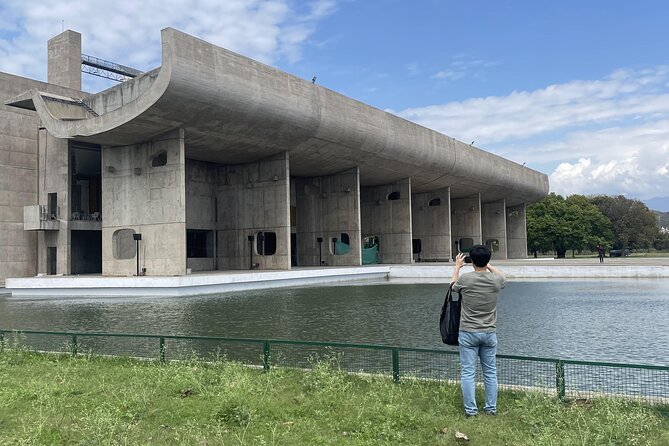
- The Capitol Complex gets serious attention: The Assembly Hall, Secretariat, Open Hand Monument, Geometric Hill, and Tower of Shadows form the heart of Day 1.
- Food stops are flexible and inexpensive: Snacks are not included, but Rusty keeps stops budget-friendly and can adjust lunch choices to your preferences.
- Access can depend on local conditions: The public housing visit is subject to local variables, and poor weather or unexpected closures can require a different plan.
Why Chandigarh needs more than a quick sightseeing stop
Chandigarh is often presented as India’s great modernist experiment. That is true, but a list of famous concrete buildings will not tell you how the city works. Its sectors, public institutions, open spaces, housing, markets, and water systems were all part of a larger plan.
Rusty is well suited to explain that plan. He is a third-generation citizen of Chandigarh and spent 24 years living in Corbusier’s public social housing. He also studied in schools designed by Jeanneret and worked in offices designed by Maxwell Fry. That background gives the tour a useful local angle. You are not only looking at shapes and materials. You are hearing how the buildings fit into daily life.
The humor matters, too. Architecture tours can become a long parade of dates, names, and concrete surfaces. Rusty uses jokes, stories, and visual explanations to keep the subject moving. The tone is designed to work for architecture students, families, couples, backpackers, and people who arrive with little prior knowledge.
This is not a quick photo tour. Day 1 focuses heavily on the Capitol Complex and major buildings. Day 2 widens the picture to markets, museums, water, public housing, and university life. You should expect time in the vehicle between sites, short walks, frequent stops, and a lot of explanation.
More Architecture and Landmark Tours in India
- Old Delhi Food-Spice Market-Temples Tour Soon Featured on NETFLIX
★ 5.0 · 304 reviews - Old Goa: Walking Tour of Heritage Churches
★ 4.9 · 81 reviews - World heritage Somnathpur sculptures and Talakadu temple mystery
★ 5.0 · 79 reviews
Day 1: Chandigarh’s civic center and modernist experiments
The first day begins at 9:00 a.m. with pickup offered and transport in an air-conditioned vehicle. The stated group limit is 41 people, although the experience is designed around guided access and personal attention. If you care about photography or architectural detail, tell Rusty early so he can allow time for the views and visual details that interest you.
Capitol Complex: the city’s boldest statement
The Capitol Complex is the natural starting point. It contains the Secretariat, Assembly Hall, and Open Hand Monument, and it is recognized as a UNESCO World Heritage site. You get about an hour here, with admission included.
This is the part of Chandigarh where the city’s political ambitions become physical. The buildings use large concrete forms, strong shadows, broad spaces, and geometric patterns. The scale can feel imposing, but the guide’s job is to connect that scale with the city’s founding purpose and government structure.
The access is especially valuable because the complex is not simply a place you wander through casually. Insider-guided access helps you understand how the buildings relate to one another, rather than seeing isolated monuments from the outside. Bring a camera, since photography fees are included.
Le Corbusier Centre: plans, models, and working ideas
The old architects’ building is now the Le Corbusier Centre, and the visit lasts about 50 minutes. This stop shifts from public monuments to the working process behind the city.
You can expect visual demonstrations of early ideas for naturally cooled and more sustainable buildings. That makes the stop useful even if you are not trained in architecture. Instead of treating design as an abstract subject, the visit shows how Chandigarh’s architects thought about heat, shade, airflow, and the local climate.
The center also helps put the rest of the tour in order. After seeing the finished civic buildings, you get a better sense of the experiments and planning decisions that led to them.
Same old streets, another chapter:
- Fontainhas Heritage Walk by Make It Happen
★ 5.0 · 2,834 reviews - The Great Indian Food Tour: Old Delhi Food and Heritage Walk
★ 5.0 · 1,698 reviews - Old Goa Heritage Walk by Make It Happen
★ 5.0 · 797 reviews - Old Delhi Food, Heritage&Cultural Walk with Rickshaw ride to Masterji Kee Haveli
★ 5.0 · 742 reviews
Gandhi Bhawan and Panjab University
Gandhi Bhawan, at Panjab University, is one of Chandigarh’s most recognizable buildings. The 30-minute guided visit focuses on Pierre Jeanneret’s design and the building’s distinctive spinning lotus-shaped roof.
This is a smaller and more intimate stop than the Capitol Complex. Look closely at how the form works from different angles. The building is memorable because it does not rely on a conventional box shape, yet it remains tied to the practical and institutional purpose of a university.
The broader Panjab University visit lasts about 40 minutes. You will see another side of Chandigarh’s planning: a campus designed not only for classrooms, but also for movement, gathering, shade, and public life. The university gives you a chance to see how modernist ideas were used in an everyday educational setting, not just for government buildings.
Chandigarh Architecture Museum
The Architecture Museum is housed in a raw concrete building inspired by Le Corbusier’s 1965 Zurich Pavilion. You get an hour to explore three levels of exhibits and historical material.
This is one of the most useful stops for building a timeline. You can look at rare exhibits and follow the city from its early planning through its architectural development. If the first half of the day leaves you wondering how all these bold projects came together, the museum helps supply the missing framework.
The concrete structure itself is part of the lesson. The tubular stairway and stripped-down surfaces show that the museum is not a neutral container. Its design continues the modernist story it presents.
Open Hand, Geometric Hill, and the Tower of Shadows
The Open Hand Monument receives its own 25-minute visit, separate from the earlier Capitol Complex stop. This is the symbolic center of Chandigarh, representing peace and unity. You get close access and a chance to hear the story behind Le Corbusier’s vision. On a windy day, the monument’s moving form can add an extra touch of drama.
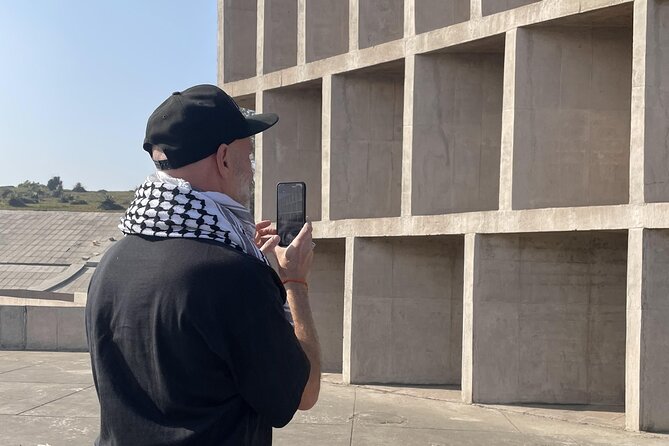
Geometric Hill takes about 20 minutes. Its grid-like earth mounds and concrete forms were designed as part of the Capitol Complex. This stop rewards a slower look. It is less about entering a building and more about understanding how land, form, and movement were used together.
The Tower of Shadows is a short 15-minute visit, but it is not a throwaway stop. Le Corbusier designed it as a demonstration structure for studying the movement of the sun. The building shows how the architects tested light and shade rather than treating climate as an afterthought.
Taken together, these three sites explain different parts of Chandigarh’s character: a public symbol, a sculptural setting, and a practical solar study.
Museum Maison Jeanneret
The first house constructed in Chandigarh became the home of Pierre Jeanneret for 11 years and is now Museum Maison Jeanneret. The visit lasts about 30 minutes.
This house gives you a more human scale after the huge civic buildings. You can see how Jeanneret lived and worked, and how his design ideas appeared in a domestic setting. The stop also helps separate Jeanneret’s contribution from Corbusier’s. The two are often mentioned together, but their work had different moods and uses.
For me, this is the kind of place that makes an architecture tour worthwhile. A residence can show proportion, light, furniture, and daily routines in a way that a monumental government building cannot.
Day 2: water, shopping, memory, and ordinary housing
Day 2 begins at Sukhna Lake and then moves through the city’s public and commercial life. It is a useful counterweight to the first day. You still see major designs, but you also spend more time watching how Chandigarh is used.
Sukhna Lake and the city’s quieter edge
The 30-minute walk at Sukhna Lake is gentle. The manmade lake was designed by Corbusier to help refresh groundwater and cool the northern sectors of the city.
Rusty explains the lake’s creation and its later development. This is a good reminder that Chandigarh’s plan involved more than buildings. Water, open space, climate, and recreation all had a role.
The stop is also a practical reset after Day 1’s heavy concentration of architecture. You can walk, look across the water, and hear about the city without standing inside a concrete monument.
Sector 17 Market: Corbusier for everyday commerce
Sector 17 Market is covered on foot for about an hour. The tour focuses on the commercial designs that are easy to overlook when Chandigarh is discussed mainly through its government buildings.
You walk through shaded, tree-lined paths and watch the city’s public life unfold. The value here is context. A planned city is not successful only because its monuments photograph well. It also needs places where people shop, meet, sit, and pass through their daily routines.
This is one of the better stops for anyone who wants to understand Chandigarh beyond architecture school terminology. It shows how the city’s design works at street level.
Chandigarh War Memorial
The War Memorial sits within the Bougainvillea Garden in Sector 3. The 30-minute visit is more reflective than the modernist sites.
The memorial was conceived by Lieutenant General J. F. R. Jacob and designed with architectural restraint. You get a quieter look at how memory and public space can be handled without the scale of the Capitol Complex.
The setting in the garden gives the stop a different rhythm. It is a pause from the strong concrete forms and a chance to consider the people and events remembered by the city.
Pierre Jeanneret’s public housing
The tour includes a rare walking visit through Pierre Jeanneret’s public socialist housing. This housing remains functional in its original form, and the visit is subject to local variables.
This is one of the most valuable parts of the program because it shows the city as a place where people live, not just a collection of monuments. You can see how design choices were adapted for repeated housing units, shared needs, and practical routines.
Rusty’s personal connection matters here. Having lived in this type of housing, he can explain it from experience rather than only from architectural notes. Access is not guaranteed in every circumstance, so treat this as a special possibility rather than the one stop you should book the whole tour around.
Government Museum and Art Gallery
The one-hour guided visit to the Government Museum and Art Gallery takes you into a 1960s heritage museum designed by Le Corbusier. Its collection includes artifacts from the pre-partition era in Pakistan and one of the world’s largest collections of Greco-Buddhist art.
This stop broadens the tour beyond modern architecture. The museum connects Chandigarh to the region’s older artistic traditions and to the upheaval of partition. It also shows how a new city can hold objects and stories from places and periods that came before it.
If you are mainly booking for buildings, do not skip this. It gives the architectural story cultural weight and helps prevent the tour from feeling like two days of concrete sightseeing.
Lake Club: recreation in Corbusier’s late work
The final listed stop is the Lake Club, with about 30 minutes for a guided visit. Corbusier designed this private yacht club for recreational boating and socializing only a year before his death.
It is a lesser-known example of his work, and that makes it a fitting final stop. The building shows how his design ideas could be used for leisure, not just government, education, or housing. You also return to the lake with a new understanding of how recreation was built into Chandigarh’s plan.
What the $71.02 price includes
At $71.02 per person, the price is strong if you make use of the full two days. You are not paying only for admission to a few buildings. The package includes an air-conditioned vehicle, pickup and drop charges, parking, driving, waiting time, all entry tickets, and photography fees.
Those costs can add up quickly in a city spread across sectors. The transport also matters in hot weather, especially when the schedule moves between the Capitol Complex, university areas, museums, housing, and the lake.
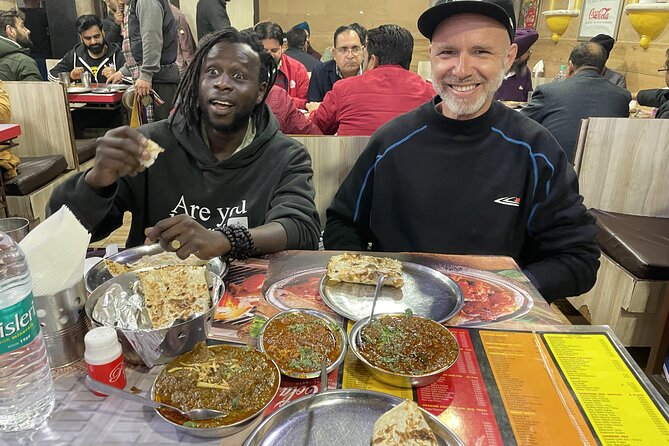
Snacks are not included. The plan is to make frequent stops where you pay for your own food and drinks, but the stops are intended to be inexpensive. Several parts of the tour can be adjusted to suit lunch preferences, which is helpful if you have dietary or budget concerns. Gratuities are optional.
The group limit is 41, so you should not assume a tiny private tour. Still, Rusty’s experience with families, students, couples, backpackers, architects, and officials suggests a flexible hosting style. The experience is likely at its best when you ask questions and tell him what kind of detail you want.
Timing, access, and conditions to consider
The start time is 9:00 a.m. and the experience lasts approximately two days. The days include many stops, but several visits are short, from 15 minutes at the Tower of Shadows to 30 minutes at Gandhi Bhawan, Open Hand, and Museum Maison Jeanneret.
That variety keeps the program from becoming monotonous, though you should still expect a full schedule. If you want long, quiet photography sessions at every building, this may feel rushed. If you want a broad understanding of Chandigarh with transport between sites, the structure makes sense.
Unexpected closures can affect the route. A public holiday once required Rusty to replace closed sites with other fascinating visits, so flexibility is useful. Poor weather can also lead to a new date or a full refund. Service animals are allowed, and most people can participate. The tour is near public transportation, but pickup is offered, which makes the start simpler.
Cancellation terms are strict close to departure. You can receive a full refund if you cancel at least six full days ahead, a 50 percent refund if you cancel two to six full days ahead, and no refund for cancellations less than two full days before the start.
Who should book this Chandigarh tour?
Book it if you want Chandigarh explained through architecture, town planning, local life, and personal stories, not just photographed from the roadside. It is especially suited to architecture and urban planning students, curious first-time visitors, families who enjoy guided learning, and anyone who wants to understand why Chandigarh looks and functions as it does.
You do not need a background in architecture. Rusty’s humor and visual explanations make the subject approachable, and the market, lake, housing, and museum stops provide variety.
You may want a shorter experience if your priority is a relaxed city walk, shopping, or a quick look at the Capitol Complex. Two days is a serious commitment, and the subject remains architecture-led even when the route moves into food, art, housing, and recreation.
For the price, the included transport and admissions make this a sensible choice. The strongest reason to book, though, is Rusty’s personal connection to the city. He can show you both the grand plan and the ordinary places that make Chandigarh a living city.
FAQ
How long does the experience last?
The tour lasts approximately two days, with a 9:00 a.m. start time.
Who leads the tour?
The experience is provided by Rusty, a third-generation Chandigarh resident, journalist, and guide with personal experience of the city’s Corbusier and Jeanneret-designed buildings.
What is included in the price?
The price includes pickup and drop charges, an air-conditioned vehicle, taxi and driving costs, parking, waiting time, entrance fees, admission tickets, and photography fees.
Are food and drinks included?
No. The tour makes frequent snack stops, but you pay for your own food and drinks. The stops are intended to be inexpensive.
Does the tour visit the Capitol Complex?
Yes. The itinerary includes the Secretariat, Assembly Hall, Open Hand Monument, Geometric Hill, and Tower of Shadows within the Capitol Complex area.
Is the public housing visit guaranteed?
The public socialist housing visit is subject to local variables, so access may not always be possible.
How large can the group be?
The maximum group size is 41 people.
What happens if bad weather cancels the tour?
If poor weather causes cancellation, you will be offered a different date or a full refund.
Latest history tours reviewed in India
- Fort Kochi Heritage Day Cycling Tour★ 4.2 · 26 reviews
- Candolim: Heritage Walk of Fort Aguada Port and Jail Complex★ 4.9 · 25 reviews
- Agra Fort: Guided UNESCO Heritage Walking Tour★ 4.9 · 21 reviews
- World heritage Ahmedabad city tour in private car with guide and lunch★ 5.0 · 44 reviews
- Private Elephanta Caves UNESCO World Heritage Site Tour★ 5.0 · 34 reviews
- Mumbai: South Mumbai Heritage Walking Guided Tour★ 4.5 · 69 reviews
- Hill-station & Heritage: Lonavala & Karla Caves Tour from Mumbai★ 5.0 · 60 reviews
- Best South Mumbai Heritage Walk★ 5.0 · 122 reviews
India History Tours, compared.
The Great Indian Food Tour: Old Delhi Food and Heritage Walk
Read our review →
Old Delhi Food, Heritage&Cultural Walk with Rickshaw ride to Masterji Kee Haveli
Read our review →
Blue City Heritage Private Walking Tour With Pickup and Drop-Off
Read our review →
Private Heritage Walking Tour in Jaisalmer Fort and Old Bazaar
Read our review →
Old Delhi Food-Spice Market-Temples Tour Soon Featured on NETFLIX
Read our review →
Panaji: Heritage Walk through Goa’s Latin Quarter
Read our review →Browse the lists this tour appears in