

Review · AMSTERDAM
Amsterdam: Private Pedicab Historical Sightseeing Tour
Amsterdam’s history comes into focus from a pedicab seat. You can cover the old center, canal ring, Jewish quarter and Museumplein without the strain of a long walking tour, while Bram de Haan explains how the city grew from Dam Square into the canal city you see today. I like the small scale: the pedicab can use streets that cars cannot. I also like the mix of famous sights and less obvious corners, from the Montelbaanstoren to the Portuguese Synagogue.
The main drawback is the price: $230 for a private group of up to two is a serious outlay, especially for a two-hour ride. You’ll also need to check the weight rule carefully, since the combined passenger limit is 200 kilograms and the experience is not suitable for anyone over 100 kilograms.
Key points at a glance
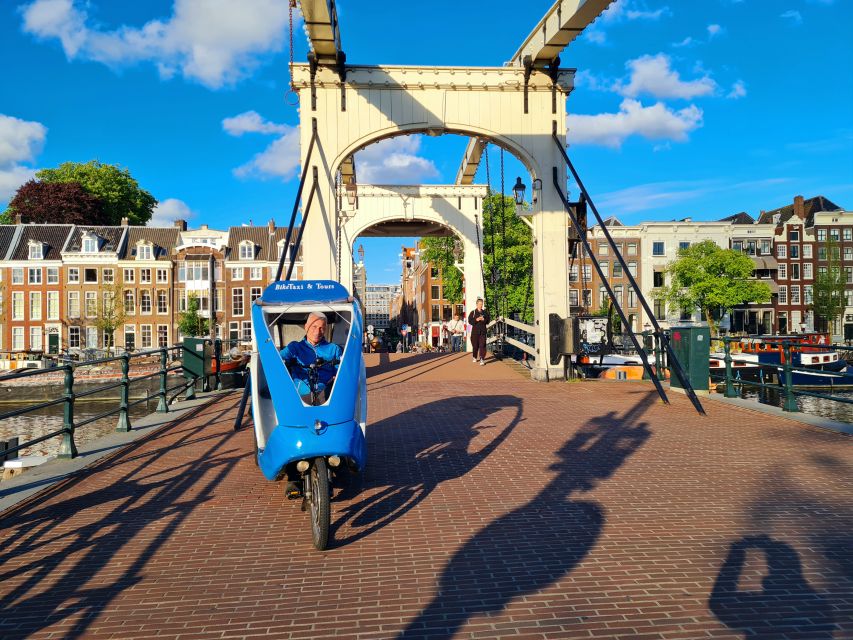
- A private ride for two: You get your own pedicab and guide rather than joining a large sightseeing group.
- A broad historical route: The two hours connect Dam Square, Zeedijk, Chinatown, the Jewish quarter, the Amstel, the canal ring and Museumplein.
- A strong choice for limited walkers: You see a lot of central Amsterdam while remaining seated for most of the tour.
- Bram de Haan leads the experience: He uses photographs and maps as well as spoken explanations.
- Hotel pickup and drop-off are included: You wait outside your hotel, then can choose a preferred finish location in advance.
- Mind the passenger limit: The combined weight of everyone riding must not exceed 200 kilograms.
Why a pedicab works well in central Amsterdam

A pedicab gives you a different view of Amsterdam than a bus or canal boat. You sit close to street life, at a height that lets you see canal houses, bridges and passing bicycles without being sealed behind glass. The small vehicle also allows access to streets where cars cannot go, a useful advantage in the old center.
This is not a hop-on, hop-off service. The ride is a private, guided overview, with the driver explaining what you are seeing as you move between stops. You should expect a steady sequence of viewpoints rather than long visits inside museums or synagogues.
That distinction matters. If you want to spend an hour inside the Rijksmuseum, this is not the right tour. If you want help making sense of Amsterdam before exploring on your own, two hours gives you a good first look.
The route is especially helpful for people who find long walks difficult. Several people who took the ride were older or had limited walking ability, and the seated format allowed them to see a wide stretch of the city. A blanket is available in cold weather, though warm clothing is still a good idea. One earlier visitor wished for a blanket on a cold day, so do not rely on the weather looking mild when you leave your hotel.
More Private History Tours in Amsterdam
- Anne Frank and the Jewish History of Amsterdam Private Tour
★ 5.0 · 307 reviews - Private Boat Tour Amsterdam – 90 Min incl. welcome drink on historic saloon boat
★ 5.0 · 82 reviews - Amsterdam Private Historical Walking Tour
★ 5.0 · 75 reviews
Dam Square explains where Amsterdam began
The tour begins at Dam Square, the city’s central meeting place and the point from which Amsterdam developed. It is an efficient starting point because several major symbols of the city sit together here: the Royal Palace, the New Church and the National Monument.
Your guide uses the square to set the scene. Rather than treating Amsterdam as a collection of pretty canals, the tour begins with the city’s origins and growth. You learn why this spot became the heart of the old center and how the surrounding city expanded from it.
Dam Square can be crowded and visually busy, so the benefit of having a local guide is practical as well as historical. You get help sorting the important buildings from the surrounding shops and activity. The stop also gives you an early chance to take photographs before the ride moves into narrower streets.
Zeedijk and Chinatown show the city’s layers
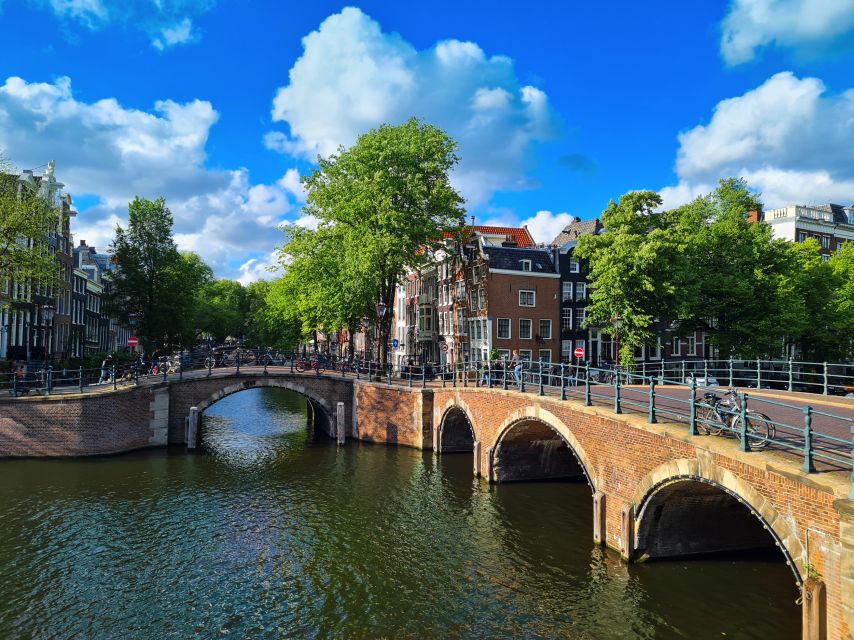
Next comes Zeedijk, a street that once formed part of the dikes protecting the old city. That simple change in use tells you a lot about Amsterdam. A defensive water barrier became an urban street as the city grew beyond its earlier boundaries.
Here you see the oldest café still standing with its original interior. The tour does not include food or drinks, so this is a look at the place rather than a scheduled tasting stop. If you want to return later for a drink, note the location as you pass.
A little farther along, you get a glimpse of Chinatown. It is a brief part of the route, not a full food or neighborhood tour, but it adds another layer to the old center. Within a short ride, you move from medieval defenses to a working city street and then into one of Amsterdam’s best-known cultural districts.
The New Market and Montelbaanstoren
The New Market is built around one of the old city’s most important structures, a 15th-century city gate. The gate now sits in the middle of the square, where it is easy to appreciate its former role in the city’s defenses and trade.
This stop works well for visitors who want more than a parade of attractive buildings. The square gives you a clear example of how Amsterdam preserved pieces of its earlier city plan while the surrounding city changed. Your guide provides the story behind the building and the square rather than leaving you to guess what you are looking at.
A few minutes later, the pedicab reaches the Montelbaanstoren. This old watch and defense tower formed part of Amsterdam’s expanded defense line in the early 16th century. It is one of the more distinctive sights on the route, and its position provides a good view toward the Oude Waal.
That view combines houseboats with 17th-century canal houses in the background. It is a useful reminder that Amsterdam’s waterways have long served practical purposes, not just postcard appeal. Bring your camera, since this is one of the more attractive photographic stops on the ride.
More Private History Tours in the Netherlands
- Historic Amsterdam 2-Hour Private Tour with Local Guide
★ 4.9 · 53 reviews - Amsterdam: Private Anne Frank and Jewish History Tour
★ 5.0 · 26 reviews
The Jewish quarter requires time and attention
The route then enters the Jewish quarter, where the historical subject matter becomes more serious. You see the Great Synagogue, described as the first synagogue Jewish people were allowed to build in Western Europe more than 350 years ago. Across the street is the Portuguese Synagogue.
The stop also includes the Holocaust Names Monument, made from 102,000 bricks bearing the names of Dutch Jewish victims of the Second World War. This is not a light sightseeing moment, and it should not be treated as one. The monument gives the tour a direct connection to Amsterdam’s wartime history and the people who were lost.
Opposite the monument is a row of 17th-century canal houses once inhabited by successful Sephardic Jewish immigrants involved in the diamond trade. Seeing the houses alongside the synagogues and memorial helps connect architecture, commerce, religion and persecution in one compact area.
The guide’s use of old photographs and maps is particularly useful here. Amsterdam has changed greatly, and visual aids can help you understand what neighborhoods looked like before wartime destruction and later redevelopment. If you prefer a tour that stays purely cheerful, this section may feel heavy. For most visitors, that seriousness is part of its value.
The Amstel and Skinny Bridge provide the best photo stop
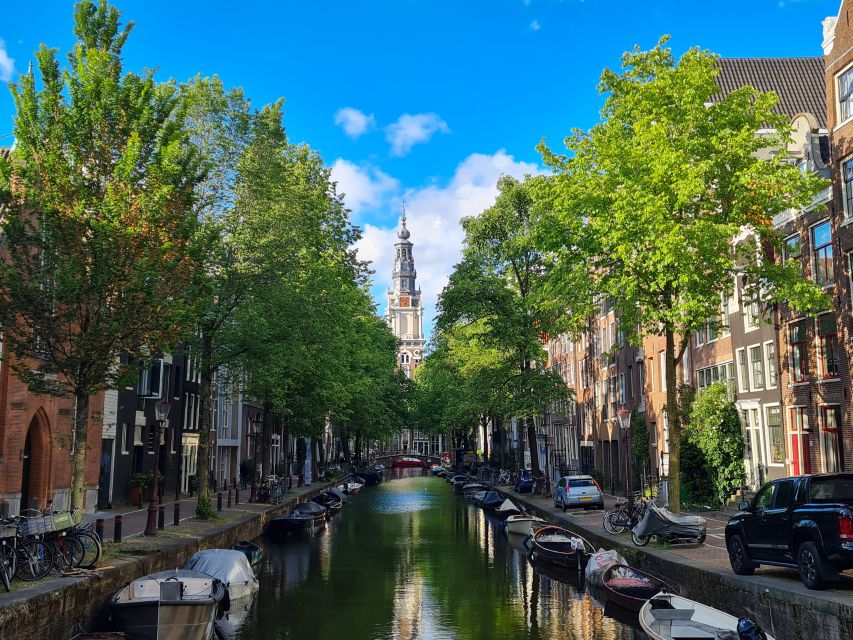
The ride continues to the Hermitage, housed in a large former 17th-century widowhouse. The building itself is part of the story, showing how an old structure can take on a new public role as a museum.
From there, you reach the Skinny Bridge, one of Amsterdam’s most recognizable bridges. Its narrow design and rows of light bulbs make it especially attractive after dark, though this tour takes place within a two-hour daytime schedule unless you arrange a later start time.
The bridge gives you a wide view over the canalized Amstel. The Amstel is the city’s main and widest canal, and the open view here offers a welcome change from the tight streets of the old center. This is one of the best places to stop for pictures, with the water, bridge and surrounding buildings all in view.
The bridge is also a good example of why the pedicab format works. You can pause at a scenic point without having to search for a parking space or hurry past it from a larger vehicle. Still, do not assume every stop includes a long walk or extended photo break. If you want to get out for pictures, say so to your guide.
The canal ring reveals Amsterdam’s planning
The central section of the tour runs through the 17th-century canal district, the half-circle of waterways surrounding the old center. On a city map, the layout is easy to spot. From the pedicab, you see the canal houses that once belonged to successful merchants.
The houses are not identical, and that is part of their appeal. Their differences reflect changing building periods, personal taste and the wealth of the people who commissioned them. At the same time, you begin to notice repeated features that reveal when and how the buildings were constructed.
This is where a local guide adds real value. Without explanation, the canal ring can become a string of attractive facades. With context, you start reading the streets as a record of Amsterdam’s commercial growth, social divisions and building habits.
The ride also lets you cover more of the canal district than you could comfortably manage on foot in two hours. You will not examine every canal, but you get a useful orientation for later walks. Ask Bram to point out areas you may want to revisit after the tour.
Museumplein closes the route with Amsterdam’s big museums
The final scheduled stop is Museumplein, a large 19th-century green square surrounded by the country’s most important museums. The Rijksmuseum and Van Gogh Museum are the major names here.
The pedicab passes through the Rijksmuseum tunnel and stops in the middle of the square. That approach gives you a memorable view of the museum building and places you near two of Amsterdam’s main cultural attractions, though admission to either museum is not included.
Museumplein is a sensible ending point because it lets you continue your day in several directions. You can arrange to finish there, or choose another desired location ahead of time. The tour also includes hotel drop-off, so confirm your preferred ending point when booking rather than leaving the matter until the last minute.
Bram’s guiding style and what you actually receive
Bram de Haan is the named guide associated with this experience. His role is more than driving. He explains the city’s development, uses maps and photographs, answers questions and adds personal insight into the neighborhoods along the route.
The strongest part of the guiding is the connection between places. Dam Square explains the city’s beginning. The Jewish quarter connects Amsterdam to religious freedom, commerce and wartime loss. The canal ring shows the wealth and planning of the 17th century. Museumplein brings the story into modern cultural Amsterdam.
The tour is offered in English, Dutch or German. Since it is private, you have more freedom to ask questions than you would on a large group outing. You can also request picture stops, and one person who extended the ride to three hours found that the guide was willing to make stops along the way. The advertised experience lasts two hours, so any extension should be confirmed and may involve an additional arrangement.
Price, comfort and practical limits
At $230 per group of up to two, the cost works out to $115 per person if two people share it. That is expensive compared with a public walking tour, but the comparison is not quite fair. You are paying for a private vehicle, hotel pickup, a local guide, a tailored route and a way to see central Amsterdam with much less walking.
The value is strongest for first-time visitors, couples who want a private overview and anyone with limited mobility. It is less compelling if you are a strong walker who enjoys exploring slowly and already knows the city. In that case, a cheaper public tour followed by independent walks may suit you better.
The combined passenger weight must not exceed 200 kilograms, and the activity is listed as unsuitable for people over 100 kilograms. Check this carefully before booking, especially if two people are riding together. The experience is private, but it is designed for no more than two passengers.
Hotel pickup and drop-off are included. Wait outside, in front of your hotel. Food and drinks are not included, so plan a café stop before or after the ride if you want one.
Should you book the Amsterdam pedicab tour?
Book it if you want a comfortable, private introduction to Amsterdam and value explanation over independent wandering. It is particularly useful on your first day, when the city’s canals, old streets and historic neighborhoods can otherwise blur together.
I would also recommend it to older visitors and people with limited walking ability. The route covers a lot, and the pedicab avoids turning your first look at Amsterdam into an exhausting march.
Skip it if $230 feels too high for two hours, if you want substantial time inside museums, or if you prefer to explore at your own pace. For everyone else, the combination of local context, unusual transport, hotel pickup and a wide central route makes this a practical way to get your bearings.
FAQ
How long is the Amsterdam pedicab tour?
The tour lasts two hours. Starting times depend on availability.
How many people can join the private pedicab?
The price covers a private group of up to two people.
What languages does the guide speak?
The tour is available in English, Dutch and German.
Is hotel pickup included?
Yes. Pickup and drop-off are included. You should wait outside in front of your hotel.
Where does the tour begin?
The sightseeing route starts at Dam Square, in the heart of Amsterdam’s old center.
Can I choose where the tour ends?
Yes. You can set a desired finish location in advance.
What is included in the price?
The price includes the private pedicab ride, hotel pickup and drop-off, a blanket in cold weather, and detailed explanations of the sights.
Is there a passenger weight limit?
Yes. The combined passenger weight cannot exceed 200 kilograms, and the activity is not suitable for anyone over 100 kilograms.
Latest history tours reviewed in Amsterdam
- Skipping Lines & Sipping Beers: A History Tour of Amsterdam★ 5.0 · 22 reviews
- Amsterdam Walking Tour:Anne Frank, History & Liberal Culture★ 5.0 · 18 reviews
- Amsterdam: Iconic Canals & Historic Sights Walking Tour★ 4.5 · 90 reviews
- Amsterdam: Jewish Quarter and History Guided Tour★ 4.7 · 210 reviews
- Amsterdam: Luxury Canal Cruise with Historic VR Experience★ 4.7 · 31 reviews
- Amsterdam: Historic Boat Cruise with open bar and nibbles★ 4.9 · 31 reviews
- Amsterdam: Walking Tour of Historic Center★ 4.6 · 24 reviews
- Amsterdam: Ghost Walking Tour and Dark History★ 4.8 · 118 reviews
Amsterdam History Tours, compared.

Amsterdam Food and Cultural Tour with Tastings
Read our review →

Amsterdam: Haunted History and Ghost Walking Tour
Read our review →
Amsterdam High-End Dutch Food & History Tour – Up to 8 guests
Read our review →
Anne Frank and the Jewish History of Amsterdam Private Tour
Read our review →
Amsterdam: 3-Course Meal in Historic 1st Class Waiting Rooms
Read our review →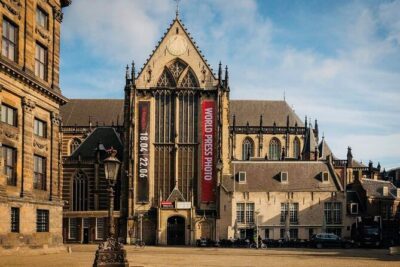
Amsterdam: Jewish Quarter and History Guided Tour
Read our review →Browse the lists this tour appears in