
Review · CAMBODIA
Angkor Wat Sunrise & Ancient City Discovery
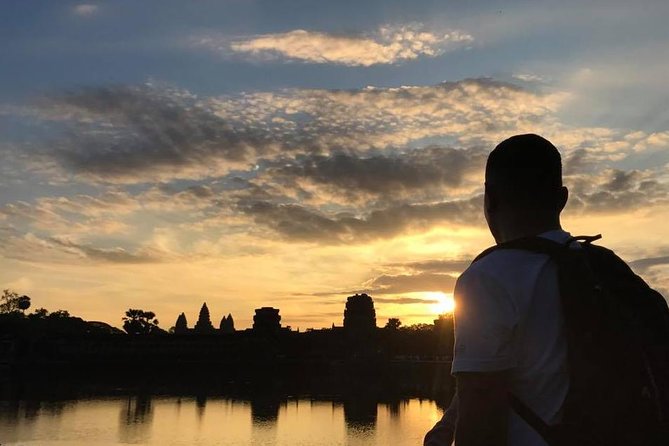
Angkor Wat looks most mysterious before breakfast, when the temple rises from the dark and the first light catches its towers. This nine-hour cycling tour pairs that famous sunrise with forest paths and several major temples, giving you a fuller day than a visit limited to Angkor Wat.
I like the easy logistics: a mountain bike, helmet, hotel pickup, food, water, and coconut juice are included. I also like the small maximum group of 10, plus guides such as Vannarath, Bobo, Sihal, and Mr. Seng, who are praised for careful pacing, temple knowledge, and good photo suggestions.
The main drawback is the early start and physical effort. You begin at 5:00 a.m., cycle for much of the day, and still need to pay the $37 one-day temple pass separately. Hotel drop-off is not included, so plan for your own ride back.
Key points to know before booking
- Sunrise comes first: You reach Angkor Wat in the dark and watch the towers change as the sun appears.
- The bike adds access: Forest tracks and quieter routes connect the temples in a more active way than a vehicle tour.
- Six major temple areas are included: Angkor Wat, Angkor Thom, Bayon, Preah Khan, Ta Prohm, Tanei, and Prasat Chrung feature in the route.
- The group stays small: The maximum is 10 people, with an English-speaking guide leading the day.
- Food and drinks are covered: Breakfast, lunch, drinking water, and fresh coconut juice are included.
- Budget for the pass: The $70 tour price does not include the $37 one-day Angkor admission ticket.
Why cycling makes Angkor feel different
Angkor is not one temple sitting beside a parking lot. It is a huge archaeological complex spread through trees, old roads, gates, walls, and waterways. A bicycle helps you feel that scale.
You move between temple stops under your own power, rather than stepping from a van and walking only the most famous section. The route includes asphalt, dirt roads, elevated paths, and single-track sections, according to the equipment and route descriptions. That variety is part of the fun, though it also means you should be comfortable riding for several hours.
I like the pause-and-pedal rhythm. You ride through the wooded setting, leave the bike to explore carved stone chambers, then get back in the saddle. It gives the day a clear shape and breaks up the walking that can make a large temple complex tiring.
The supplied Giant or Trek mountain bike is a practical choice for this route. A helmet is included, and the bikes are described as quality mountain bikes. You should still tell the operator about any dietary needs when booking and bring sunscreen, sunglasses, and a camera.
More Ancient History Tours in the world:
- Colosseum: Underground and Ancient Rome Tour
★ 4.7 · 12,691 reviews - Colosseum & Ancient Rome with Arena Floor Option I Max 6 People
★ 5.0 · 3,306 reviews - Rome: Colosseum, Ancient Rome Tour or AudioGuided Tour
★ 4.4 · 2,879 reviews
5:00 a.m. pickup and the first ride to Angkor Wat
The day begins at 5:00 a.m. with hotel pickup. That early departure is not a minor detail. You are leaving before dawn, so have your clothes, camera, and footwear ready the night before.
At Angkor Wat, you arrive while it is still dark. The famous view builds slowly, first as a silhouette and then as the towers and galleries take on warm color. The changing light is the reason this tour begins so early. You get the visual drama of sunrise and still have most of the day left for other temples.
After the outdoor viewing, your guide takes you through Angkor Wat’s chambers and explains the site’s history. The temple is large enough that a guide adds useful order. You can learn what you are looking at instead of treating the complex as a collection of impressive stones.
The sunrise area can be busy, and the timing matters. Guide Vannarath is praised for finding good photo positions and trying to avoid the worst crowds. Mr. Seng is also noted for pointing out small details that are easy to miss. Those details matter most at a temple this large, where it is simple to spend an hour looking at the wrong wall.
Angkor Thom’s south gate and the old defensive walls
From Angkor Wat, the route continues toward Angkor Thom. The south gate is one of the most memorable approaches in the complex. It presents the fortified character of the old city, with a broad entrance and monumental sculptures leading toward the walls.
The appeal here is not only the gate itself. Your guide can help you understand how the entrance worked as part of a defensive city rather than as a separate monument. Cycling also lets you approach through the larger setting, so you get a better sense of distance and scale.
The route includes the west and north gates as well. The supplied itinerary does not give a full stop-by-stop time schedule, so the amount of time at each gate can vary. That flexibility can be useful if your guide adjusts the pace, but you should not expect every listed point to receive the same long visit.
A distinctive part of the route is the ride along the protection wall toward Prasat Chrung. You climb and venture onto the wall for views across the surrounding area. This is one of the more unusual parts of the day, but it is also a reason to take the physical demands seriously. Uneven paths and wall sections are not the same as a flat city bike ride.
Bayon, where stone faces dominate the visit
Bayon is the central temple of Angkor Thom and one of the complex’s most recognizable sights. Its towers carry large carved faces, creating a close, enclosed experience that differs from Angkor Wat’s long galleries and open approach.
You should expect to leave the bikes and walk through the temple. This is where a guide can point out carvings and explain the layout, rather than leaving you to circle the towers without context. The route is designed for temple discovery, not simply for collecting exterior photographs.
The cycling format also helps with transitions. After Bayon, you do not need to wait for a vehicle to work through the complex’s roads and gates. You return to the bike and continue through the wooded surroundings.
The tradeoff is time and energy. Bayon is worth attention, but the full day includes several more temples. If you stop for every photograph, the ride may become rushed later. I would ask your guide early about the day’s pace so you know where you can linger.
More History Tours in the world:
- New York City: American Museum of Natural History Ticket
★ 4.5 · 15,447 reviews - History and Hauntings of Salem Guided Walking Tour
★ 5.0 · 14,564 reviews - Lisbon: History, Stories and Lifestyle Walking Tour
★ 4.8 · 10,902 reviews - London Small Group Tour of Historical Pubs
★ 5.0 · 10,422 reviews
Preah Khan and the quieter rhythm of the route
Preah Khan is one of the major temples included on the ride. Its long corridors and layered spaces reward slow walking, and it gives you another way to read Angkor’s architecture after the open scale of Angkor Wat and the tower faces of Bayon.
This is the type of stop where the bike tour feels most useful. You are not simply visiting the three best-known monuments and calling it a day. You are moving farther through the complex and seeing how different temple plans create different moods.
The route also includes Tanei, a smaller temple area compared with the most famous stops. The supplied information does not promise a fixed amount of time at Tanei, so treat it as part of the broader discovery route rather than assuming a long formal tour at every monument.
I like this mix because it gives you variety. You see major temples, gates, walls, and forest tracks instead of repeating the same kind of stop. The drawback is that the day can feel full. This is a sightseeing workout, not a slow single-temple visit.
Ta Prohm and the famous tree-covered ruins
Ta Prohm is another highlight on the route. Its atmospheric ruins and trees make it one of the most recognizable places in Angkor, and the temple feels very different from Bayon or Angkor Wat.
Your guide can help you focus on the stonework and layout, not only the dramatic roots and doorways. The trees are memorable, but Ta Prohm is also a working archaeological site and a sacred place. Respect the barriers, follow instructions, and give worshippers space.
Because Ta Prohm is famous, it can be one of the busier stops. Starting at sunrise helps you use the early hours well, but the tour still covers a popular area. The cycling route may give you a quieter approach between monuments, yet it cannot guarantee an empty temple.
This is also a good point to judge your energy. Breakfast and water are included, and fresh coconut juice is part of the day, but food does not remove the need to pace yourself. Use the breaks, drink regularly, and do not treat the final temples as optional in your planning.
Breakfast, lunch, and the practical value of the inclusions
Breakfast and lunch are included, along with pure drinking water and fresh coconut juice. That makes the $70 price easier to assess because you are not paying only for a guide and a bicycle. A full-day visit to Angkor can involve extra food stops and drink purchases, so having those basics arranged saves time.
The meals also support the schedule. You begin before normal breakfast hours and continue well into the day. I would still bring sunscreen and perhaps a small personal snack if you need food at a specific time, but the tour already covers the main meals listed.
The $37 temple pass is extra. Your total fixed cost is therefore $107 per person before any personal spending or the ride back to your hotel. That is not the cheapest way to see Angkor, but it is reasonable if you value a small group, a full day, a supplied mountain bike, an English-speaking guide, meals, drinks, and hotel pickup.
The value is weaker if you only want sunrise at Angkor Wat and a quick visit to one or two temples. In that case, a shorter arrangement may suit you better. The price makes more sense for someone who wants a broad, active day without arranging bikes, food, and the route alone.
Guides, group size, and the personal feel
The maximum group size is 10. That is small enough for a guide to manage the cycling pace and answer questions without turning the day into a moving crowd.
Several guides are named in the experience feedback. Vannarath is praised for being friendly, careful, informative, and helpful with photographs. Bobo is associated with varied riding conditions and confident off-road guidance. Sihal is described as friendly and professional, while Mr. Seng is noted for detailed explanations and a strong grasp of the sites.
Those details give you a useful idea of the guiding style to expect, but a specific guide cannot be guaranteed from the information provided. What you can count on is an English-speaking guide and a route built around both riding and temple interpretation.
One particularly useful point is the handling of solo bookings. The tour has operated for a single person without raising the price or canceling the departure. That suggests a good option if you are traveling alone, although you should still rely on the booking confirmation for your own date.
Dress, fitness, and what to bring
Angkor remains an active spiritual site. Shorts and skirts above the knees, along with bare shoulders, are prohibited in sacred palaces. Wear clothing that covers your shoulders and knees, even though you will also be cycling in warm conditions.
You should be comfortable riding a mountain bike on a mixture of surfaces. The tour is open to most people, but the route includes dirt roads, forest trails, elevated paths, and a section involving the protection wall. If you rarely cycle, this may feel demanding by the later temple stops.
Bring a camera, sunglasses, and sunscreen. A helmet is provided, as are the bike, water, and coconut juice. Ask about dietary requirements at the time of booking so the included meals can be planned properly.
The tour offers hotel pickup but not hotel drop-off. Arrange your return before setting out, especially since the day ends after roughly nine hours and you may be tired.
Cancellation and booking timing
Free cancellation is available if you cancel at least 24 hours before the local start time. Cancellations or changes made inside that 24-hour window are not accepted for a refund.
The tour is booked, on average, nine days ahead. That is a useful planning signal, especially if you want a particular date or are visiting during a busy period. Confirmation is received at booking, and the experience uses a mobile ticket.
Who should book the Angkor sunrise bike tour?
I would choose this tour if you want to see more than Angkor Wat and prefer movement to sitting in a vehicle. It suits active people, photographers, solo visitors, and anyone who wants an English-speaking guide to explain details along the way.
It is also a good fit if you value convenience. The operator handles hotel pickup, bicycles, helmets, breakfast, lunch, water, and coconut juice. You pay extra for the temple pass and arrange your way back to the hotel, but the main day is organized.
I would hesitate if you dislike early mornings, have limited cycling experience, or want a relaxed visit with long, unhurried stops. The 5:00 a.m. start and full route are the point of the tour, not small side details.
Should you book it?
Book this tour if your ideal Angkor day includes sunrise, several major temples, forest riding, and a guide who can add context and help with photographs. The strongest reasons are the broad route, small group size, supplied equipment, and included meals and drinks.
Skip it if you only want a short Angkor Wat visit or would rather conserve your energy in a vehicle. For the right rider, though, the bicycle turns the complex into a connected place rather than a list of monuments. Just budget the extra $37 pass, dress for temple rules, and arrange your ride home.
FAQ
What time does the tour start?
The start time is 5:00 a.m.
How long does the experience last?
The cycling and temple tour lasts approximately nine hours.
Is hotel pickup included?
Yes. Hotel pickup is included, but hotel drop-off is not.
Is the Angkor temple pass included in the price?
No. The one-day temple pass costs $37 and must be purchased separately.
What equipment is provided?
A quality Giant or Trek mountain bike and a helmet are provided.
Are food and drinks included?
Yes. Breakfast, lunch, pure drinking water, and fresh coconut juice are included.
Is the tour conducted in English?
Yes. An English-speaking tour guide leads the experience.
What should I wear at Angkor?
Wear clothing that covers your shoulders and knees. Shorts and skirts above the knees, along with bare shoulders, are prohibited in sacred palaces.
Latest history tours reviewed in the world
- From Athens: Ancient Olympia Full-Day Private Tour★ 4.8 · 22 reviews
- From Athens: Explore Ancient Corinth & Charming Nafplion★ 4.6 · 102 reviews
- From Athens: Explore Ancient Greece 4-Day Tour★ 4.7 · 73 reviews
- From Albufeira: Wine Tasting & Historic Silves Tour★ 4.9 · 421 reviews
- From Albufeira: Historical Algarve Region Tour★ 4.7 · 585 reviews
- From Alexandria: Full-Day Guided Tour of Historical Sights★ 4.5 · 54 reviews
- Freiburg: Exciting City Tour with sightseeing and history★ 4.3 · 103 reviews
- From Abu Dhabi: Grand Mosque, Royal Palace& Heritage Village★ 4.6 · 197 reviews
Cambodia History Tours, compared.
Siem Reap: Banteay Srei and Grand Circuit Heritage Tour
Read our review →
Browse the lists this tour appears in