Review · PORTO
Porto Guided Tour to the Historical Center on a Tuk Tuk
Porto’s steep lanes and scattered viewpoints make a tuk tuk a smart way to get your bearings fast. In less than two hours, you can move from the Cathedral to São Bento, across the river to Serra do Pilar, and past the city’s grand churches without wearing out your legs. The best part is the range: famous sights, quiet corners, bridges, gardens, and river views all fit into one compact ride.
I like the access to narrow cobbled streets that larger vehicles cannot use, and I like the private format, which lets your driver adjust the pace and answer questions. The included glass of Port wine adds a pleasant local touch. The main drawback is sound: engine noise, traffic, and wind can make the guide hard to hear while the tuk tuk is moving.
- Serra do Pilar viewpoint: Pause above the Douro for one of Porto’s finest views.
- São Bento Station: See 20,000 blue-and-white tiles telling stories from Portuguese history.
- Private tuk tuk ride: Your group travels alone, with each vehicle holding two to four adults.
- Port wine tasting: Sip a glass of the drink most linked with Porto.
- Historic center highlights: Visit the Cathedral, Clérigos, churches, Palácio da Bolsa, and more.
- Fast city orientation: A practical first-day introduction for a short stay.
Why a tuk tuk works well in Porto
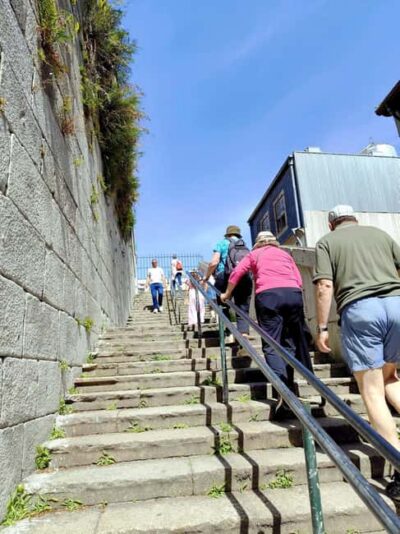
Porto is compact on a map but tiring on foot. The historic center rises and falls sharply, with stone lanes, stairways, and long climbs between the river and the upper city. A tuk tuk gives you a broad view without asking you to conquer every slope before lunch.
The route also helps you connect places that can feel separate when explored on foot. You begin near the Cathedral, pass through the upper center, move toward Clérigos and the old commercial quarter, then cross the Douro to Vila Nova de Gaia for the view from Serra do Pilar. That geography matters. You see how Porto’s high ridge, riverfront, and southern bank fit together.
I would book this near the start of a Porto visit. It gives you a useful mental map, and several people found it helpful for deciding which places to revisit later. It is not a substitute for entering the major monuments, but it shows you where they are and which ones deserve more time.
What the 1-hour-50-minute route covers
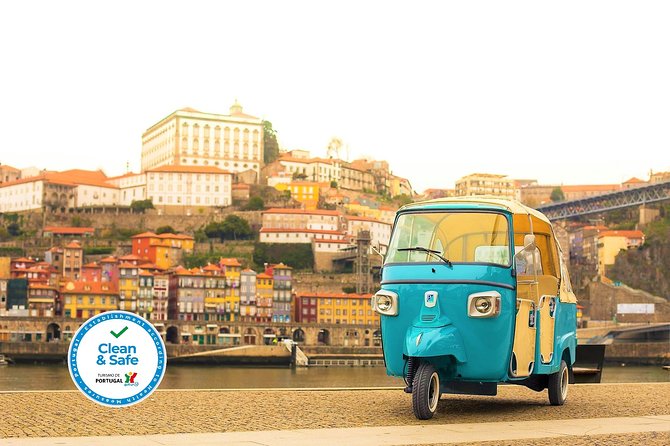
The tour begins at R. de Augusto Rosa 180, close to Porto’s Cathedral. The published route includes several drive-by sights and a series of short stops, usually around five to fifteen minutes. That means you will see a lot, but you should not expect a slow museum tour.
The exact order can change with traffic. Porto’s narrow streets and ongoing metro construction have caused occasional road closures, and local traffic can take time from the sightseeing. The company says schedules may change for these reasons, so keep your plans after the tour flexible.
Your driver-guide handles the driving and local commentary. The tour is offered in English, and guides named Ana, Anna, Victor, Natalia, Bernardo, Fabian, Gabby, and Gonçalo have all been singled out for friendly service, good city knowledge, humor, or strong communication. The quality can depend on the individual guide, so it is fair to expect a useful introduction, but not a perfectly uniform presentation every time.
More History Bike, Segway and Tuk-Tuk Tours in Portugal
- Explore Lisbon by Tuk Tuk: History and Viewpoints
★ 5.0 · 840 reviews - Historic Porto by Private Electric Tuk Tuk to Top Landmarks
★ 4.5 · 735 reviews - Private Tuk Tuk Tour Through Lisbon’s Historical Streets
★ 5.0 · 734 reviews
The Cathedral and Porto’s medieval core
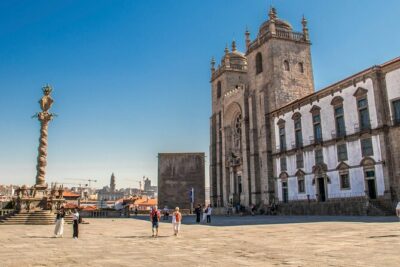
The first major stop is Porto Cathedral, known locally as Sé do Porto. Its construction began in the twelfth or thirteenth century, and its Romanesque form was altered and restored over many centuries. The result is a medieval-looking church shaped by repeated changes, rather than a building frozen in one period.
You get about ten minutes here, and admission is not included. That short visit is enough to admire the exterior, see the hilltop setting, and decide if you want to return for a longer look. The nearby terrace gives you a sense of Porto’s layered streets and the drop toward the river.
The tour also points out the pillory on the Cathedral terrace. This stone column is a twentieth-century reproduction based on a 1797 drawing, placed there after buildings around the Cathedral were cleared during the Estado Novo period. It is a small detail, but it opens a window onto the way modern governments reshaped historic Porto.
The Episcopal Palace sits beside the Cathedral. Its roots may reach back to the thirteenth century, while the current Baroque appearance comes largely from an eighteenth-century remodelling linked to Nicolau Nasoni. You can admire the grand façade from outside, but entry is not included and the stop is only about five minutes.
São Bento Station and the city’s grand squares
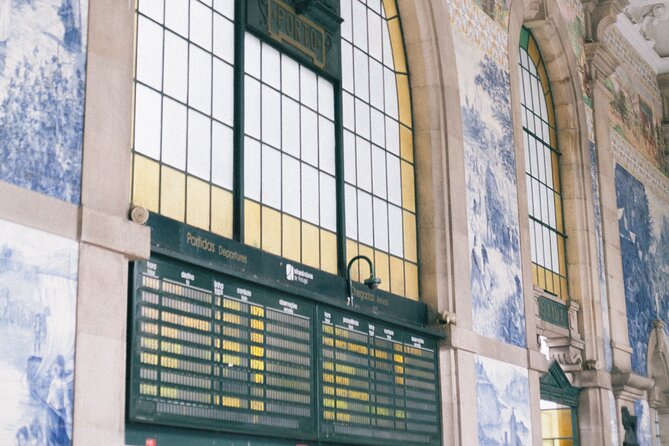
São Bento Railway Station is one of the route’s strongest stops. The building dates from the early twentieth century, with a glass and iron roof and a lobby covered in about 20,000 painted tiles by Jorge Colaço. The panels show scenes from Portuguese life and history, so even a brief visit feels worthwhile.
You get around ten minutes here, and admission is free. This is one place where the tuk tuk format works especially well. You can step out, walk into the entrance hall, take in the tiles, and return to the vehicle without spending half a day on a formal tour.
The route continues through several central squares, including the area now known as Praça de Lisboa and the square associated with Charles Albert of Sardinia. These spaces reflect Porto’s changing urban life, from old workshops and medieval walls to eighteenth-century planning and nineteenth-century monuments.
At Fonte dos Leões, you see a nineteenth-century French-made fountain decorated with lions. It was cast by the Val d’Osne foundry and is largely based on a fountain in Leicester, England. The stop is brief, but it is a nice example of how Porto’s public spaces borrow ideas from beyond Portugal.
Porto’s churches, gardens, and Clérigos Tower
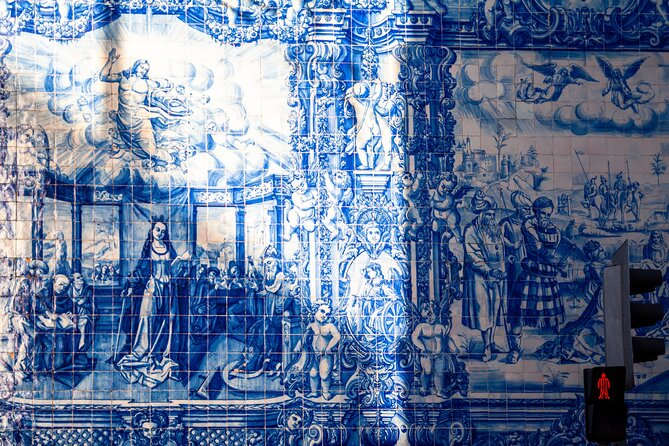
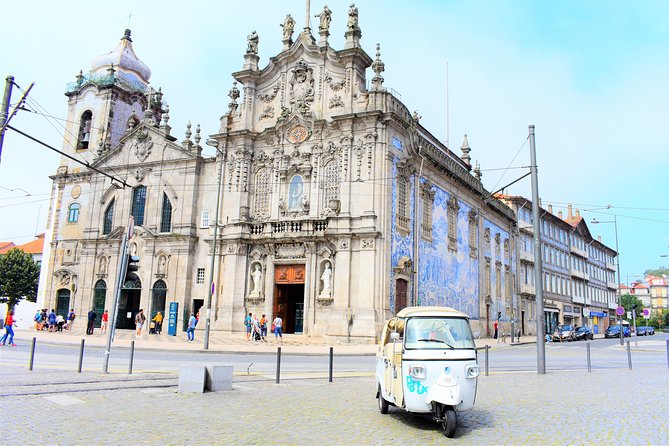
The route passes two important churches known for Porto’s exuberant Baroque and Rococo style. One has a classical façade and an elaborate Rococo altarpiece associated with Nicolau Nasoni. The other is known for its carved interior and blue-and-white tile panels added to the side façade in 1912.
The information provided does not promise long interior visits at these churches, so treat them mainly as landmarks to note for later. If you enjoy carved wood, gilded decoration, and tilework, write down their locations and return when you have more time.
Cordoaria Garden, also called João Chagas Garden, offers a short change of pace. Rope makers worked here for about two centuries, and the area became a public garden in the nineteenth century. The park includes statues, modern sculpture, and the work of German landscape designer Emile David.
Nearby, Clérigos Tower rises above the city. Its Baroque church and tall bell tower are among Porto’s most recognizable sights. The tour allows about five minutes, and tower admission is not included. You will get the essential orientation and a chance to photograph the profile, but climbing the tower requires a separate visit and more time.
More Old Town and Historic Centre Walks in Portugal
- Lisbon: Live Fado Show with Port Wine in Historic Center
★ 4.7 · 4,166 reviews - Porto: Historical Center Walking Tour
★ 4.8 · 898 reviews - Lisbon’s historic old town in a tuk-tuk in German
★ 4.9 · 319 reviews - Albufeira: Old Town History Walking Tour with Tapas & Wine
★ 4.7 · 96 reviews
From cultural monuments to Porto’s commercial heart
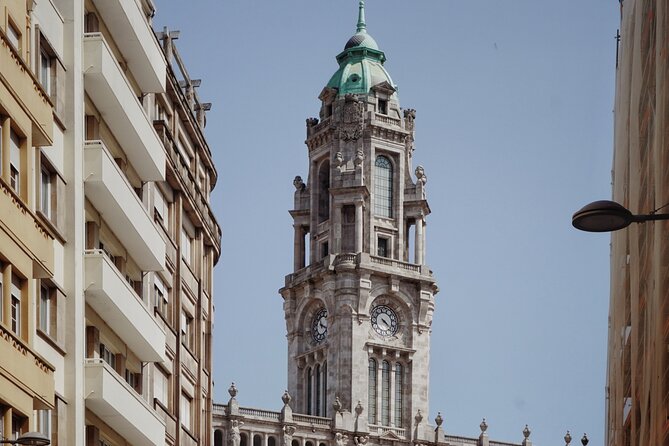
The route then moves toward some of Porto’s most important civic and commercial buildings. The former São Bento da Vitória monastery dates from the late sixteenth century and later served several public and cultural roles, including space connected with the National Theatre São João, the Porto National Orchestra, and district archives.
The Palácio da Bolsa, or Stock Exchange Palace, is a nineteenth-century neoclassical building and one of the city’s major monuments. Its Arab Room is the famous interior highlight, but entering takes a separate ticket. The tuk tuk can show you where it is and explain its place in Porto’s commercial past, but you will need to return for the full guided visit.
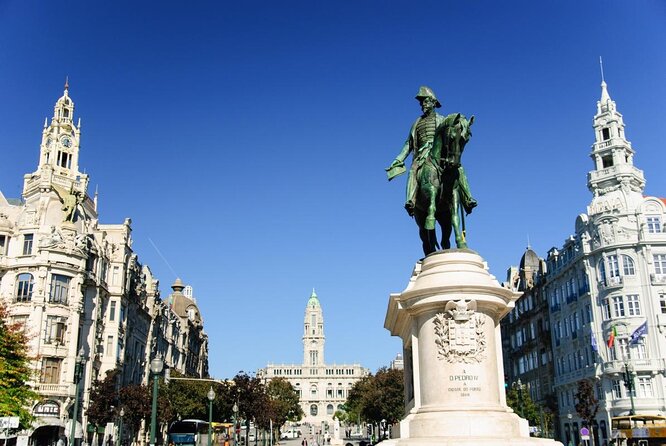
The nearby statue of D. Pedro IV recalls his connection with Porto and the constitutional struggle of the nineteenth century. It is a quick roadside sight, yet the monument helps connect the city’s architecture with its political story.
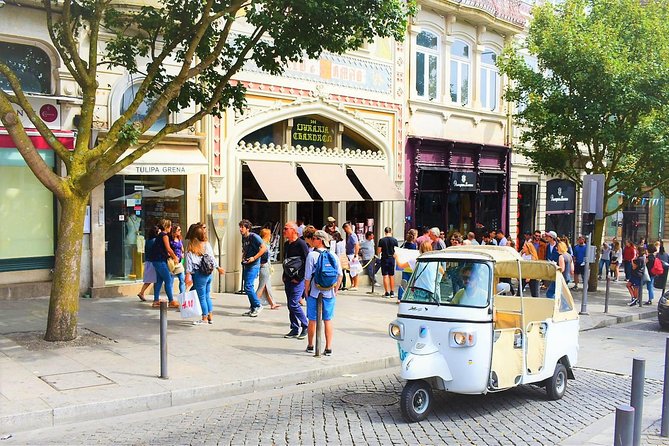
You also pass Livraria Lello, the famous Art Nouveau library with neo-Gothic details, painted interiors, a grand staircase, and a stained-glass skylight bearing the motto Decus in Labore. The building is admired for good reason, but this tour does not include entry. If you want to go inside, arrange that separately and allow enough time for the visit.
Mercado Ferreira Borges and the riverfront
Mercado Ferreira Borges is an important example of Porto’s iron architecture. Built in 1885 to replace an older market, it had a short life as a market before taking on other uses. It now functions as an entertainment venue connected with Hard Club.
The nearby square includes a monument to Infante Dom Henrique, a central figure in Portugal’s maritime story. The location is also close to Palácio da Bolsa and the river, so it helps you understand how trade, shipping, and public life once met in this part of the city.
The tour passes the former Alfândega Nova, the old customs building. Its neoclassical design combines iron with stone, brick, and wood, and it now houses the Transport and Communications Museum as well as a congress center. Again, this is mainly an outside orientation. You will need another visit for the museum.
One of the most impressive church stops is Igreja de São Francisco. Construction began in the fourteenth century, while the interior gained its famous gilded woodwork in the seventeenth and eighteenth centuries. The decoration is so lavish that the church earned the nickname Church of Gold. It has been a national monument since 1910 and forms part of Porto’s UNESCO-listed historic center.
The church entrance is not included, so consider the tour’s short look a preview. If ornate interiors interest you, this is one of the places I would prioritize for a separate visit.
Crossing the Douro for the Serra do Pilar view
The route becomes especially rewarding when it reaches Vila Nova de Gaia and the Serra do Pilar monastery. Construction began in 1538 and continued for more than a century. The circular church and circular cloister are unusual, and the monastery’s terrace provides a wide view over Porto, Gaia, the Douro, the Cathedral, and the Dom Luís I Bridge.
You get about fifteen minutes here, the longest stated stop on the route. That is enough time for photographs and a quick look around, though not for a full exploration of the monastery.
This viewpoint is the visual payoff of the ride. From high above the river, Porto’s dense historic center finally makes sense. You can see the Cathedral on the ridge, the bridge linking the two banks, and the riverfront below. I would not skip this stop, even if you have already seen Porto from ground level.
Bridges and the Port wine pause
The Dom Luís I Bridge is one of Porto’s defining structures. Designed by Teófilo Seyrig, a disciple of Gustave Eiffel, it opened in 1886 with two overlapping iron decks. The upper deck now carries Porto’s metro, while the lower level serves road traffic and pedestrians.
The route also points out the Infante Bridge, opened in 2003. It replaced road use on the upper deck of Dom Luís I Bridge and links Porto with Gaia farther east. Seeing both bridges helps explain how the city’s transport network has changed while the older bridge remains a major visual symbol.
At some point during the ride, you receive a glass of Port wine. It is a small inclusion, not a winery tour, but it connects the sightseeing with the drink that made Porto famous. Do not expect a detailed tasting lesson. Think of it as a pleasant sample during a fast city introduction.
Comfort, group size, and practical limits
Each tuk tuk holds two, three, or four adults of average height, with a stated weight limit of up to 75 kilograms per person. Larger parties use more than one vehicle but travel together and stop at the same places.
That private format is a real advantage for couples, families, and small groups. Children must be accompanied by an adult, and service animals are allowed. Most people can take part, although the open vehicle can feel exposed in wet or windy weather. Bring a raincoat if the forecast is uncertain.
Sound is the chief comfort issue. A few passengers found it hard to hear commentary while the tuk tuk was moving. I would sit close to the guide, ask questions at stops, and avoid assuming that every passing building will receive a full explanation.
The tour costs about $42.33 per person. For a private ride with a local driver-guide, a Port sample, and nearly two hours of city coverage, that can be fair value, especially if you have limited time or dislike steep walks. It is less compelling if you want detailed history at every monument or plan to explore Porto slowly on foot.
Free cancellation is available up to 24 hours before the start time. Poor weather can lead to a new date or a full refund, while late cancellations are not refunded. The experience requires at least two people per booking.
Who should book this Porto tuk tuk tour?
I would choose it for a first morning or afternoon in Porto, especially if you have one or two days in town. It suits families, older visitors, people with limited mobility, and anyone who wants a quick overview before exploring on foot.
It is also useful for photographers. The route includes high viewpoints, bridges, tiled façades, church exteriors, gardens, and river scenes. Guides such as Ana, Anna, Victor, and Gonçalo have been praised for helping with stops, views, local tips, and a relaxed mood.
I would skip it if your main goal is long interior visits, a formal architectural lecture, or a quiet ride with uninterrupted conversation. Traffic may slow the final part, and the open vehicle can be noisy. You should also confirm the meeting point carefully, since one person found it difficult to locate and another experienced a late cancellation linked to street closures.
Should you book it?
Book this tour if you want a fast, friendly overview of Porto and value seeing the city’s layout more than entering every monument. The Serra do Pilar viewpoint, São Bento Station, bridge crossings, and narrow streets give you a strong first look, while the Port tasting adds a local flavor.
Skip it if you have plenty of time and prefer to walk, read, and linger. For most short stays, though, the tuk tuk is a practical way to cover Porto’s hills and major sights before choosing where to return.
FAQ
How long does the Porto tuk tuk tour last?
The tour lasts approximately 1 hour and 50 minutes.
Where does the tour begin?
It begins at R. de Augusto Rosa 180, 4000-528 Porto, Portugal.
Where does the tour end?
The activity ends back at the meeting point.
Is the tour private?
Yes. Only your group participates in the private activity.
How many people fit in one tuk tuk?
Each tuk tuk can carry two, three, or four adults of average height, with a stated limit of up to 75 kilograms per person.
What happens if my group is larger than four people?
Larger groups use multiple tuk tuks and travel together, making the same stops at the same time.
Is a Port wine tasting included?
Yes. A glass of Port wine is included in the tour.
Are monument entrance fees included?
No. Entrance fees for monuments are not included.
Is the tour offered in English?
Yes. The tour is offered in English and includes a driver-guide and local guide.
Can I cancel for a refund?
You can cancel at least 24 hours before the start time for a full refund. Cancellations made less than 24 hours before the experience are not refunded.
Latest history tours reviewed in Portugal
- From Albufeira: Historical Algarve Region Tour★ 4.7 · 585 reviews
- From Albufeira: Wine Tasting & Historic Silves Tour★ 4.9 · 421 reviews
- Faro: Private & Flexible Walking Tour in Historic Center★ 4.5 · 52 reviews
- Lisbon on a Tuk Tuk Tour: History & Viewpoints★ 4.9 · 204 reviews
- Évora: Private & Flexible Walking Tour in Historic Center★ 4.7 · 73 reviews
- Porto: Douro Valley History & Wine Tour with Cruise & Lunch★ 4.6 · 433 reviews
- Coimbra: Private & Flexible Walking Tour in Historic Center★ 4.9 · 92 reviews
- Monsanto and Historical Villages Tour – 3 Options Available★ 5.0 · 23 reviews
Porto History Tours, compared.
Douro Valley: Historical Sites, Wine Experience, Lunch & Cruise
Read our review →
Porto: An Intimate Fado Show in a Historical Tavern
Read our review →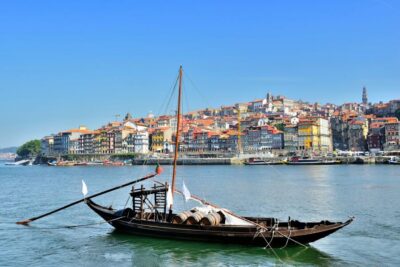
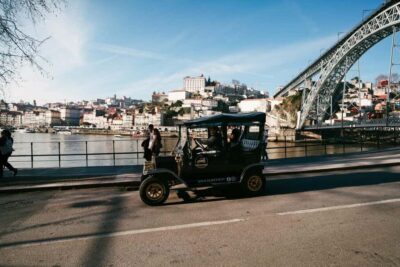
Porto: Private Tour of the Historic City in a Ford T Car
Read our review →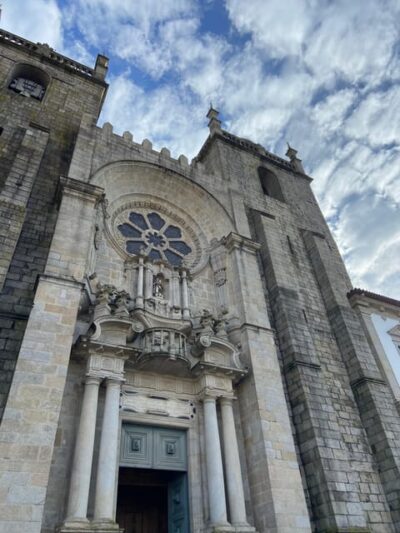
Historic Porto by Private Electric Tuk Tuk to Top Landmarks
Read our review →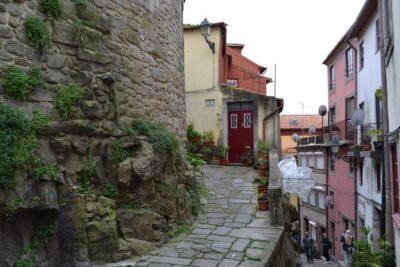
3-Hour Porto Jewish Heritage Walking Tour with Local Guide
Read our review →