
Review · TBILISI
Mtskheta: Ancient Capital of Georgia Half-Day Tour
Mtskheta is where Georgia’s story comes together: royal power, Orthodox faith, river valleys, and a town that still feels tied to its past. The tour’s best surprise is the contrast between the towering Chronicle of Georgia above Tbilisi and the small, walkable streets of old Mtskheta.
I like the flexible start time and the short driving distances, which leave more room for churches, views, and questions. I also like the guides’ personal touch. Khatuna, Khato, Alexi, Oksana, and others have been praised for explaining Georgian history clearly and adjusting the pace for families. The main drawback is that this is a highlights tour, not a long archaeological expedition, and the churches require walking, steps, and suitable clothing.
Key points to know before you book
- Four major stops in four hours: See the Chronicle of Georgia, Svetitskhoveli Cathedral, Mtskheta, and Jvari Monastery without committing to a full-day excursion.
- Flexible timing: A morning or late-afternoon departure is wiser in summer, when Mtskheta can reach 35°C.
- Private group format: You can ask questions, slow down for photographs, and adjust the pace more easily than on a large coach tour.
- Excellent guide choice matters: Guides including Khatuna, Khato, Alexi, Guram, and Oksana have been praised for history, local culture, and practical advice.
- Bring church-ready clothes: Men should avoid shorts and sleeveless tops. Women need covered shoulders and knees and a headscarf inside Orthodox churches.
- Good value at $48 per person: Entrance fees and water are included, while lunch is not.
Why Mtskheta makes a smart first outing from Tbilisi
Mtskheta sits close enough to Tbilisi for a half-day visit, yet it gives you a quick introduction to several sides of Georgia. You get monumental stone churches, old capital history, river views, local food, and a hilltop monastery in one compact trip.
That makes this tour especially useful at the beginning of a Georgian holiday. A good guide can explain how the country’s early capitals, Christian traditions, royal families, legends, and present-day customs fit together. Several guides also give practical suggestions for eating and sightseeing in Tbilisi, which adds value beyond the four scheduled stops.
The tour is listed at $48 per person. At that price, the value is strongest if your booking includes private transport, entrance fees, water, and hotel pickup and return. A private group also means you are not simply being moved from one photo stop to another. You can ask about religious art, Georgian customs, wine, food, or the stories behind the monuments.
Lunch is not included, so plan to eat before or after the tour. The half-day format is also useful if you have an afternoon train, an evening reservation, or only a short stay in Tbilisi.
More Ancient History Tours in the world:
- Colosseum: Underground and Ancient Rome Tour
★ 4.7 · 12,691 reviews - Colosseum & Ancient Rome with Arena Floor Option I Max 6 People
★ 5.0 · 3,306 reviews - Rome: Colosseum, Ancient Rome Tour or AudioGuided Tour
★ 4.4 · 2,879 reviews
The Chronicle of Georgia begins with a wide Tbilisi view
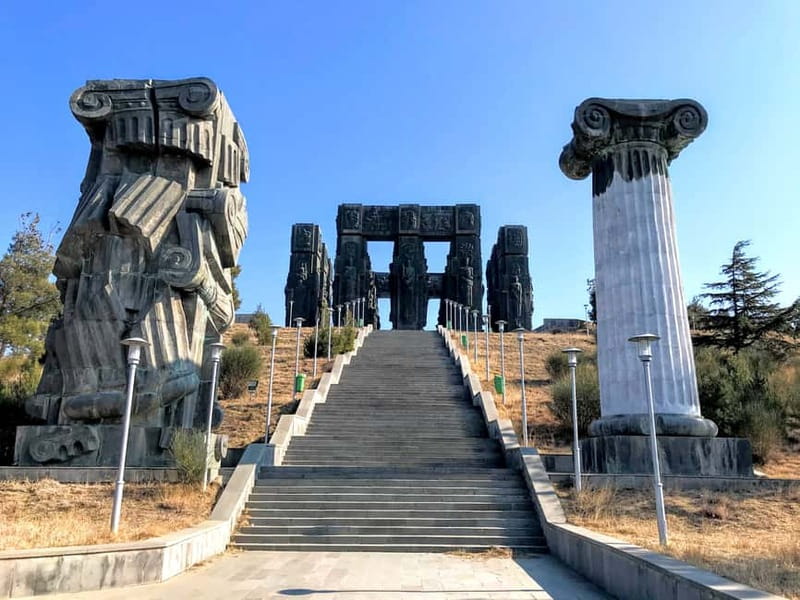
The first major stop is the Chronicle of Georgia, about 40 minutes including a visit, guided explanation, and time for photographs. This huge monument uses tall stone columns and carved scenes to present episodes from Georgian history and religious tradition.
You come here for scale and views. From the monument, you can look across Tbilisi and toward Tbilisi Sea, a large body of water on the city’s edge. The setting feels open and dramatic after the tighter streets of central Tbilisi.
This stop works well early in the day because it gives you a visual orientation. Your guide can point out how the city spreads across the hills and explain why the monument matters before you move on to older religious sites.
The name can make the site sound like a traditional ruin, but it is a modern monument rather than an ancient church. That distinction matters if you expect archaeological remains. Its appeal comes from the scale, carved panels, open views, and the way it frames Georgian identity.
Allow time for sun exposure here. A hat, sunglasses, and water are useful, especially in summer. The stone surfaces and open position offer little relief from midday heat.
The road to Mtskheta passes through Georgia’s softer scenery
The trip from Tbilisi to Mtskheta includes a scenic drive through a limestone canyon. You are not stuck in a vehicle for hours, which is one of the tour’s practical strengths. Most of the time is given to the actual sites rather than a long transfer.
The drive also helps you see how quickly the city gives way to hills, river valleys, and open country. This is a small taste of the scenery you would encounter on a longer Georgian journey, without spending a full day on the road.
The provider describes the tour as suitable in all seasons. That is reasonable, since the route is short and the main attractions remain open year-round, but the experience changes with the weather. Winter can bring cold and wind at Jvari, while summer heat is most noticeable in Mtskheta. Spring and autumn should offer the easiest walking conditions, though the tour can work in any season with the right clothes.
Svetitskhoveli Cathedral carries the weight of Georgian Christianity
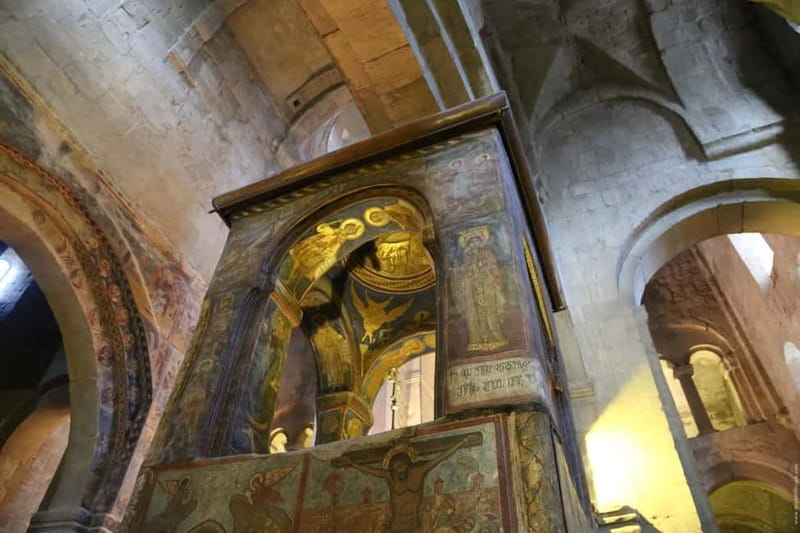
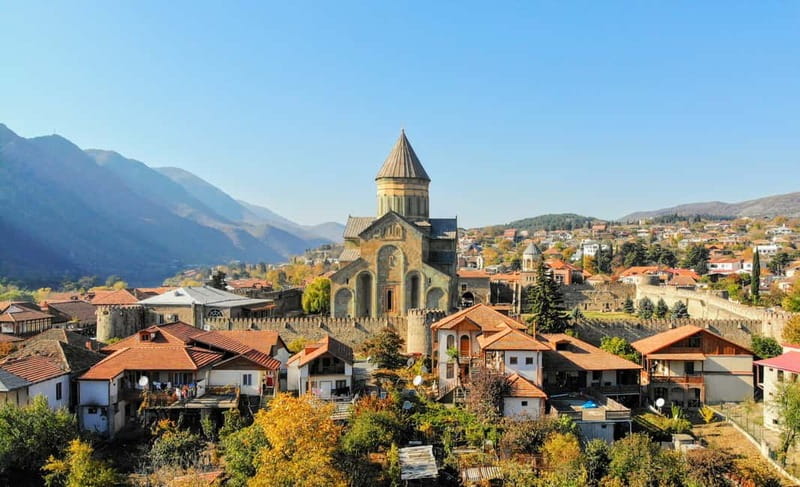
Svetitskhoveli Cathedral receives about an hour, making it the most substantial stop on the route. It is a UNESCO World Heritage site and one of Georgia’s most important churches.
The cathedral is not just a pretty stone building. It is a working Orthodox religious site with centuries of royal, spiritual, and artistic importance. Inside, your guide can explain the traditions connected with the cathedral, the role of Mtskheta in Georgian Christianity, and the details of the building’s design.
Give yourself time to look beyond the main facade. Stone carving, arches, frescoes, and the layout of the church all reward a slower visit. The atmosphere may change during a service or religious holiday. Entry to parts of the church can be limited at those times, so your guide may need to focus on the exterior and the surrounding grounds.
Dress modestly. Men should not wear shorts or sleeveless shirts. Women should cover their shoulders and knees and wear a headscarf inside. A scarf may be available at the entrance, but bringing your own is more convenient.
This is also where the guide can make the biggest difference. Names praised for strong explanations include Khatuna, Khato, Alexi, and Oksana, though your assigned guide may be someone else. The best experience here comes from asking questions rather than simply walking behind the guide and taking photographs.
More Half-Day Tours in the world:
- Lima’s Vibrant Heritage: Exploring the City’s Landmarks Half-day
★ 4.5 · 581 reviews - From Ho Chi Minh: Cu Chi Tunnels Half-Day History Tour with Guide
★ 5.0 · 480 reviews - Naxos: Half-Day Guided History and Culture Sightseeing Tour
★ 4.7 · 435 reviews - Singapore: Historical Half-Day Bike Tour
★ 4.8 · 399 reviews
Mtskheta’s streets add food and everyday Georgian life
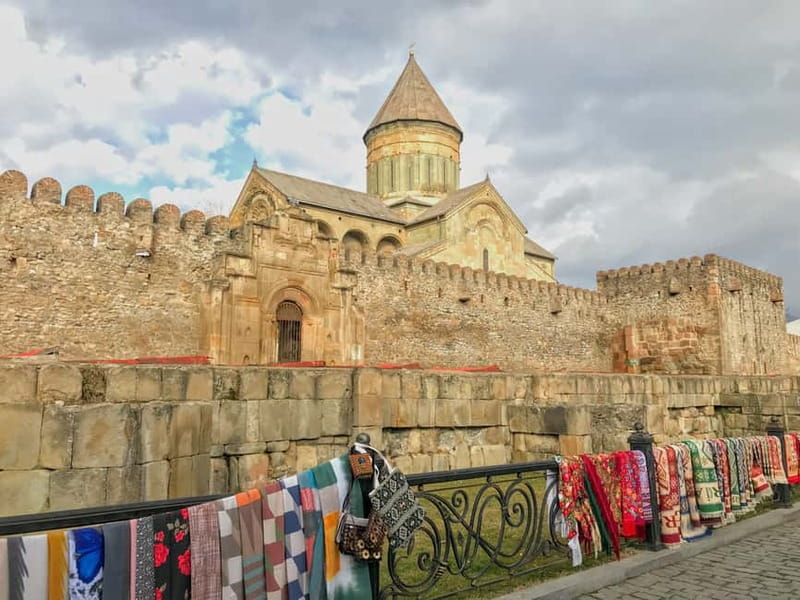
After the cathedral, the tour allows about 30 minutes in Mtskheta itself. This is short, so think of it as a focused stroll rather than a full town visit.
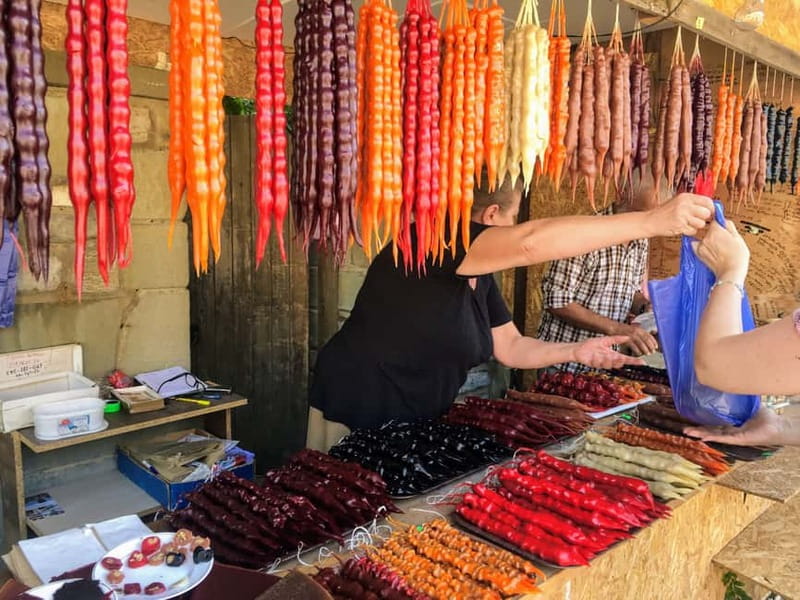
The old capital has cobblestone streets, souvenir stalls, sweets, wine, coffee, and small local businesses. You might find churchkhela, the traditional Georgian sweet made with nuts and concentrated grape juice, along with other snacks and gifts. Wine ice cream is another unusual treat mentioned on the route.
This part of the tour gives the day a welcome change of pace. The churches explain national history and faith. The market streets show how visitors encounter Georgia today, through food, conversation, small purchases, and local hospitality.
Do not expect untouched ancient ruins. Mtskheta has been renewed in parts, and its streets are arranged for modern visitors. That does not make the stop uninteresting, but it does set the right expectation. You are visiting a living historic town, not an abandoned settlement.
If you enjoy buying food souvenirs, ask your guide for help. Guides such as Khatuna have been praised for pointing people toward good churchkhela and wine. A little local advice can save you from choosing a product based only on the brightest packaging.
Jvari Monastery gives the tour its finest view
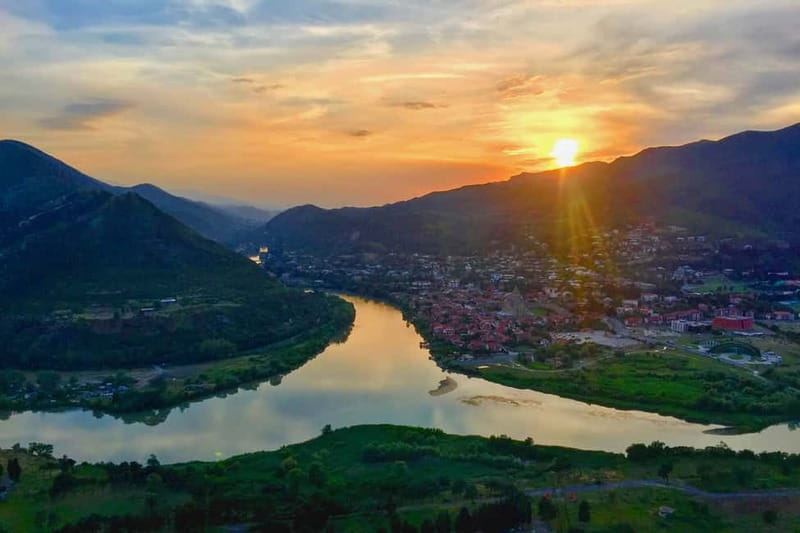
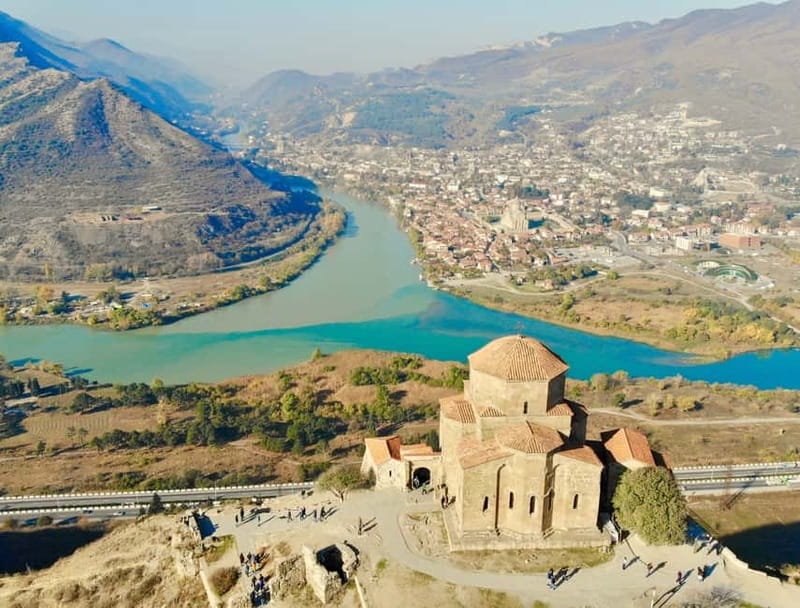
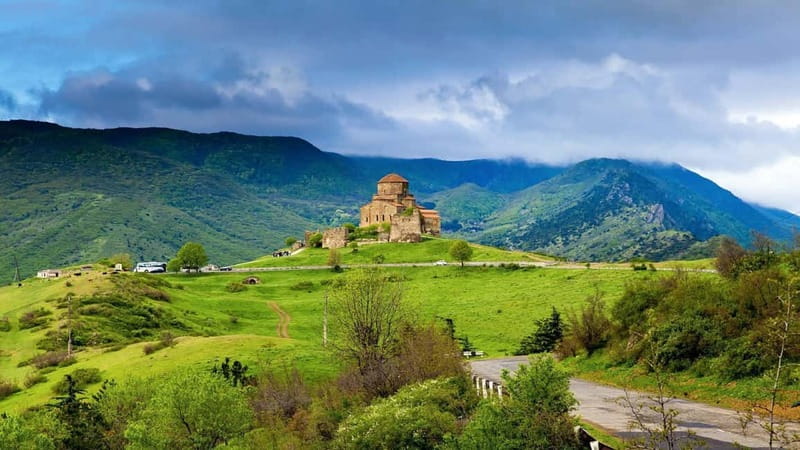
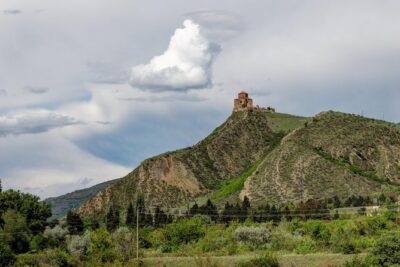
Jvari Monastery gets about 45 minutes and is the high point of the day, both literally and visually. The church sits above Mtskheta and looks toward the meeting point of the Aragvi and Mtkvari rivers.
The view explains Mtskheta’s importance better than a paragraph of history can. Rivers meet below the hill, the town spreads across the valley, and the surrounding hills create a natural setting for a place of worship. On a clear day, Mount Kazbeg may be visible in the distance.
Jvari is a photo stop, but it deserves more than a quick picture from the parking area. Walk around the exterior, look through the openings toward the valley, and listen to the guide’s explanation of the monastery’s religious and historical role.
Be ready for walking and steps. One lower rating specifically noted the difficulty of the return route because of many steps and no cable car. That warning is important for anyone with limited mobility, knee problems, or a stroller. The activity information uses the phrase wheelchair accessible, but it also says the tour is not suitable for wheelchair users and that access to the monuments is pedestrian-only. I would trust the practical warning and contact the provider before booking if accessibility is a concern.
Late afternoon can be especially pleasant here, and past visitors have found the route suitable for sunset. The light can soften the stone and spread across the river valley. Still, sunset timing depends on the season and your departure time, so confirm the start time rather than assuming the tour will end at sunset.
The guide can turn a short route into a real history lesson
The route is fixed enough to keep the tour efficient, but the private format gives it a personal feel. You can stop for questions, request more time for photographs, and ask for extra context about Georgian food, wine, religion, or daily life.
Guide quality is the tour’s most important variable. The strongest names associated with this experience include Khatuna, Khato, Alexi or Aleksi, Oksana, Guram, and Jonah. Their strengths include clear English, Russian-language guiding, safe driving, friendly conversation, and an ability to explain both facts and local stories.
Families can benefit from the flexible pace. One family traveling with a 10-month-old found the guide willing to slow down, while another family with a four-year-old completed the route comfortably. That does not remove the need for walking, heat protection, or church-appropriate clothes, but it does make the private format more forgiving than a strict group schedule.
The tour is also a good fit for solo visitors. A guide can take photographs, explain details you might miss alone, and answer questions as they arise. Several guides are also described as helpful with restaurant suggestions and the rest of a Tbilisi itinerary.
Timing, transport, and what to pack

The stated duration is four hours. Pickup depends on the booking option, and hotel pickup and return are included with the private option. The listed return points include Tbilisi locations and Europe Square, so confirm your exact pickup and drop-off point when booking.
Transport has received a high rating, with 92 percent of published ratings giving it a perfect score. The strongest practical comments focus on smooth hotel pickup, clean vehicles, working air conditioning, and careful driving. Air conditioning matters in July and August, when the stone sites can feel much hotter than expected.
Choose a morning departure in summer if you dislike heat. A late-afternoon departure can work well for softer light and cooler streets, but check that the churches will be accessible during your chosen time.
Bring:
- Comfortable shoes with a good grip
- Water, though a bottle is included
- Sunglasses and a sun hat
- Weather-appropriate clothing
- A scarf or clothing that can cover shoulders and knees
Religious services and holidays can restrict entry to some churches. Your guide can still explain the buildings and grounds, but an interior visit is not guaranteed at those times.
Who will get the most from this Mtskheta tour
I would choose this tour if you want a compact introduction to Georgian history without spending a full day away from Tbilisi. It suits first-time visitors, photographers, couples, families, solo visitors, and anyone interested in Orthodox churches.
It is particularly useful if you prefer a guide who can connect separate sites into one story. The Chronicle of Georgia shows a modern interpretation of national identity. Svetitskhoveli presents the country’s central religious tradition. Mtskheta adds food and street life. Jvari then puts the whole area into view.
I would look elsewhere if you want long hikes, archaeological ruins, a food-focused excursion, or extensive time inside each church. Thirty minutes in Mtskheta is enough for a taste, not a full exploration, and four hours cannot cover every monastery near the old capital.
The route also involves walking on uneven surfaces and steps. It is not suitable for wheelchair users according to the practical restrictions provided, despite the separate accessibility note. Families with young children may manage well, but strollers and tired legs can be awkward at Jvari.
Should you book the Mtskheta half-day tour?
Book it if you want the main sights in a well-planned half-day, value hotel transport, and prefer a private guide who can answer questions. At $48 per person, the combination of transport, entrance fees, water, and personal guiding makes sense, especially for a small party.
Choose a morning departure in hot weather, wear church-ready clothing, and ask for a guide such as Khatuna, Khato, Alexi, or Oksana if names can be requested. For the best photographs, consider a late-afternoon start, but confirm the timing around church services.
Skip it if you need fully step-free access or want to spend hours wandering Mtskheta independently. For most first visits from Tbilisi, though, this is an efficient and worthwhile way to meet Georgia’s old capital, major churches, and valley views in a single outing.
FAQ
How long does the Mtskheta tour last?
The tour lasts four hours, including transport between Tbilisi and the main stops.
What places does the tour visit?
The route includes the Chronicle of Georgia, Svetitskhoveli Cathedral, Mtskheta town, and Jvari Monastery.
Is hotel pickup included?
Hotel pickup and drop-off are included when you select the private option. Confirm the exact pickup point when booking.
What languages does the guide speak?
Live guiding is available in English and Russian.
Is lunch included?
No. Lunch is not included in the tour price.
What should I wear to the churches?
Men should not wear shorts or sleeveless shirts. Women should avoid shorts and sleeveless tops and should wear a headscarf inside Orthodox churches. Covered, weather-appropriate clothing is the safest choice.
Is the tour suitable for wheelchair users?
The practical information says the tour is not suitable for wheelchair users, and access to the churches and monuments is pedestrian-only. The route can also include steps, particularly around Jvari Monastery.
Latest history tours reviewed in the world
- From Athens: Ancient Olympia Full-Day Private Tour★ 4.8 · 22 reviews
- From Athens: Explore Ancient Corinth & Charming Nafplion★ 4.6 · 102 reviews
- From Athens: Explore Ancient Greece 4-Day Tour★ 4.7 · 73 reviews
- From Albufeira: Wine Tasting & Historic Silves Tour★ 4.9 · 421 reviews
- From Albufeira: Historical Algarve Region Tour★ 4.7 · 585 reviews
- From Alexandria: Full-Day Guided Tour of Historical Sights★ 4.5 · 54 reviews
- Franklin: Ghost Tour in Historic Franklin★ 4.8 · 65 reviews
- Freiburg: Exciting City Tour with sightseeing and history★ 4.3 · 103 reviews
Tbilisi History Tours, compared.
Mtskheta, Jvari, gori, uflistsikhe, history and panorama (group tours)
Read our review →
Tbilisi old town & soviet heritage – Private driver-guided Tour
Read our review →Browse the lists this tour appears in