
Review · WASHINGTON DC
DC Monuments & History Guided E-Cart Tour-Blankets
Washington DC packs a lot into a small central area, and this two-hour electric-cart ride gives you a quick look at the city’s big civic monuments without asking you to walk between them. I like the photo stops and the way guides such as Lorenzo, Feyzi, Elmira, and Fernando add stories, jokes, and useful context instead of simply pointing at buildings.
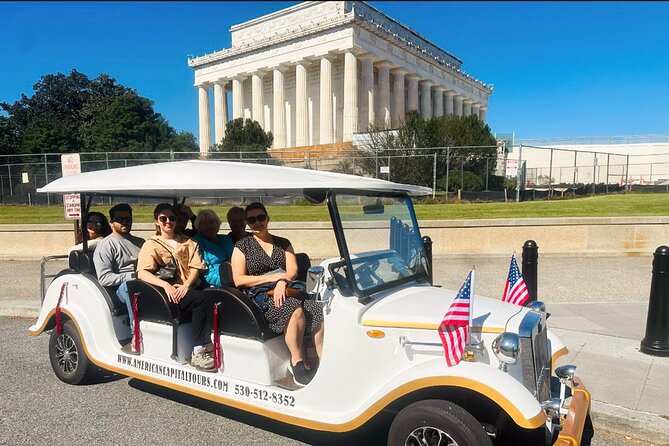
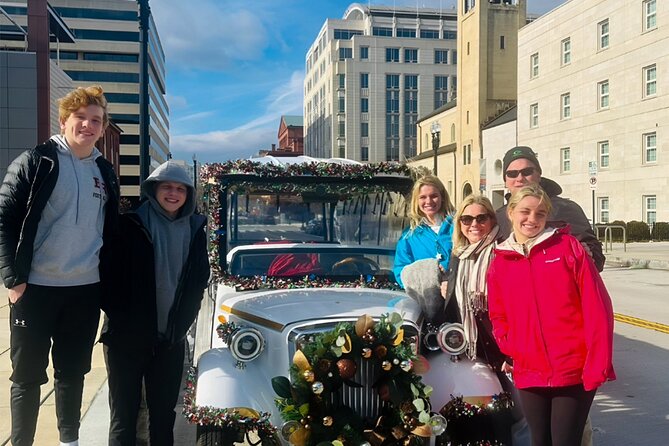
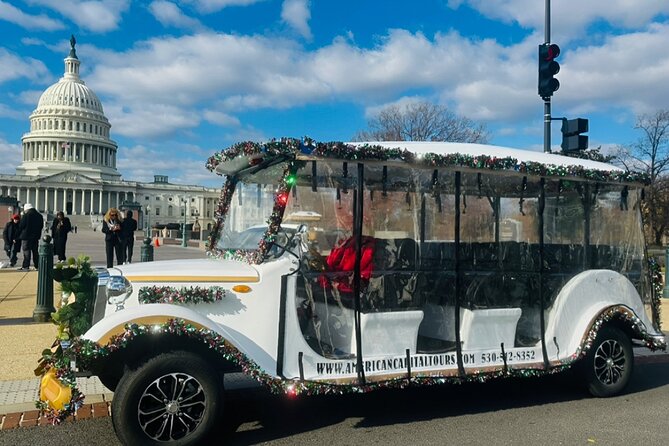
I also like the practical pace. You can see Capitol Hill, the National Mall, several war memorials, and the White House in one outing, then decide which places deserve a longer visit. The main caution is the open-air vehicle: blankets help, but winter wind can make the ride very cold, and the cart you receive may not have the plastic cover shown in some promotional images.
Key points to know before booking
- Two hours cover a lot of ground: You see the main monuments without spending most of the day on foot.
- The guides make the difference: Lorenzo, Feyzi, Elmira, Fernando, and others are praised for facts, humor, photos, and friendly service.
- You stop outside major sights: The tour is for orientation and sightseeing, not interior visits to museums or government buildings.
- Cold weather needs serious clothing: Blankets are supplied, but the electric carts are not heated.
- The vehicle may vary: Some carts have plastic curtains or covers, while others are fully open.
- The $52.70 price buys convenience: It is strongest value for a first visit, a short stay, families, or anyone who wants to limit walking.
A fast, lively introduction to Washington DC
The appeal here is simple: you get a broad view of Washington DC in about two hours, with a guide doing the driving and explaining what you see. The route begins at 333 G Street NW and returns there, making it easy to fit into a sightseeing day.
This is not a museum tour and it is not a serious study of one monument. Think of it as a moving introduction. You pass the city’s central landmarks, leave the cart at selected stops, take pictures, and hear the stories that help the buildings make sense.
The route includes Capitol Hill, the National Gallery of Art, the National Museum of Natural History, the National Museum of African American History and Culture, the Washington Monument, the Jefferson Memorial, the Franklin Delano Roosevelt Memorial, the Martin Luther King Jr. Memorial, the Lincoln Memorial, the Vietnam Veterans Memorial, the Korean War Veterans Memorial, the Albert Einstein Memorial, and the White House.
That is an ambitious list for two hours. You will not explore every site in depth, but you will get a useful map in your head. For a first afternoon in town, that can be more valuable than spending hours inside one museum before you understand how the city fits together.
More History Bike, Segway and Tuk-Tuk Tours in the USA
- Charlotte’s Ultimate Southern Charm Historical City Cart Tour
★ 5.0 · 1,347 reviews - Asheville Historic Downtown Guided Electric Bike Tour with Scenic Views
★ 5.0 · 1,234 reviews - Private Guided Historic Electric Cart Tour of St. Augustine
★ 5.0 · 1,194 reviews
Capitol Hill and the museums along the Mall
The first named stop is Capitol Hill, the political heart of the United States. You get a look at the Capitol dome, the Senate and House buildings, and the Supreme Court. The stop is listed at about five minutes, so plan on a quick introduction and photographs rather than a long walk through the neighborhood.
Capitol Hill is more than government buildings. The area also includes Eastern Market, known for produce, meat, cheese, crafts, and antiques. The tour does not give you time to shop there, but the reference helps place the formal government district in a real neighborhood.
The route also takes in the National Gallery of Art and several Smithsonian museums along the National Mall. The National Gallery holds more than 150,000 works across painting, sculpture, decorative arts, photography, prints, and drawings. The National Museum of Natural History is free and open 364 days a year, while the National Museum of African American History and Culture opened its permanent home in 2016.
You should treat these museums as orientation points, not included admissions or guided visits. If one catches your eye, return later with several hours available. This is one of the tour’s useful features: it helps you choose where to spend your limited museum time.
The Washington Monument and the presidential memorials
The Washington Monument gets about ten minutes. That is enough for photographs and a quick look at the obelisk, but not enough for an interior visit or a trip to the observation level. Admission is not included.
The monument rises 555 feet and is built from marble, granite, and bluestone gneiss. Its Egyptian-style obelisk form is easy to recognize, but your guide can add the kind of detail you might miss on your own, including the fact that construction took 36 years.
From there, the route moves toward the memorials beside the Tidal Basin and in West Potomac Park. The Jefferson Memorial receives about ten minutes. Its subject was the principal author of the Declaration of Independence, a founder of the Democratic-Republican Party, and the third president of the United States.
The Franklin Delano Roosevelt Memorial is also included in the route. It honors Roosevelt and the era of his presidency through an outdoor memorial spread across the park. The timing here is part of the tradeoff: you get the broad picture, but you will need a separate visit if you want to read every inscription and examine each feature.
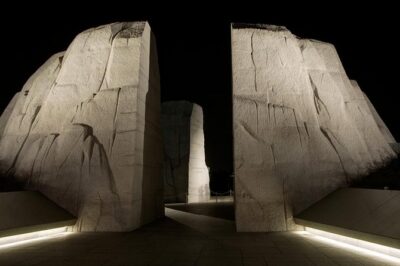
The Martin Luther King Jr. Memorial has an approximately eight-minute stop. Its central image is the Stone of Hope, a granite statue of King by sculptor Lei Yixin. This is a meaningful place to pause, even briefly, and the guide’s explanation can help connect the memorial to the wider civil rights story.
The Lincoln Memorial and the war memorials
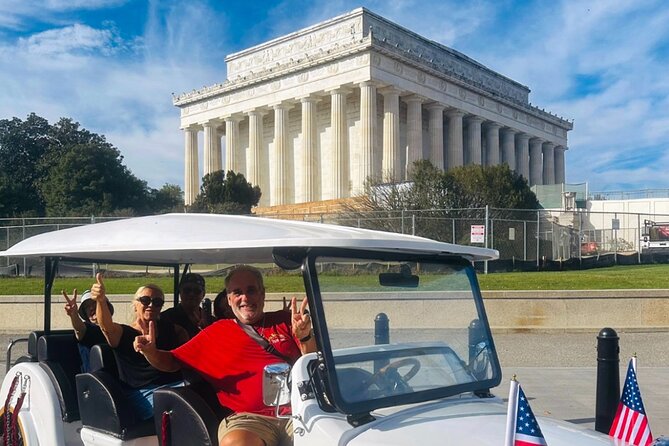
The Lincoln Memorial gets the longest named stop, about 15 minutes. That gives you time to climb the steps, see the seated Lincoln, look across the Reflecting Pool, and take the classic photograph toward the Washington Monument.
The memorial’s 36 Doric columns represent the states in the Union when Lincoln died. Two additional columns frame the entrance behind the colonnade. Your guide may explain the design while giving you space to look around, but 15 minutes still passes quickly if the area is busy.
The nearby Vietnam Veterans Memorial and Korean War Veterans Memorial are also part of the route. Both are powerful but very different. The Vietnam memorial honors those who served in that war, while the Korean War memorial, dedicated in 1995, commemorates those who served in Korea.
The Albert Einstein Memorial adds a lighter stop. It is a bronze seated figure of Einstein holding manuscript papers. It is an easy place for a playful photo, and it breaks up the more formal sequence of presidential and military memorials.
The best way to use these stops is to decide in advance which ones matter most to you. If Lincoln is your priority, use the 15 minutes well and keep your camera ready. If the Vietnam memorial matters more, ask your guide for any extra context and plan to return later for a quieter look.
Same old streets, another chapter:
- New York City: American Museum of Natural History Ticket
★ 4.5 · 15,447 reviews - History and Hauntings of Salem Guided Walking Tour
★ 5.0 · 14,564 reviews - Charleston’s Old South Carriage Historic Horse & Carriage Tour
★ 5.0 · 10,023 reviews - Beneath The Streets Underground History Tour
★ 4.5 · 8,006 reviews
Finishing at the White House
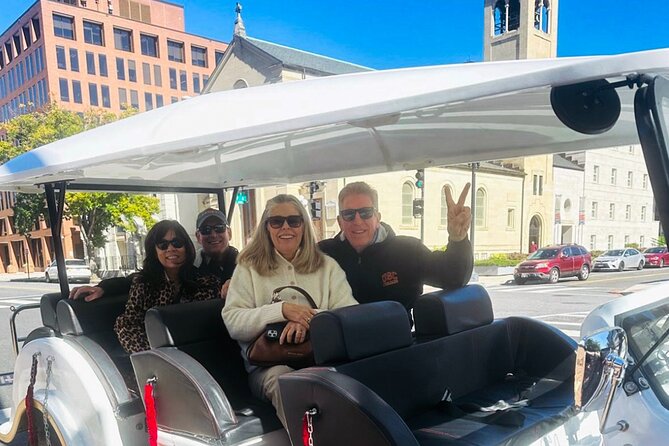
The final named stop is the White House, with about five minutes allocated. You see the official residence and workplace of the president at 1600 Pennsylvania Avenue NW. It has housed every president since John Adams, when the national capital moved from Philadelphia in 1800.
This is an outside visit. Admission is not included, and the tour does not provide an interior White House visit. Five minutes is enough for a picture and a quick explanation, though security areas and crowds can affect how close you get.
Ending here works well because the White House is one of the places most people want to see first. By this point, you will also have a clearer sense of how the federal district connects with the Mall and the memorial parks.
What the guides add to the ride
The strongest part of this experience is the guide sitting in front of you. Names vary by departure, but Lorenzo, Feyzi, Elmira, Fernando, Fazy, and Faizie are among the guides praised for clear facts, humor, and personal attention.
Several guide habits are especially useful. Guides may take pictures for you at stops, answer questions, and add small details beyond the basic dates and names. One guide kept teenagers interested with jokes and even made a hot chocolate stop for children. Another made a solo rider feel comfortable and entertained when she was the only person on the tour.
That personal approach matters in Washington. The monuments can look impressive but distant if you do not know why they were built or what details to notice. A good explanation turns a row of marble buildings into a connected story about presidents, war, civil rights, and American government.
The guide quality can vary, as it does on any guide-led outing. Some passengers found a driver’s accent difficult to follow, and one reported that the guide relied more on questions than on a steady flow of information. If you have trouble hearing, sit where you can clearly hear the speaker and ask questions early.
The cart, blankets, and the cold-weather problem
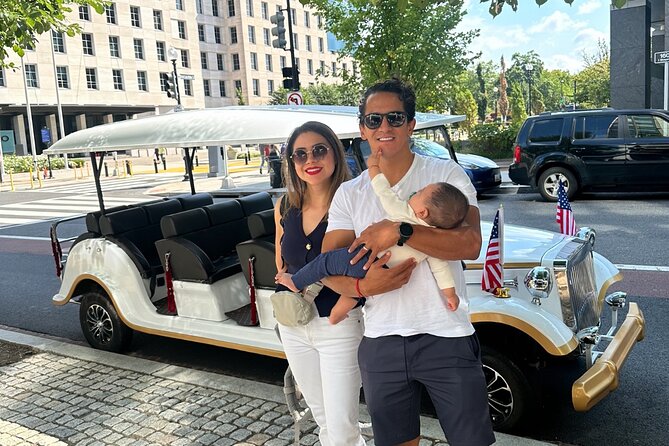
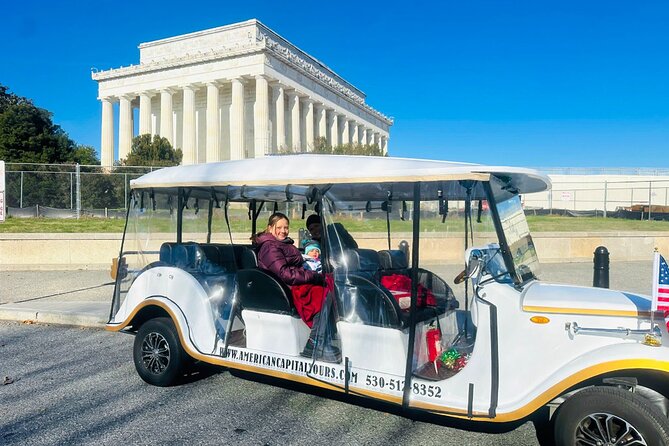
The vehicle is the most important practical issue. The tour is promoted as an open-air electric-cart experience, and the cart offers a better view than a closed vehicle when conditions are comfortable. You can look out in every direction and feel closer to the monuments than you would from a large bus.
But the cart is not heated. Several departures in December and January were described as very cold, windy, or uncomfortable, especially when the cart had no plastic sides. Blankets were helpful, but they could not replace a winter coat, hat, gloves, and scarf.
There is also a vehicle-description problem to keep in mind. Some carts have plastic curtains or covers, while others do not. The operator has indicated that covers may be removed for visibility or may vary with availability and weather. Do not book this expecting the exact covered cart shown in an image.
The safest advice is straightforward: choose a mild day if possible. For a cold-weather booking, dress for an exposed ride even if blankets are promised. If you need guaranteed shelter, an enclosed bus or another indoor option may suit you better.
At night, the open cart can offer a pleasant view of illuminated monuments, and the tour still includes photo stops. Just remember that darkness does not make the cart warmer. A night departure in cold weather requires the same careful clothing.
Is $52.70 a fair price?
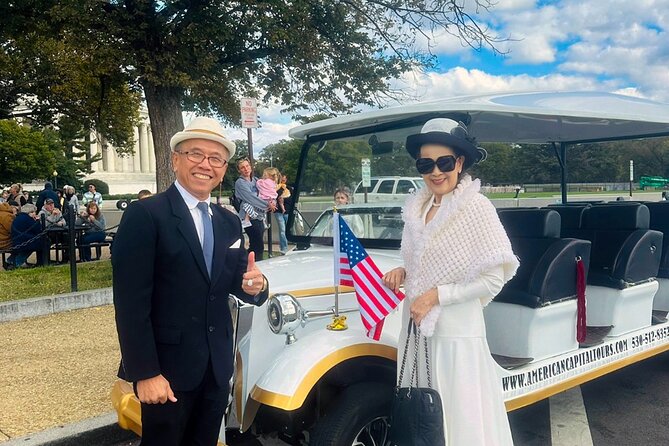
At $52.70 per person, this is not the cheapest way to get around Washington DC, but the price can make sense. You are paying for a guide, transportation, a concentrated route, photo stops, and the convenience of covering distances that would take much longer on foot.
The value is strongest if you have only one day, are traveling with children, have limited mobility, or want to see the main sights before choosing where to return. A two-hour introduction can save you from spending half a day wandering between monuments without a plan.
The value is weaker if you already know Washington well or want long visits inside the museums and memorials. You will still need separate time for those places, and the tour cannot provide a detailed visit to all 14 listed sights in two hours.
The complimentary key chain is a small extra, not a reason to book. The real value lies in the guide’s explanations and the efficient route. If your guide is as helpful as Lorenzo, Feyzi, Elmira, or Fernando, the personal commentary can make the price feel reasonable.
Who should book this electric-cart tour?
I would point this tour toward first-time visitors who want a quick overview. It also fits families, couples, solo visitors, and anyone who would rather spend two hours riding than walking long distances between widely separated monuments.
It is especially useful near the start of your stay. After seeing the Lincoln Memorial, the museums, the White House, and the Capitol area from the cart, you can plan return visits with better judgment.
Families may appreciate the short format and the chance to keep moving. Guides have entertained teenagers with jokes and helped children stay comfortable with blankets and, in one case, hot chocolate. Still, young children who dislike cold or wind may not enjoy an uncovered cart.
This is not the best choice for a visitor seeking a quiet, scholarly tour of one subject. It is also a poor fit if you expect to enter the White House, Washington Monument, Capitol, or museums during the ride. You are seeing the exteriors and learning the basic story.
The maximum group size is listed as 71, although the actual vehicle arrangement may feel smaller depending on the departure. Confirm the meeting point at 333 G Street NW and allow enough time to find it. The tour returns to that same location.
Free cancellation is available when you cancel at least 24 hours before the start time. Inside that window, refunds are not provided and changes are not accepted. Last-minute bookings also deserve care, since one booking made only minutes before departure resulted in a missed tour and poor communication.
Should you book it?
Book this tour if you want a fast, guided first look at Washington DC, especially if walking is a concern or your schedule is tight. The guide interaction, photo stops, and wide route give you a useful introduction for a fair price.
Think twice if you are visiting in freezing or rainy weather. The blankets are thoughtful, but the cart may be open, uncovered, and exposed to wind. For the best experience, choose mild weather, dress warmly, and treat the ride as an overview rather than a full visit to every monument.
FAQ
How long is the DC Monuments and History Guided E-Cart Tour?
The tour lasts approximately two hours.
Where does the tour begin?
It begins at 333 G Street NW, Washington, DC 20001.
Where does the tour end?
The tour returns to the same meeting point at 333 G Street NW.
Is the tour offered in English?
Yes. The experience is offered in English.
Does the tour operate during the day and at night?
Yes. The included experience is described as a two-hour day or night monuments and history guided e-cart tour.
Are admission tickets included?
Admission is not included for the Washington Monument or the White House. The tour mainly provides outside visits and photo stops. Several museums along the route have free admission, but museum entry is not part of the two-hour cart ride.
Are blankets provided?
Yes. Blankets are provided, and guides have used them to help passengers stay warm. They are an extra comfort, not a replacement for warm clothing.
Is the electric cart covered?
The vehicle can vary. Some carts have plastic curtains or covers, while others may be open. The cart is not heated, so dress for wind and cold if you book in winter.
Can I cancel for a full refund?
Yes, if you cancel at least 24 hours before the experience begins. Cancellations within 24 hours are not refunded, and changes inside that period are not accepted.
Latest history tours reviewed in the USA
- Franklin: Ghost Tour in Historic Franklin★ 4.8 · 65 reviews
- Fort Worth: Stockyards History Tour Pub Crawl★ 4.8 · 39 reviews
- Downtown Flagstaff Haunted History Walking Tour★ 4.7 · 46 reviews
- New York City: Flatiron Food, History, and Architecture Tour★ 4.8 · 43 reviews
- Fairbanks: Gold Dredge 8 Historic Train Tour★ 4.7 · 219 reviews
- Fairbanks: Private Mush on the Historic Yukon Quest Trail★ 5.0 · 30 reviews
- Charleston:Evening Haunted History Horse-Drawn Carriage Tour★ 4.7 · 38 reviews
- Philadelphia: Valley Forge National Historical Park Tour★ 4.9 · 39 reviews
Washington DC History Tours, compared.
Guided African American History Tour with Reserved Museum Entry
Read our review →
Smithsonian Museum of Natural History – Exclusive Guided Tour
Read our review →
African American History Tour with Museum of African American History Ticket
Read our review →
Washington, DC: African American History Tour & Museum Entry
Read our review →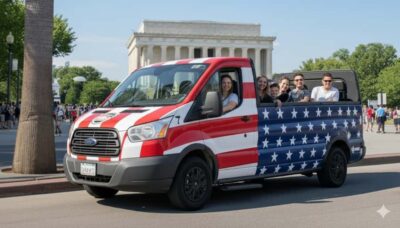
D.C: Monuments & History Guided Open-Air Bus Tour-Day &Night
Read our review →
DC: Georgetown History & Architecture Tour with Local Guide
Read our review →Browse the lists this tour appears in