
Review · PHILADELPHIA
2.5 Hour Philadelphia History Tour with Washington War Tent Show
George Washington’s war tent is the unusual centerpiece here. You do not just hear about the Revolutionary War from a sidewalk. You enter the Museum of the American Revolution for a presentation featuring the tent Washington used through much of the conflict, then receive a discount to return and explore the museum at your own pace.
I like the compact route through Philadelphia’s most important founding sites, and I like the small group, capped at 12 people. Guides such as Tom, John, Maria, Caroline, PJ, and Carla have been praised for making dense material lively and answering questions well. The main drawback is that most landmark interiors are not included, so you see Independence Hall and the Liberty Bell Center from outside.
Key points to know before you book
- Washington’s war tent is the tour’s special feature: The museum presentation gives you an object with a direct connection to the Revolutionary War.
- Twelve people is the maximum group size: That makes it easier to hear the guide and ask questions than on a large bus tour.
- You cover a lot of Old City: The route includes Independence Hall, Congress Hall, Carpenters’ Hall, Elfreth’s Alley, Betsy Ross House, Franklin’s grave, and the President’s House site.
- The $45 price includes more than a street walk: You get the guided tour, museum presentation, a later discount for museum entry, and a donation to a local historic nonprofit.
- Plan extra time for interiors: Independence Hall and the Liberty Bell Center are viewed from outside on this tour, and their admission is not included.
- Wear sensible shoes: This is a 2.5-hour walking tour with many stops and a fair amount of ground to cover.
Washington’s tent gives the tour a strong center
Philadelphia can feel like one large history lesson compressed into a few downtown blocks. This tour works best because it gives that lesson a clear thread: how the city helped create the United States, and how public ideas about freedom changed over time.
The presentation of George Washington’s war tent at the Museum of the American Revolution is the most distinctive part. The tent was present during many important moments of the war and served as Washington’s field headquarters and living space for much of the conflict. Seeing it in a museum setting gives the tour a physical anchor after the earlier stops have introduced the people and buildings around it.
You can then use the discounted museum ticket after the walking portion ends. That is a useful arrangement. The guided visit gives you context first, while a later museum visit lets you move more slowly through the exhibits instead of trying to absorb everything during a timed group stop.
More Shows in the USA:
- Lisbon: Live Fado Show with Port Wine in Historic Center
★ 4.7 · 4,166 reviews - Porto: An Intimate Fado Show in a Historical Tavern
★ 4.8 · 2,055 reviews - Lisbon: Fado Show with Wine in a Historic Venue
★ 4.8 · 1,294 reviews
Starting at The Signer in Signer’s Garden
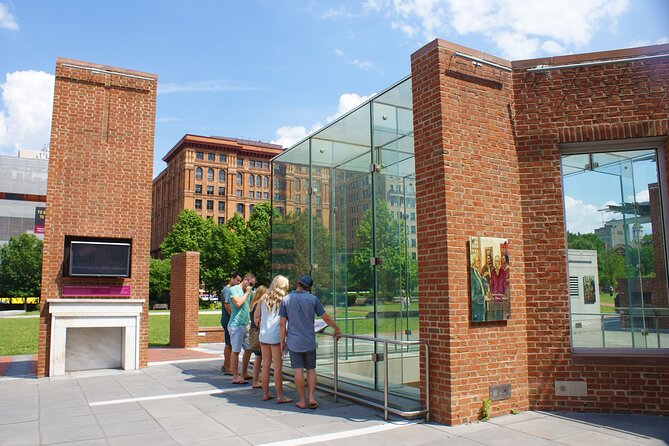
The meeting point is Signer’s Garden, at 434 to 498 Chestnut Street, near the center of Old City. Look for the statue called The Signer. It represents the people who signed both the Declaration of Independence and the United States Constitution, along with the ideals associated with freedom.
This five-minute opening is brief, but it sets the tone. The guide begins with the broad idea of public service and self-government before moving into the specific buildings where those ideas were argued over. Confirmation arrives at booking, and the tour is offered in English.
The starting point is near public transportation, which matters in Philadelphia’s historic core. The tour finishes in Old City, so you end in a useful area for further sightseeing, food, or a return visit to the museum.
Independence National Historical Park in one concentrated walk
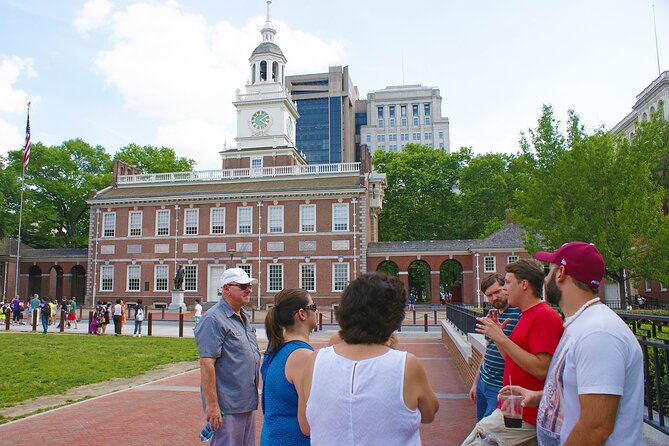
The first major section moves through Independence National Historical Park. You see Independence Hall, Congress Hall, and Old City Hall, while the guide explains how each building fit into the city’s political life.
The strength of this part is connection. Independence Hall is not treated as a lone photo stop. You hear about the debates, philosophies, compromises, and conflicts that unfolded around the creation of the new nation. Congress Hall then shows how the early federal government operated after the Constitution was adopted.
Old City Hall adds another piece to the story. The tour places these buildings in the wider growth of American government, rather than presenting them as unrelated old façades. That approach is especially useful if this is your first time in Philadelphia and you want a basic map of the historic district before choosing which buildings deserve a longer visit.
Independence Hall and Congress Hall from the outside
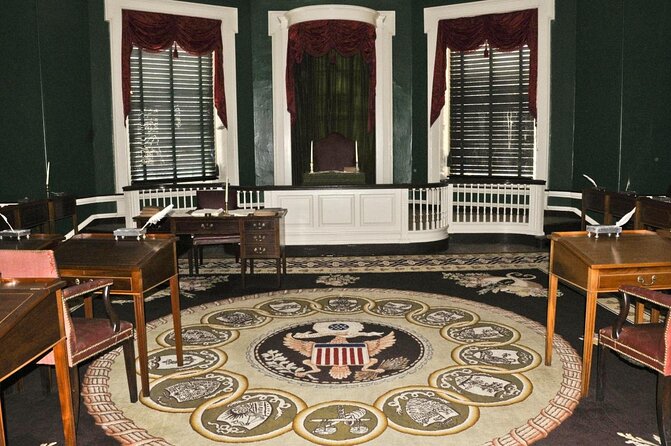
Independence Hall is the famous image on the back of the $100 bill, but this experience does not include an interior tour. You circle the building and discuss the Founding Fathers, the arguments held there, and the events that made the site important.
That outside view is valuable for orientation, but it is also a clear limitation. If walking through Independence Hall is a priority, you will need to arrange that separately. The same practical point applies to Congress Hall. The guide explains its role as the original home of the United States Congress, but admission is not included.
This tour is best viewed as a guided introduction, not a replacement for every major Philadelphia attraction. It helps you decide where to spend additional time.
More History Tours in the USA:
- New York City: American Museum of Natural History Ticket
★ 4.5 · 15,447 reviews - History and Hauntings of Salem Guided Walking Tour
★ 5.0 · 14,564 reviews - Charleston’s Old South Carriage Historic Horse & Carriage Tour
★ 5.0 · 10,023 reviews - Beneath The Streets Underground History Tour
★ 4.5 · 8,006 reviews
The Liberty Bell and the myths around it
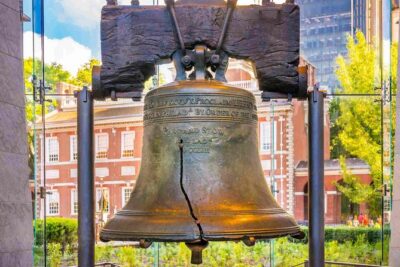
The Liberty Bell Center is another outside stop. You learn about the bell’s past use and the way it became a symbol for abolitionists, the women’s suffrage movement, and the civil rights movement.
The promise to sort out some of the bell’s myths is a welcome touch. Philadelphia’s best historical tours do not simply repeat familiar stories. They show how later generations used the bell and reshaped its meaning.
You do not enter the Liberty Bell venue as part of this tour. If you want the classic photograph inside the center, plan to visit before or after the walk. That extra stop is worth planning around, since the bell is one of the city’s busiest sights.
Carpenters’ Hall and the birth of a new political system
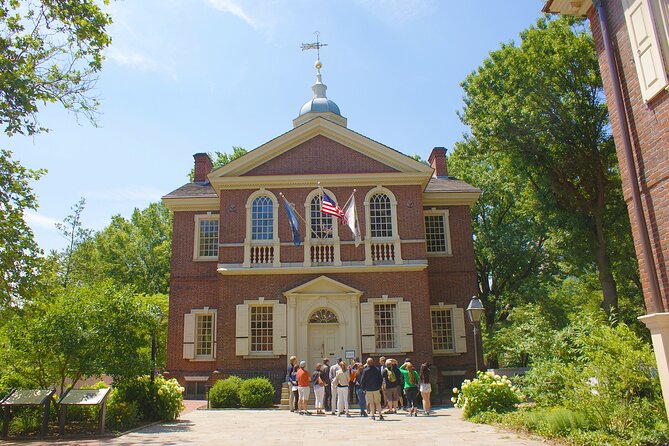
Carpenters’ Hall is viewed from outside, but the building carries major weight. It hosted the First Continental Congress and is also tied to the founding of the Commonwealth of Pennsylvania.
This is the kind of stop that can be easy to miss if you explore alone. The building is not as instantly recognizable as Independence Hall, yet the guide can explain why its meeting rooms mattered. The discussion helps you follow the movement from colonial protest to organized resistance and, eventually, independence.
Again, admission is not included. You are paying for the explanation and the route, not a full indoor visit to every site.
The Museum of the American Revolution and Washington’s field headquarters
The museum stop lasts about 20 minutes and includes the presentation of Washington’s war tent. Admission for this presentation is included, which gives the tour a real indoor component and a welcome pause from the sidewalks.
The tent helps make the military side of the Revolution more concrete. Instead of thinking only about speeches and documents, you are reminded that Washington spent years directing a war from temporary quarters. The presentation also ties together the people and places discussed earlier.
The discounted museum admission after the tour is one of the better value points. If you have another hour or two, you can return when you are ready and explore the rest of the collection. If your Philadelphia schedule is tight, the guided presentation still gives you the museum’s most distinctive object without requiring a full museum visit.
Elfreth’s Alley, where the city feels residential
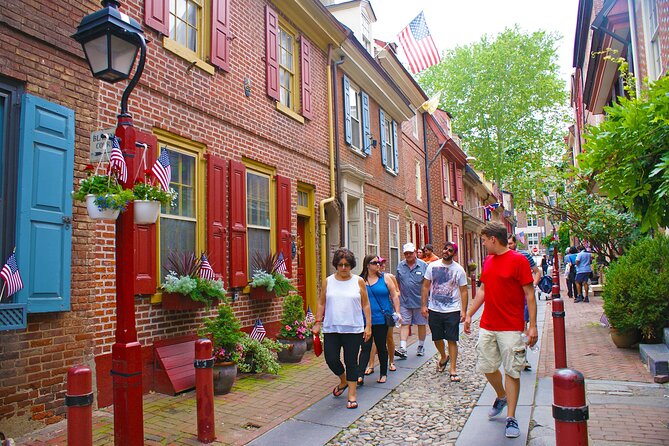
Elfreth’s Alley is one of the most appealing stops because it changes the scale of the tour. After grand public buildings, you walk along a narrow residential street lined with brick houses dating to the early 1700s.
It is recognized as the oldest continuously occupied residential street in the United States. The tight homes, brickwork, and small architectural details offer a look at daily urban life rather than only national politics.
The stop lasts about ten minutes, so you should not expect a detailed interior visit. Instead, use it to notice the street itself. This is a good place for photographs, but remember that it remains a residential area. Keep the group moving and respect the homes.
Betsy Ross, Benjamin Franklin, and the President’s House
The route passes the Betsy Ross House, associated with the seamstress said to have sewn the first American flag. The guide also addresses the story’s uncertain parts, which is more useful than presenting the traditional tale as settled fact.
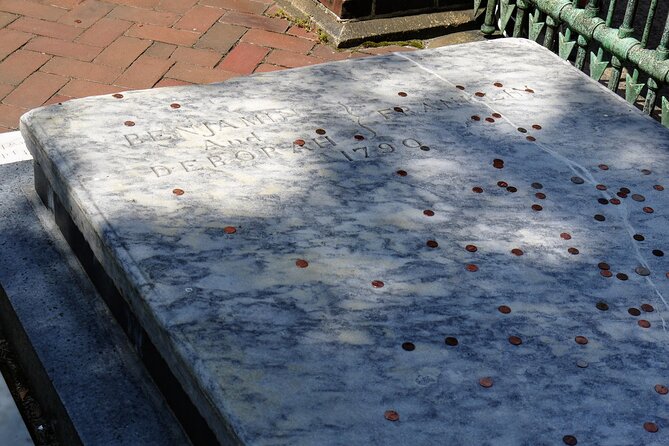
You then walk along Arch Street near Benjamin Franklin’s grave. Franklin’s burial site is a short but meaningful reminder that the Revolution involved printers, scientists, writers, diplomats, and organizers as well as soldiers and politicians.
The final stop is the President’s House site, where George Washington and John Adams lived while serving as president. The location also raises the difficult subject of enslaved people who lived there. The active archaeological work adds another layer, showing that downtown Philadelphia is still producing evidence about the nation’s early years.
These later stops broaden the tour beyond heroic founder stories. You get a more complicated picture of the early republic, including the gap between political liberty and the lives of enslaved people.
The guides make the difference
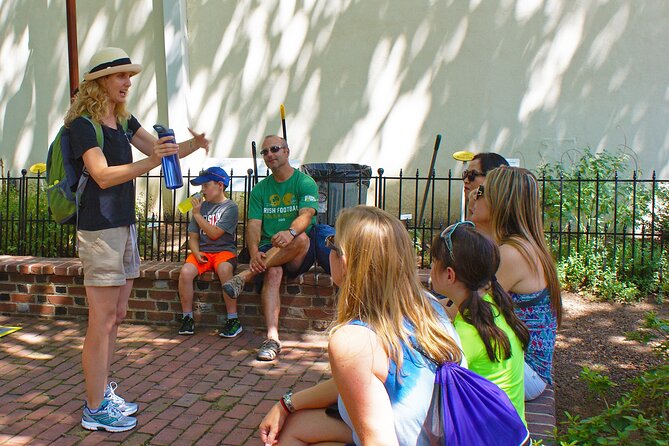
A history walk succeeds or fails with its guide. The strongest feedback here centers on guides who can explain a large amount of material without turning the route into a lecture.
Tom is described as animated and especially strong at bringing each site to life. John has been praised for answering questions, adding extra detail, and keeping children interested. Maria Gorshin is noted for patient explanations and attention to families, while Caroline Hodash is described as clear, warm, and good at giving context.
Other guides named in the feedback include PJ, Carla, David, Donato, Pat, Peter, Laura, Alex, and PK. Their styles may differ, but the recurring strength is the ability to connect facts with stories and respond to the group’s interests. David, for example, has been praised for fitting a great deal into 2.5 hours and offering restaurant suggestions afterward.
Because guide assignments can vary, you should not book solely to receive one particular person. Still, the range of strong guide comments suggests that the experience depends on a solid local team rather than a single personality.
Is $45 a fair price?
At $45 per person, this is not the cheapest way to walk around Old City, since many of the sites can be seen independently. The value comes from the interpretation, the efficient route, the small group, the included Washington tent presentation, and the museum discount.
The maximum group size of 12 is important. You are not lost in a crowd, and there is a better chance to ask a question or hear a story clearly. The donation to a local nonprofit historic organization is another modest plus.
I would call the price fair for a first visit, especially if you have only a few hours in Philadelphia. It is less compelling for someone who already knows the historic district and prefers to spend extended time inside Independence Hall, the Liberty Bell Center, or the museum.
Practical details for a smoother visit
The tour lasts about 2.5 hours and is conducted in English. Most people can participate, and service animals are allowed. Since the route is outdoors and includes several blocks of walking, comfortable shoes and weather-appropriate clothing are sensible choices.
The tour starts in Signer’s Garden and ends in Old City. You do not need to arrange transportation between stops. Public transportation is nearby, and the ending location makes it easy to continue sightseeing.
Give yourself extra time if you plan to visit the Liberty Bell Center or Independence Hall separately. The tour does not include those interior admissions, and the bell center is specifically worth visiting before or after if you want to see the bell indoors.
Free cancellation is available up to 24 hours before the start time. Within 24 hours, the payment is not refunded, and changes are not accepted.
Who should book this Philadelphia history walk?
I would choose this tour for a first-time visitor, a family with older children, a history fan, or anyone with a short stay who wants a well-planned introduction. The route covers the main founding sites without requiring you to work out the order yourself.
It also suits people who like questions and stories more than a silent audio guide. Guides have been praised for adapting to families, offering food recommendations, and suggesting other places to visit when a building is closed.
I would skip it if your main goal is extensive time inside historic buildings. The tour gives you an outside look at several major sites and only one included museum presentation. For a full museum and Independence Hall experience, plan separate admissions and more time.
Should you book it?
Book it if you want Philadelphia’s Revolutionary story explained in a compact, personal walk, with the Washington war tent as a memorable centerpiece. The combination of a 12-person limit, strong guide roster, historic streets, and discounted museum return ticket makes $45 reasonable.
Just set your expectations correctly: this is an overview with selected access, not a full indoor tour of every landmark. Add time for the Liberty Bell Center, Independence Hall, or the rest of the museum, and this tour becomes a useful first chapter to your Philadelphia visit.
FAQ
How long is the Philadelphia history tour?
The tour lasts approximately 2 hours and 30 minutes.
What is the price?
The listed price is $45 per person. Group discounts are available.
How large is the tour group?
The maximum group size is 12 travelers.
Is entry to Independence Hall included?
No. Independence Hall is viewed from the outside, and admission is not included.
Do I enter the Liberty Bell Center?
No. The tour discusses the Liberty Bell from outside the center. You should plan a separate visit if you want to enter.
What is included at the Museum of the American Revolution?
The tour includes a presentation featuring George Washington’s war tent. You also receive a discounted ticket to visit the rest of the museum after the tour.
Where does the tour start and finish?
The tour starts at The Signer statue in Signer’s Garden, at 434 to 498 Chestnut Street. It ends in Old City, Philadelphia.
Latest history tours reviewed in the USA
- Franklin: Ghost Tour in Historic Franklin★ 4.8 · 65 reviews
- Fort Worth: Stockyards History Tour Pub Crawl★ 4.8 · 39 reviews
- Downtown Flagstaff Haunted History Walking Tour★ 4.7 · 46 reviews
- New York City: Flatiron Food, History, and Architecture Tour★ 4.8 · 43 reviews
- Fairbanks: Gold Dredge 8 Historic Train Tour★ 4.7 · 219 reviews
- Fairbanks: Private Mush on the Historic Yukon Quest Trail★ 5.0 · 30 reviews
- Charleston:Evening Haunted History Horse-Drawn Carriage Tour★ 4.7 · 38 reviews
- Philadelphia: Valley Forge National Historical Park Tour★ 4.9 · 39 reviews
Philadelphia History Tours, compared.
Revolution and the Founders: History Tour of Philadelphia
Read our review →
Philadelphia Old City Historic Walking Tour with 10+ Top Sites
Read our review →
Philadelphia: Valley Forge National Historical Park Tour
Read our review →Browse the lists this tour appears in